
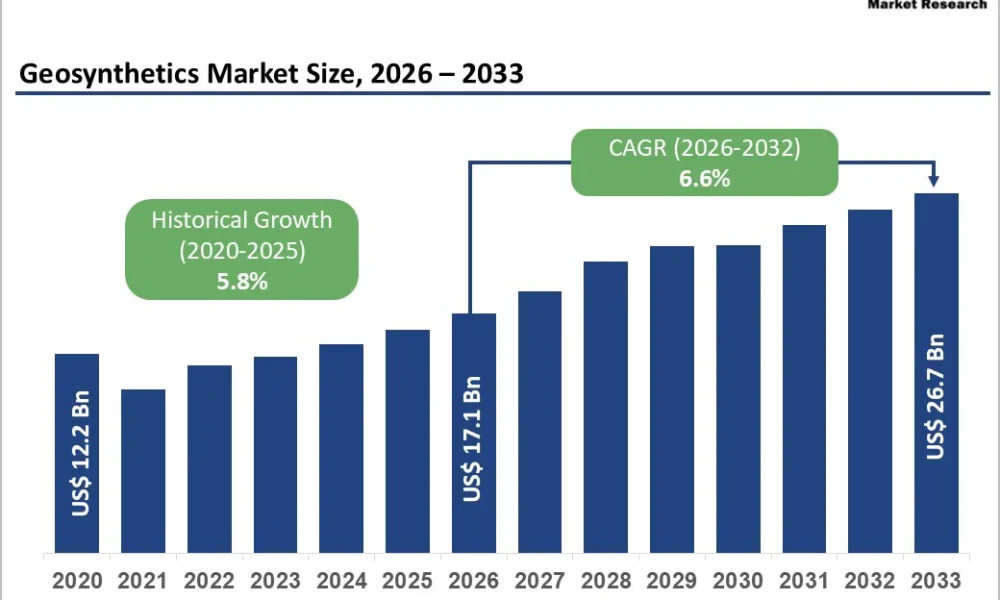
The global Geosynthetics Market is witnessing steady expansion, supported by rising infrastructure investments and increasing adoption of advanced civil engineering materials. According to Persistence Market Research, the global geosynthetics market size is valued at US$ 17.1 billion in 2026 and is projected to reach US$ 26.7 billion by 2033, growing at a CAGR of 6.6% between 2026 and 2033. Geosynthetics are widely used in road construction, landfills, drainage systems, erosion control, and water management projects due to their durability, cost-effectiveness, and soil reinforcement properties. The increasing focus on sustainable construction practices and improved ground stabilization solutions continues to strengthen demand across developed and emerging economies.
Market statistics reflect strong adoption across transportation infrastructure, waste management facilities, and hydraulic engineering projects. The leading segment in the geosynthetics market is expected to be driven by extensive use in road and highway construction, where soil reinforcement and separation applications are critical. Geographically, Asia Pacific is anticipated to dominate due to rapid urbanization, large-scale infrastructure programs, and increasing government investments in transportation and water management systems. These factors, combined with technological advancements in polymer-based materials, are reinforcing long-term market growth and enhancing overall industry competitiveness.
Download Your Free Sample & Explore Key Insights : https://www.persistencemarketresearch.com/samples/4119
Key Highlights from the Report
➤ The global geosynthetics market is projected to grow from US$ 17.1 billion in 2026 to US$ 26.7 billion by 2033 at a CAGR of 6.6%.
➤ Rising infrastructure development and road construction activities are significantly driving geosynthetics demand worldwide.
➤ Soil reinforcement and separation applications remain key revenue-generating segments in the market.
➤ Asia Pacific leads the global geosynthetics market due to rapid urban expansion and government-backed infrastructure projects.
➤ Growing adoption in waste management and landfill lining systems is boosting long-term demand.
➤ Technological innovations in polymer materials are enhancing durability and performance efficiency.
Market Segmentation
The geosynthetics market is segmented based on product type, application, and end-user industry. By product type, the market includes geotextiles, geomembranes, geogrids, geonets, and other related materials. Geotextiles are widely used for filtration, separation, and reinforcement applications, while geomembranes play a crucial role in containment systems such as landfills and reservoirs. Geogrids are extensively applied in road stabilization and retaining wall construction. Each product category contributes uniquely to infrastructure durability and environmental protection, making segmentation critical for understanding revenue distribution across the global geosynthetics industry.
From an end-user perspective, the market is categorized into transportation infrastructure, environmental engineering, water management, mining, and construction sectors. Transportation infrastructure represents a major share due to extensive use in highways, railways, and airport runways. Environmental engineering applications, including landfill lining and erosion control, are also gaining prominence due to stricter environmental regulations. The increasing emphasis on sustainable construction materials further supports growth across these application segments, reinforcing the long-term expansion of the geosynthetics market.
Want Specific Data? Request Report Customization : https://www.persistencemarketresearch.com/request-customization/4119
Regional Insights
Asia Pacific dominates the geosynthetics market owing to rapid industrialization and expanding urban infrastructure projects. Countries across the region are investing heavily in highways, bridges, dams, and railway networks, which require advanced soil stabilization and reinforcement solutions. Growing population density and urban planning initiatives are further encouraging the adoption of geosynthetics in large-scale public infrastructure projects.
North America and Europe also represent significant markets due to mature construction industries and strong regulatory frameworks promoting sustainable infrastructure. Investments in landfill management systems, erosion control measures, and water conservation projects continue to support demand. Additionally, ongoing modernization of transportation networks contributes to consistent market expansion in these regions.
Market Drivers
The primary driver of the geosynthetics market is the rapid growth of infrastructure development projects worldwide. Expanding road networks, railway lines, and airport constructions require durable soil reinforcement materials to enhance structural integrity and extend project lifecycles. Geosynthetics provide cost-effective solutions for separation, filtration, drainage, and reinforcement, making them essential in modern civil engineering. Increasing urbanization in developing economies further accelerates infrastructure investments, strengthening product demand across multiple applications.
Another significant driver is the growing emphasis on environmental sustainability and waste management. Geosynthetics are widely used in landfill lining systems to prevent soil and groundwater contamination. They also play a vital role in erosion control and water conservation projects. As environmental regulations become stricter, industries are increasingly adopting advanced containment and protection materials, which supports sustained growth of the geosynthetics market.
Market Restraints
Despite strong growth prospects, the geosynthetics market faces challenges related to fluctuating raw material prices. Most geosynthetic products are manufactured using polymer-based materials, and price volatility in these inputs can impact overall production costs. This may affect profit margins and create pricing pressure within competitive markets, particularly in price-sensitive developing economies.
Another restraint is the limited awareness and technical expertise in certain regions. While developed markets have well-established engineering standards, some emerging economies lack adequate technical knowledge regarding advanced geosynthetic applications. This may slow adoption rates and delay implementation in smaller infrastructure projects. Addressing training gaps and increasing awareness will be essential for unlocking full market potential.
Market Opportunities
Significant opportunities exist in the expansion of smart infrastructure and sustainable urban development initiatives. Governments worldwide are focusing on resilient construction methods that reduce maintenance costs and environmental impact. Geosynthetics align well with these goals by enhancing soil stability and extending infrastructure lifespan. Increasing adoption in green building projects further opens new growth avenues for manufacturers.
Emerging markets present additional opportunities due to rising investments in water management and flood control systems. Climate change concerns and extreme weather events are prompting authorities to strengthen drainage networks and coastal protection systems. Geosynthetics offer reliable solutions for slope stabilization and hydraulic engineering projects, positioning the market for long-term expansion.
Exclusive Data Awaits – Continue to Checkout : https://www.persistencemarketresearch.com/checkout/4119
Company Insights
Key players operating in the Geosynthetics Market include:
- SOLMAX
- NAUE GmbH
- Berry Global
- Koninklijke Ten Cate N.V.
- GSE Environmental
- Officine Maccaferri S.p.A.
- Low & Bonar
- Propex Operating Company, LLC
- Fibertex Nonwovens A/S
- TENAX Group
- AGRU America, Inc.
- HUESKER Group
- TYPAR Geosynthetics
- Global Synthetics
- CTM Geosynthetics
Recent Developments:
- January 2024 – A leading geosynthetics manufacturer expanded its production capacity to meet growing infrastructure demand.
- September 2023 – A major industry participant introduced an advanced geomembrane solution for landfill applications.
Future Opportunities and Growth Prospects
The future of the geosynthetics market appears promising as infrastructure modernization and environmental protection initiatives gain momentum globally. Continued innovation in polymer technologies and increased adoption across transportation and waste management sectors are expected to reinforce growth through 2033. With a projected market value of US$ 26.7 billion and a steady CAGR of 6.6%, the industry is well-positioned to benefit from long-term investments in resilient and sustainable construction solutions.




