
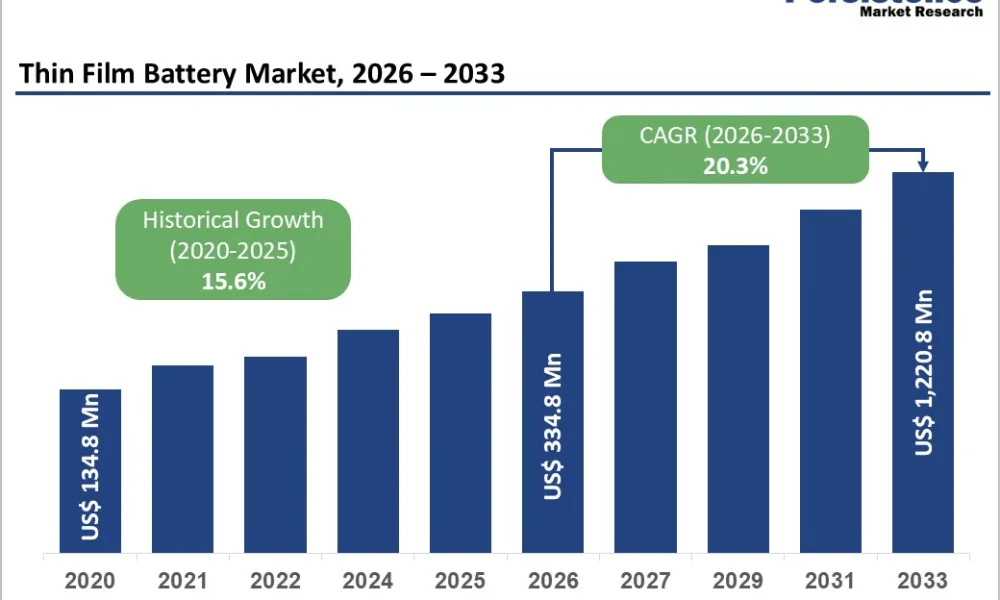
The Global Thin Film Battery Market is entering a phase of accelerated transformation, driven by surging demand for ultra-compact, lightweight, and flexible energy storage solutions. The market was valued at US$ 334.8 million in 2026 and is projected to reach US$ 1,220.8 million by 2033, expanding at a remarkable CAGR of 20.3% between 2026 and 2033. This growth significantly outpaces the historical CAGR of 15.6% recorded between 2020 and 2025.
Unlike conventional lithium-ion batteries, thin-film batteries are engineered for applications where size, weight, flexibility, and safety are mission-critical. From wearable health monitors and implantable medical devices to IoT sensors and aerospace micro-systems, these batteries are redefining how energy is integrated into next-generation electronics.
Market Overview
Thin-film batteries are solid-state energy storage devices fabricated through thin-layer deposition technologies. Their ultra-thin profiles—often less than 1 mm and sometimes below 50 microns—make them ideal for compact, flexible, and embedded applications.
The market addresses critical miniaturization requirements across:
- Consumer electronics
- Medical implants and wearable diagnostics
- IoT sensors and smart infrastructure
- Aerospace and defense micro-systems
- Smart packaging and RFID solutions
The rapid convergence of connected devices, flexible electronics, and distributed power systems is pushing thin-film batteries from niche applications into broader commercialization.
Key Industry Highlights
- East Asia leads with approximately 31% market share, supported by electronics manufacturing dominance in China, Japan, and South Korea.
- North America holds 27%, driven by aerospace, defense, and advanced medical device ecosystems.
- Europe accounts for 26%, supported by energy efficiency regulations and IoT adoption.
- Rechargeable thin-film batteries dominate with 72% share in 2026.
- Disposable thin-film batteries are the fastest-growing segment, driven by smart cards and RFID.
- Healthcare leads end-use industries with nearly 30% share.
Market Dynamics
Growth Driver 1: Proliferation of IoT Devices and Distributed Connectivity
The explosive expansion of the Internet of Things (IoT) ecosystem is a foundational driver of thin-film battery demand.
IoT devices surpassed the global population in 2011, and by 2025, global internet users reached nearly 6 billion. Governments and enterprises are investing heavily in connected infrastructure, including:
- Smart cities
- Industrial automation
- Intelligent transportation
- Remote healthcare monitoring
India’s Smart City Mission and Digital India initiatives are catalyzing connected infrastructure development. Similarly, Europe reports that 29% of enterprises with 10+ employees use IoT systems, with even higher adoption among large enterprises.
Thin-film batteries directly enable this connectivity wave. IoT sensors often operate in space-constrained environments—embedded in walls, pipelines, wearables, or industrial machinery—where conventional battery sizes are impractical. Ultra-thin, long-lasting micro-power sources are essential for multi-year sensor deployments.
Growth Driver 2: Aerospace and Defense Micro-Power Requirements
Aerospace and defense sectors demand highly reliable, lightweight, and compact energy solutions for advanced systems.
The U.S. aerospace and defense industry generated nearly US$ 995 billion in 2024, reflecting strong demand for advanced micro-power integration. Similarly, Europe’s aerospace and defense turnover reached €325.7 billion in 2024.
India’s defense production reached record levels under its self-reliance initiatives, with defense exports surging significantly.
Thin-film batteries are increasingly integrated into:
- Micro-electromechanical systems (MEMS)
- Satellite constellations
- Unmanned aerial systems (UAS)
- Deployable military sensors
- Wearable soldier equipment
These applications require minimal weight penalties, stable operation across extreme temperatures, and high reliability—characteristics ideally suited to thin-film battery technologies.
Market Restraints
Manufacturing Scalability and Cost Barriers
Despite strong demand, production scalability remains a major challenge.
Thin-film batteries require:
- Advanced deposition technologies
- Precision cleanroom environments
- Specialized electrolyte materials
- High capital investment
Small and mid-sized manufacturers face difficulties scaling from pilot production to mass manufacturing. High per-unit costs compared to traditional lithium-ion batteries restrict adoption primarily to premium or mission-critical applications.
Material supply constraints and limited expertise in printable electronics in some regions further add complexity to commercialization efforts.
Key Market Opportunities
Flexible Electronics and Printed Battery Integration
The convergence of flexible electronics and printed battery manufacturing presents a transformative opportunity.
Solid-state thin-film batteries offer inherent safety advantages, including:
- Lower leakage risk
- Reduced combustion hazards
- Enhanced thermal stability
Nanotechnology advancements have improved performance metrics such as energy density and charge cycles. Emerging ultra-thin batteries can conform to curved surfaces, including human skin, without compromising efficiency.
Printed battery fabrication techniques are also approaching commercial viability. These innovations could dramatically reduce costs and enable large-scale integration into:
- Smart textiles
- Electronic skin patches
- Flexible consumer electronics
- Intelligent packaging
As flexible electronics ecosystems mature, thin-film battery vendors capable of delivering scalable solutions stand to capture significant growth.
Healthcare and Remote Monitoring Expansion
Healthcare represents the largest end-use segment, accounting for approximately 30% of market share in 2026.
The global aging population and increased focus on continuous remote patient monitoring are accelerating demand for wearable and implantable medical technologies.
Thin-film batteries power:
- Glucose monitors
- Cardiac implants
- Skin-mounted health patches
- Portable diagnostic devices
- Neurostimulators
These applications require biocompatibility, flexibility, and long-term reliability—attributes that traditional batteries struggle to deliver.
Regulatory frameworks in developed markets are increasingly supporting reimbursement for remote patient monitoring services, strengthening the economic case for wearable device adoption.
Elevate your business strategy with comprehensive market data. Request a sample report now: https://www.persistencemarketresearch.com/samples/32511
Category-Wise Analysis
Battery Type Insights
Rechargeable Thin-Film Batteries – Market Leader
Rechargeable thin-film batteries hold 72% market share in 2026.
Their dominance stems from lifecycle cost advantages and suitability for:
- Smartwatches
- Fitness trackers
- Medical monitors
- Industrial IoT sensors
Although initial purchase costs are higher, multi-cycle usage significantly reduces long-term operational expenses.
Disposable Thin-Film Batteries – Fastest Growing
Disposable thin-film batteries are expanding rapidly, driven by:
- Smart cards
- RFID tags
- Interactive packaging
- Limited charging environments
Cost-sensitive and single-use applications favor disposable formats where recharging infrastructure is unavailable or impractical.
End-Use Industry Insights
Healthcare – Leading Segment
Healthcare commands roughly 30% of market share. Regulatory mandates for biocompatibility and long-term stability elevate thin-film batteries as a preferred solution in medical-grade devices.
Telecommunications & IoT – Fastest Growing
Telecommunications and IoT represent the fastest-growing end-use category.
India’s telecom revenue crossed US$ 43 billion in FY25, with 5G contributing significantly to data usage. Expanding 5G infrastructure requires distributed sensor networks and edge computing systems—applications ideally suited for thin-film micro-power integration.
Regional Insights
East Asia – Market Leader (31%)
East Asia leads the market due to electronics manufacturing dominance and strong innovation ecosystems.
China’s internet penetration reached 78.6% by 2024, with over 1.1 billion mobile internet users. Massive consumer markets and manufacturing scale drive battery integration across wearables and smart electronics.
Companies such as Samsung SDI Co. Ltd. and LG Chem are leveraging advanced lithium-based solutions and R&D investments to strengthen regional leadership.
North America – Advanced Technology Hub (27%)
North America holds 27% share, supported by aerospace, defense, and medical innovation.
Companies like STMicroelectronics and Blue Spark Technologies contribute to wearable, medical, and IoT battery advancements.
The region’s aerospace employment ecosystem and medical device regulatory infrastructure create sustained demand for high-reliability micro-power systems.
Europe – Sustainability and Automotive Innovation (26%)
Europe captures 26% of the global market.
Germany’s automotive R&D leadership and energy efficiency policies promote battery integration into IoT and industrial systems.
Innovators such as Ilika Plc. and NGK Insulators, Ltd. contribute advanced solid-state and ceramic battery technologies to European and global markets.
Competitive Landscape
The Thin Film Battery Market is moderately fragmented with mild oligopolistic tendencies.
Key players include:
- BrightVolt
- Enfucell
- LionVolt
- BTRY AG
- Ultralife Corporation
- The Kurt J. Lesker Company
Large corporations leverage scale and R&D investment, while niche innovators focus on flexible, printed, and 3D-architecture microbattery designs.
Key Industry Developments
In June 2024, AGC Inc., through AGC Plasma Technology Solutions, advanced scalable thin-film battery material production using vacuum coating platforms such as magnetron sputtering and PlasmaMAX™ PECVD. These technologies enable uniform coatings on flexible substrates, supporting mass production of lightweight, high-performance thin-film batteries.
Future Outlook
The Thin Film Battery Market is set for transformative expansion through 2033.
Key future growth pillars include:
- Expansion of IoT ecosystems
- Wearable healthcare integration
- Aerospace micro-power systems
- Flexible electronics convergence
- Solid-state battery advancements
While manufacturing scalability and cost pressures remain challenges, technological innovation and increasing application diversity will sustain long-term momentum.
With a projected value exceeding US$1.22 billion by 2033 and a CAGR of 20.3%, thin-film batteries are poised to become foundational components in the next generation of connected, wearable, and intelligent devices worldwide.
Related Reports:




