
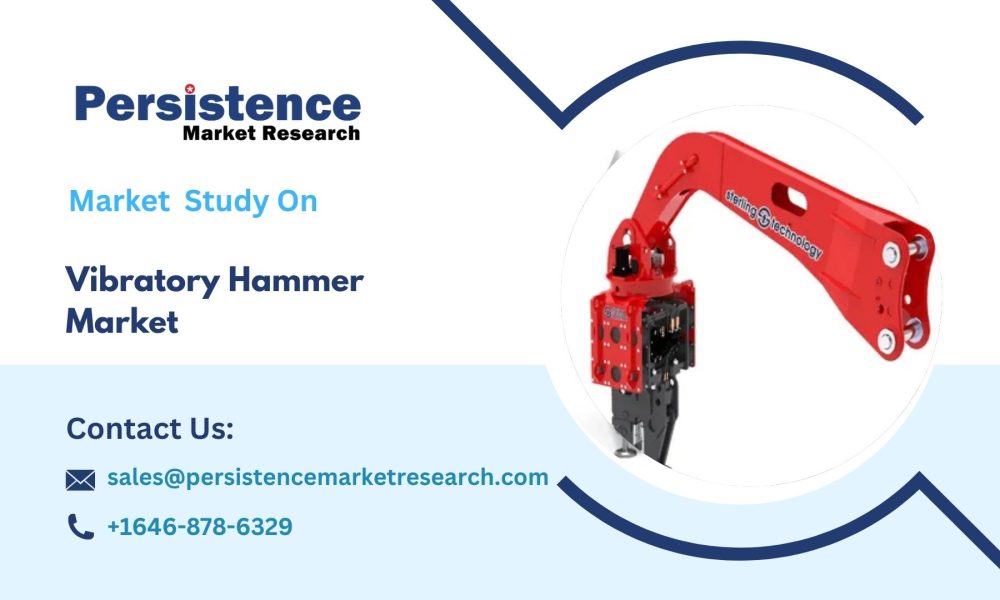
The vibratory hammer market occupies a vital position within the global construction and foundation equipment industry, serving as a core solution for efficient pile driving and extraction across infrastructure, marine, and energy projects. Vibratory hammers use high-frequency vertical vibrations to reduce soil resistance, enabling faster and less disruptive pile installation compared to traditional impact hammers. These systems are widely deployed in applications such as bridge construction, port and harbor development, sheet piling for retaining walls, and foundation works for offshore and onshore energy infrastructure. As construction timelines tighten and environmental regulations become stricter, vibratory hammers are increasingly favored for their speed, reduced noise levels, and lower structural stress on piles.
The global vibratory hammer market is anticipated to be valued at US$ 942.6 million in 2026 and is projected to reach US$ 1,385.9 million by 2033, growing at a CAGR of 5.7% between 2026 and 2033. Market expansion is driven by accelerating infrastructure investment worldwide, which is projected to reach US$ 94 trillion by 2040, alongside rapid urbanization, with 68% of the global population expected to live in urban areas by 2050. Hydraulic vibratory hammers represent the leading product segment due to their high power-to-weight ratio, adaptability across soil conditions, and compatibility with modern excavators and cranes. Geographically, Asia Pacific leads the market, supported by large-scale urban infrastructure development and coastal projects, while Europe remains a key growth region due to offshore wind energy expansion and stringent environmental standards.
Infrastructure Investment and Market Leadership Dynamics
The vibratory hammer market is fundamentally linked to long-term infrastructure development cycles. Governments across both developed and emerging economies are prioritizing investments in transportation networks, flood control systems, and urban redevelopment projects. These initiatives require deep foundation solutions that can be deployed efficiently in dense urban environments where noise, vibration, and time constraints are critical considerations. Vibratory hammers address these needs by enabling rapid pile installation with comparatively lower environmental impact, making them well suited for modern construction requirements.
Market leadership is shaped by a combination of equipment reliability, technological innovation, and regional construction demand. Asia Pacific dominates global demand due to massive investments in highways, rail networks, ports, and coastal protection projects. Europe’s leadership is reinforced by its strong focus on renewable energy infrastructure, particularly offshore wind farms that rely heavily on advanced piling solutions. North America maintains a significant share through steady investment in infrastructure rehabilitation and energy projects. Together, these regions define the competitive and technological trajectory of the global vibratory hammer market.
𝐃𝐨𝐰𝐧𝐥𝐨𝐚𝐝 𝐅𝐫𝐞𝐞 𝐒𝐚𝐦𝐩𝐥𝐞 & 𝐂𝐡𝐞𝐜𝐤 𝐭𝐡𝐞 𝐋𝐚𝐭𝐞𝐬𝐭 𝐌𝐚𝐫𝐤𝐞𝐭 𝐀𝐧𝐚𝐥𝐲𝐬𝐢𝐬: https://www.persistencemarketresearch.com/samples/25090
Key Highlights from the Report
• The global vibratory hammer market is projected to reach US$ 1,385.9 million by 2033.
• Market growth is supported by global infrastructure investment expected to reach US$ 94 trillion by 2040.
• Asia Pacific leads the market due to rapid urbanization and large-scale construction activity.
• Offshore wind energy projects are emerging as a major demand driver.
• Hydraulic vibratory hammers dominate due to efficiency and operational flexibility.
• Environmental regulations are accelerating the shift from impact to vibratory piling methods.
Market Segmentation Analysis
Market segmentation in the vibratory hammer industry reflects differences in power systems, application environments, and end-user requirements. By product type, the market is primarily segmented into hydraulic vibratory hammers, electric vibratory hammers, and mechanical vibratory hammers. Hydraulic vibratory hammers account for the largest share of global demand, as they offer superior performance, precise control, and compatibility with a wide range of carriers such as excavators and cranes. Their ability to handle diverse soil conditions and pile types makes them the preferred choice for large infrastructure and marine construction projects.
Electric vibratory hammers are gaining traction in applications where emissions and noise restrictions are particularly stringent. These systems are increasingly used in urban construction zones and environmentally sensitive areas, supported by the broader electrification trend in construction equipment. Mechanical vibratory hammers, while still in use, are gradually losing share due to lower efficiency and limited adaptability compared to hydraulic and electric alternatives.
From an application standpoint, the market spans onshore construction, marine and offshore construction, and industrial foundation projects. Onshore construction represents the largest application segment, driven by urban infrastructure development, transportation projects, and commercial building foundations. Marine and offshore applications are witnessing faster growth, fueled by port expansion, coastal protection initiatives, and offshore wind farm installations. Industrial foundation projects, including oil and gas facilities and heavy manufacturing plants, also contribute steadily to market demand, requiring high-capacity vibratory hammers for deep foundation work.
Regional Insights and Geographic Trends
Regional dynamics play a critical role in shaping demand patterns within the vibratory hammer market. Asia Pacific leads the global market, supported by rapid urbanization, population growth, and large-scale infrastructure programs. Countries across the region are investing heavily in transportation networks, flood mitigation systems, and coastal infrastructure to support economic growth and climate resilience. The scale of construction activity and the availability of skilled operators make Asia Pacific the most dynamic regional market for vibratory hammers.
Europe represents a mature yet evolving market, driven by infrastructure modernization and renewable energy expansion. The region’s strong emphasis on environmental sustainability has accelerated the adoption of vibratory piling methods that minimize noise and vibration. Offshore wind energy projects in Northern and Western Europe are a significant source of demand, as foundation installation for turbines requires precise and efficient piling solutions. Europe’s regulatory framework and technological leadership position it as a key innovation hub for advanced vibratory hammer systems.
North America maintains a stable market share, supported by ongoing investment in infrastructure rehabilitation, bridge replacement, and energy projects. Aging infrastructure in the United States and Canada is driving demand for efficient foundation solutions that can be deployed in constrained urban environments. Additionally, the growth of renewable energy projects, including offshore wind initiatives along coastal regions, is expected to support long-term demand. Other regions, such as the Middle East and Latin America, are gradually expanding their markets as infrastructure investment accelerates and urban development progresses.
𝐆𝐞𝐭 𝐚 𝐂𝐮𝐬𝐭𝐨𝐦𝐢𝐳𝐞𝐝 𝐌𝐚𝐫𝐤𝐞𝐭 𝐕𝐢𝐞𝐰 𝐢𝐧 𝐎𝐧𝐞 𝐂𝐥𝐢𝐜𝐤 : https://www.persistencemarketresearch.com/request-customization/25090
Market Drivers
Market drivers in the vibratory hammer industry are closely tied to global economic and demographic trends. One of the most significant drivers is the acceleration of infrastructure investment worldwide. Governments are committing substantial resources to transportation, water management, and urban development projects to support economic growth and population expansion. Vibratory hammers enable faster pile installation, reduced project timelines, and improved cost efficiency, making them an attractive solution for large-scale infrastructure programs.
Another major driver is the rapid expansion of renewable energy infrastructure, particularly offshore wind farms. Offshore wind turbine foundations require advanced piling solutions capable of operating in challenging marine environments. Vibratory hammers offer advantages in terms of precision, reduced underwater noise, and compatibility with large-diameter piles. Urbanization further amplifies demand, as dense construction environments necessitate piling methods that minimize disruption to surrounding structures and communities. Together, these drivers create a strong and sustained demand outlook for vibratory hammer equipment.
Market Restraints
Despite positive growth prospects, the vibratory hammer market faces several restraints that can impact adoption rates. High initial equipment costs remain a key challenge, particularly for small and medium-sized contractors. Advanced hydraulic and electric vibratory hammers require significant capital investment, which can limit accessibility for cost-sensitive markets. In addition, maintenance and operational requirements, including the need for skilled operators and regular servicing, can add to total ownership costs.
Another restraint is the variability of soil conditions and project-specific requirements, which can limit the applicability of vibratory hammers in certain scenarios. In extremely dense or rocky soils, traditional impact hammers may still be preferred, reducing the addressable market for vibratory solutions. Regulatory approval processes and project permitting requirements can also delay equipment deployment, particularly in environmentally sensitive areas. These factors highlight the importance of technological innovation and application-specific customization in overcoming market barriers.
Market Opportunities
The evolving construction and energy landscape presents multiple opportunities for the vibratory hammer market. One of the most promising opportunities lies in the development of electric and hybrid vibratory hammers that align with global decarbonization goals. As construction equipment electrification gains momentum, manufacturers that offer low-emission and low-noise solutions are well positioned to capture demand in urban and environmentally regulated markets.
Emerging economies represent another significant growth opportunity, as infrastructure investment accelerates to support urbanization and industrialization. New ports, transportation corridors, and energy projects provide greenfield opportunities for vibratory hammer deployment. Technological advancements, including improved vibration control systems, real-time monitoring, and automation, further enhance equipment performance and safety. These innovations not only improve operational efficiency but also expand the range of applications where vibratory hammers can be effectively deployed.
𝐂𝐥𝐢𝐜𝐤 𝐭𝐨 𝐏𝐮𝐫𝐜𝐡𝐚𝐬𝐞 𝐭𝐡𝐞 𝐅𝐮𝐥𝐥 𝐑𝐞𝐩𝐨𝐫𝐭 & 𝐒𝐭𝐚𝐫𝐭 𝐄𝐱𝐩𝐥𝐨𝐫𝐢𝐧𝐠 : https://www.persistencemarketresearch.com/checkout/25090
Company Insights and Competitive Landscape
The vibratory hammer market is moderately consolidated, with a mix of global equipment manufacturers and specialized foundation engineering firms competing on performance, reliability, and service support. Leading players focus on innovation, product differentiation, and strategic partnerships to strengthen their market positions.
• ICE – International Construction Equipment
• PVE Piling and Vibro Equipment
• Movax
• APE
• Liebherr
• Junttan
Recent developments in the market reflect a strong focus on sustainability and offshore applications. Several manufacturers have introduced next-generation vibratory hammers with enhanced energy efficiency and reduced noise emissions to meet stricter environmental standards. In parallel, equipment suppliers are expanding their portfolios to support offshore wind foundation projects, offering high-capacity vibratory hammers designed for large-diameter piles and challenging marine conditions.
Conclusion
The global vibratory hammer market is positioned for steady and resilient growth as infrastructure investment, urbanization, and renewable energy expansion continue to reshape construction practices worldwide. With the market expected to grow from US$ 942.6 million in 2026 to US$ 1,385.9 million by 2033 at a CAGR of 5.7%, vibratory hammers are increasingly recognized as efficient, environmentally responsible piling solutions. Asia Pacific’s infrastructure-driven demand, Europe’s renewable energy focus, and North America’s modernization initiatives underscore the market’s diverse growth drivers. As technological innovation advances and sustainability becomes a central priority, vibratory hammers will remain a critical enabler of modern foundation construction across global markets.




