
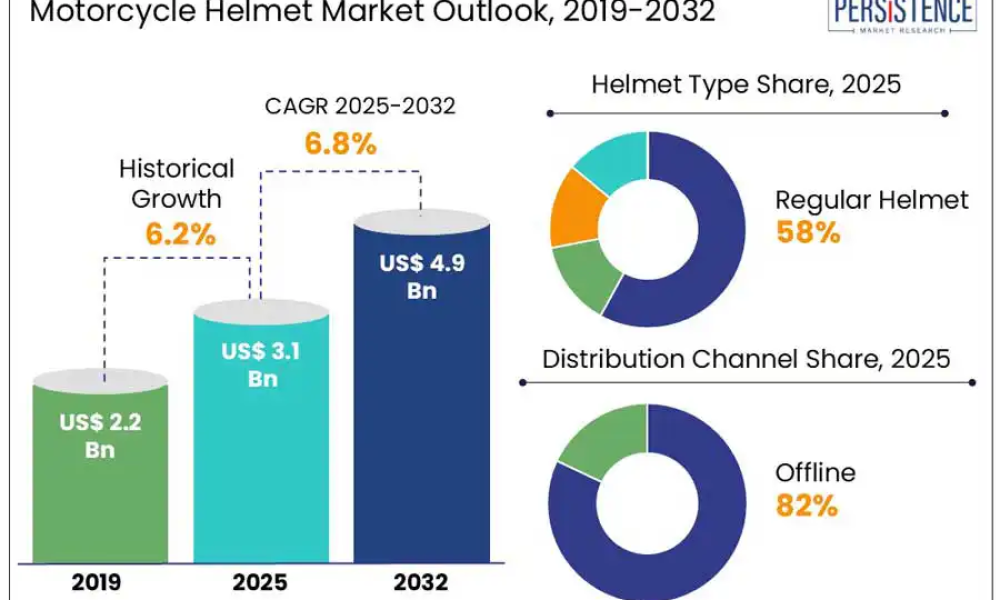
The global motorcycle helmet market is entering a phase of sustained and transformative growth, fueled by heightened safety awareness, stricter regulatory frameworks, and rapid advancements in protective gear technology. According to a recent industry analysis by Persistence Market Research, the global motorcycle helmet market is projected to grow from US$ 3.1 billion in 2025 to US$ 4.9 billion by 2032, expanding at a robust compound annual growth rate (CAGR) of 6.8% during the forecast period. This growth trajectory reflects both the expanding global motorcycle fleet and the rising emphasis on rider safety standards.
Motorcycles remain one of the most widely used modes of transportation globally, particularly in densely populated emerging economies. In 2024 alone, global motorcycle sales reached 61.8 million units, representing a 2.7% increase compared to the previous year. This surge directly correlates with increased demand for safety equipment, particularly helmets, which are the most critical protective gear for riders.
Safety regulations and awareness campaigns have been instrumental in accelerating helmet adoption rates worldwide. The National Highway Traffic Safety Administration reports that helmet use reduces the risk of death in motorcycle accidents by 37% to 42% and lowers the risk of brain injury by 41% to 69%, based on multiple safety studies. These statistics continue to influence policy frameworks and consumer behavior, making helmets not only mandatory in many jurisdictions but also widely recognized as essential safety equipment.
Manufacturers are responding proactively to evolving market demands by introducing lightweight materials, aerodynamic designs, and enhanced comfort features. The integration of smart technologies, improved ventilation systems, and enhanced impact absorption materials has elevated helmets from basic protective gear to sophisticated safety solutions.
Get Your FREE Sample Report Instantly Click Now: https://www.persistencemarketresearch.com/samples/35321
Segmentation Analysis
By Type: Full-Face Helmets Dominate, Modular Helmets Witness Rapid Growth
The motorcycle helmet market is segmented into full-face helmets, open-face helmets, modular helmets, half helmets, and off-road helmets. Among these, full-face helmets account for the largest market share due to their superior protection, comprehensive facial coverage, and compliance with stringent safety certifications. Full-face helmets are widely preferred by commuters, touring riders, and racing professionals, particularly in regions where safety standards are rigorously enforced.
Modular helmets, also known as flip-up helmets, are emerging as the fastest-growing segment. Their hybrid design combines the safety benefits of full-face helmets with the convenience of open-face helmets, allowing riders to lift the chin bar without removing the helmet. This versatility makes modular helmets highly popular among touring riders and urban commuters seeking comfort and functionality.
Open-face helmets continue to maintain steady demand, particularly among urban riders and scooter users, while off-road helmets are gaining traction in motorsports and adventure riding segments.
By Product and Vehicle Type: Increasing Demand Across Commuter, Premium, and Electric Motorcycle Segments
Motorcycle helmets are widely used across commuter motorcycles, premium motorcycles, sports bikes, and off-road vehicles. The commuter motorcycle segment dominates overall helmet demand, particularly in emerging economies where motorcycles serve as primary transportation.
However, premium motorcycle riders are driving demand for technologically advanced helmets equipped with enhanced safety features, integrated communication systems, and improved aerodynamic designs. The rapid adoption of electric motorcycles is also influencing helmet demand, as electric vehicle users often prioritize technologically advanced protective gear aligned with modern mobility solutions.
Additionally, the rise of shared mobility platforms and motorcycle taxi services is contributing to increased helmet purchases, both for individual ownership and fleet requirements.
By Technology and Distribution Channel: Smart Helmets and Online Channels Transform Market Dynamics
Technological innovation is reshaping helmet design and functionality. Smart helmets equipped with integrated Bluetooth communication, heads-up displays (HUD), GPS navigation, voice control, and crash detection systems are becoming increasingly popular. These advanced helmets enhance rider awareness, connectivity, and overall safety.
In terms of distribution channels, offline retail stores continue to dominate due to the importance of fit, comfort, and certification verification. However, online channels are experiencing rapid growth, driven by e-commerce expansion, product customization options, and wider accessibility to premium brands.
Manufacturers are leveraging direct-to-consumer platforms, digital marketing strategies, and online retail partnerships to reach broader customer bases, particularly in emerging markets.
Regional Insights
Asia Pacific Leads Global Market Due to High Motorcycle Penetration
Asia Pacific holds the largest share of the global motorcycle helmet market, driven by high motorcycle ownership rates, expanding urban populations, and rising safety awareness. Countries such as India, China, and Indonesia serve as major growth engines due to their large two-wheeler user base.
Government regulations mandating helmet usage, combined with increasing disposable incomes and growing awareness about road safety, are driving consistent demand. Additionally, rapid urbanization and traffic congestion have reinforced the importance of motorcycles as efficient transportation solutions, further boosting helmet adoption.
India, in particular, has witnessed significant market expansion due to stricter enforcement of helmet laws and rising consumer awareness about safety standards.
North America and Europe Maintain Strong Demand Through Safety Compliance and Premium Adoption
North America and Europe represent mature markets characterized by high helmet penetration rates and strong regulatory enforcement. The United States and Germany continue to demonstrate steady growth due to safety compliance, premium motorcycle adoption, and increasing participation in recreational motorcycling.
In these regions, consumers are more likely to invest in high-performance helmets with advanced materials such as carbon fiber and composite shells. Premiumization trends, combined with technological integration, are sustaining long-term growth.
Latin America and Middle East & Africa Emerging as High-Growth Regions
Emerging markets in Latin America and the Middle East & Africa are witnessing rapid growth due to expanding motorcycle ownership, improving economic conditions, and increasing safety awareness. Governments in these regions are strengthening helmet safety regulations, contributing to rising adoption rates.
These regions offer significant growth potential for manufacturers seeking to expand their geographic footprint and target new customer segments.
Customize This Report for Your Exact Requirements: https://www.persistencemarketresearch.com/request-customization/35321
Unique Features and Innovations in the Market
The motorcycle helmet market has undergone significant technological transformation, driven by advancements in materials science, digital connectivity, and safety engineering. Modern helmets now incorporate lightweight composite materials such as carbon fiber, Kevlar, and fiberglass, which enhance impact resistance while reducing overall weight.
Smart helmet technologies are reshaping rider experiences by integrating artificial intelligence, IoT connectivity, and advanced sensors. These helmets offer features such as real-time navigation, voice commands, rider-to-rider communication, crash detection, and emergency alerts. AI-powered systems can detect accidents and automatically notify emergency contacts, significantly improving post-accident response times.
Ventilation systems have also improved, offering better airflow and temperature control to enhance rider comfort, particularly in hot climates. Aerodynamic designs reduce wind resistance and noise levels, improving overall riding efficiency and comfort.
Manufacturers are increasingly focusing on sustainability by using recyclable materials, eco-friendly manufacturing processes, and energy-efficient production techniques. These innovations align with global sustainability initiatives and evolving consumer expectations.
Market Highlights
The rapid adoption of motorcycle helmets is driven by several key factors that reflect broader societal and technological trends. Safety regulations remain one of the primary drivers, with governments enforcing strict helmet usage laws to reduce fatalities and injuries.
Cost efficiency is another critical factor. Helmets significantly reduce healthcare costs associated with traumatic brain injuries and accident-related fatalities. Insurance providers and government agencies actively promote helmet use as part of road safety initiatives.
Technological advancements have enhanced helmet functionality, making them more attractive to consumers. Features such as integrated communication systems, augmented reality displays, and real-time monitoring capabilities have transformed helmets into intelligent safety devices.
The rise of electric mobility and connected vehicles is also contributing to increased helmet adoption. Riders using advanced motorcycles often seek technologically compatible helmets that enhance their riding experience.
Key Players and Competitive Landscape
The motorcycle helmet market is highly competitive, with global and regional players focusing on product innovation, strategic partnerships, and geographic expansion to strengthen their market presence. Leading companies are investing heavily in research and development to introduce technologically advanced helmets that meet evolving safety and performance standards.
Key companies operating in the global motorcycle helmet market include:
✦ Shoei Co., Ltd. focuses on premium helmet segments and continues to lead in lightweight composite technology and professional racing partnerships.
✦ Arai Helmet, Ltd. is renowned for its handcrafted helmets and superior safety engineering, maintaining strong brand loyalty among professional riders.
✦ HJC Helmets emphasizes mass production efficiency and global distribution, offering a wide range of helmets across multiple price points.
✦ Bell Helmets leverages its strong motorsports heritage to develop high-performance helmets incorporating advanced safety technologies.
✦ Studds Accessories Ltd. dominates emerging markets through cost-effective products and extensive distribution networks.
✦ Steelbird Hi-Tech India Ltd. focuses on affordable and innovative helmet solutions tailored to developing markets.
✦ Schuberth GmbH specializes in premium helmets with integrated communication systems and advanced aerodynamic designs.
✦ AGV Helmets, part of Dainese Group, continues to innovate with racing-grade helmets used in professional motorsports.
These companies are prioritizing technological innovation, product diversification, and regional expansion to capture emerging opportunities.
Recent Developments
- Leading helmet manufacturers have introduced AI-powered smart helmets equipped with crash detection sensors, integrated cameras, and real-time communication systems, enhancing rider safety and connectivity.
- Several global companies have expanded production capacity in Asia Pacific, particularly in India and Southeast Asia, to meet rising demand and reduce manufacturing costs while improving supply chain efficiency.
These developments highlight the industry’s commitment to advancing safety standards and expanding market reach.
Ready to Dive Deep? Buy Full Report Today: https://www.persistencemarketresearch.com/checkout/35321
Future Opportunities and Growth Prospects
The future of the motorcycle helmet market is highly promising, driven by evolving safety regulations, technological advancements, and increasing motorcycle adoption worldwide. Smart helmets integrated with AI, IoT, and augmented reality technologies are expected to become mainstream, offering enhanced safety and connectivity features.
Government initiatives aimed at reducing road fatalities will continue to play a crucial role in driving helmet adoption. Stricter enforcement of helmet laws, combined with public awareness campaigns, will sustain long-term market growth.
Emerging markets present significant growth opportunities due to expanding middle-class populations, rising motorcycle ownership, and improving safety awareness. Manufacturers that focus on affordability, innovation, and localized production will be well-positioned to capture these opportunities.
Technological integration will remain a key differentiator, with smart helmets offering features such as accident detection, real-time monitoring, and connected mobility integration. These advancements will enhance rider safety while creating new revenue streams for manufacturers.
Furthermore, sustainability initiatives will shape the industry’s future, encouraging manufacturers to adopt eco-friendly materials and production processes.




