
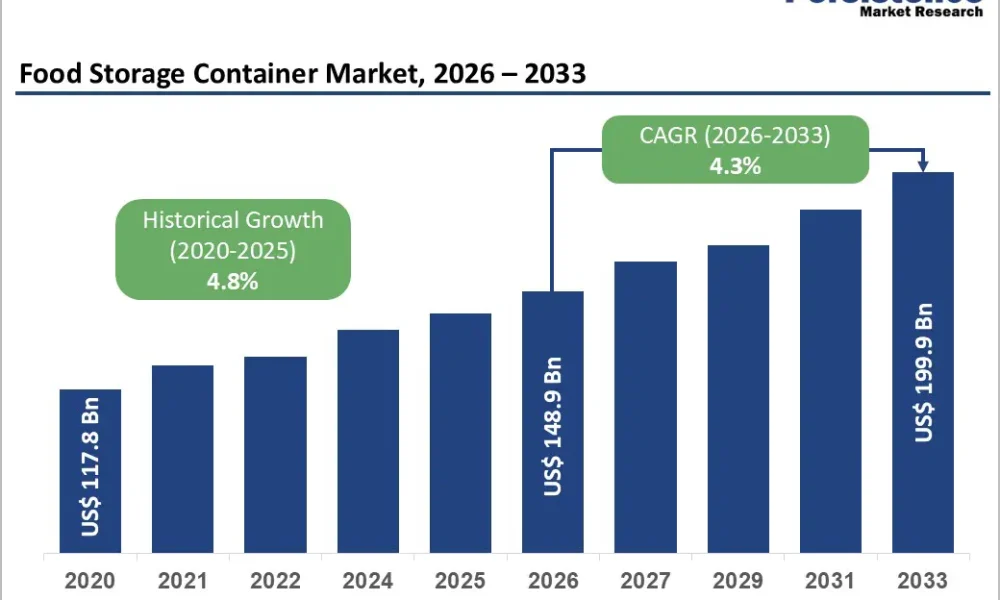
According to Persistence Market Research, the global Food Storage Container Market is poised for steady expansion over the forecast period. The market is projected to be valued at US$148.9 billion in 2026 and is expected to reach US$199.9 billion by 2033, growing at a CAGR of 4.3% between 2026 and 2033. This growth reflects sustained consumer demand for efficient food preservation solutions, particularly amid rising home meal preparation trends and increasing consumption of packaged and convenience foods. Food storage containers have evolved beyond basic utility products, becoming essential kitchen solutions that align with modern lifestyles and sustainability preferences.
The market’s steady trajectory is supported by key growth drivers such as the shift toward reusable and eco friendly storage products, expanding urban households, and greater awareness of food waste reduction. Plastic containers remain a leading product segment due to affordability and versatility, while glass and sustainable material based containers are gaining traction for health and environmental reasons. Household consumers represent the dominant end user segment, driven by home cooking and meal prepping habits. Geographically, developed regions lead the market owing to high adoption of organized kitchen storage systems and strong retail penetration, while emerging economies are witnessing gradual uptake supported by urbanization and rising disposable income levels.
Discover Exclusive Data – Request Your Free Sample : https://www.persistencemarketresearch.com/samples/36039
Key Highlights from the Report
➤ The global Food Storage Container Market is projected to expand from US$148.9 billion in 2026 to US$199.9 billion by 2033 at a CAGR of 4.3%.
➤ Sustained growth in home meal preparation is a primary driver supporting long term market demand.
➤ Increasing consumption of convenience foods is strengthening the need for reliable storage solutions.
➤ Rising adoption of reusable and sustainable storage containers is reshaping product innovation strategies.
➤ Household consumers account for the largest share of demand across end user categories.
➤ Developed regions lead the market due to high product penetration and established retail infrastructure.
Market Segmentation Analysis
The Food Storage Container Market is segmented based on product type, material, and end user. By product type, the market includes containers designed for dry food storage, liquid storage, freezer storage, and microwave compatible use. Plastic containers continue to hold a substantial share due to their lightweight design, durability, and cost effectiveness. However, glass containers are witnessing growing preference among health conscious consumers seeking non reactive and long lasting alternatives. Stainless steel and other sustainable materials are gradually gaining visibility as manufacturers align with environmental sustainability goals.
In terms of end user segmentation, the market is primarily divided into household and commercial segments. The household segment dominates demand due to rising home cooking trends, meal prepping culture, and increasing focus on organized kitchen spaces. Commercial users such as restaurants, catering services, and food processing units also contribute to demand, particularly for bulk storage solutions. The surge in convenience food consumption further supports both segments, as consumers and businesses seek effective ways to maintain freshness and reduce food wastage.
Get a Customized Market View in One Click : https://www.persistencemarketresearch.com/request-customization/36039
Regional Insights
Developed regions continue to command a significant share in the Food Storage Container Market. High awareness regarding food safety, organized retail networks, and strong consumer purchasing power drive consistent demand. Consumers in these regions increasingly prefer premium and reusable containers that align with sustainable living practices. The presence of established brands and widespread e commerce channels further enhances product accessibility and repeat purchases.
Emerging economies are experiencing steady growth driven by rapid urbanization, expanding middle class populations, and evolving lifestyle patterns. As disposable incomes rise, consumers are investing in modern kitchenware products, including advanced food storage containers. Increased exposure to global trends through digital platforms is also influencing purchasing behavior. Retail expansion and growing emphasis on food preservation are expected to support sustained growth across these markets.
Market Drivers
The primary driver of the Food Storage Container Market is sustained growth in home meal preparation. As more consumers cook at home for health, cost savings, and lifestyle preferences, demand for reliable storage solutions has intensified. Meal prepping trends require containers that preserve freshness and ensure portion control. This shift is reinforcing the need for durable, reusable, and multifunctional containers across households globally.
Another significant driver is the increasing consumption of convenience foods. Ready to eat meals and packaged food products often require secondary storage after opening. Consumers are seeking containers that maintain product quality and extend shelf life. Additionally, rising awareness of environmental sustainability is encouraging adoption of reusable storage solutions, reducing reliance on single use packaging and supporting long term market growth.
Market Restraints
Despite positive growth prospects, the Food Storage Container Market faces certain restraints. Fluctuations in raw material prices, particularly for plastics and alternative materials, can impact production costs and pricing strategies. Manufacturers may encounter challenges in maintaining competitive pricing while investing in sustainable product development.
Environmental concerns surrounding plastic usage also pose challenges for traditional container manufacturers. Regulatory pressures and consumer demand for eco friendly alternatives are pushing companies to redesign product portfolios. While this shift presents opportunities, it also requires capital investment and operational adjustments that may limit short term profitability.
Market Opportunities
The market presents strong opportunities in the development of sustainable and reusable storage solutions. As consumers prioritize environmentally responsible products, companies can expand portfolios with recyclable, biodegradable, or long lasting materials. Innovation in design, such as stackable and space saving containers, further enhances product appeal.
Digital retail channels provide another avenue for growth. Online platforms allow brands to reach a broader consumer base and showcase product features effectively. Customization, smart storage solutions, and premium design offerings can help companies differentiate themselves in a competitive market landscape while tapping into evolving consumer preferences.
Complete Your Order – Get Full Report Immediately : https://www.persistencemarketresearch.com/checkout/36039
Company Insights
Key players operating in the Food Storage Container Market include:
- Tupperware Brands Corporation
- Newell Brands (Rubbermaid)
- LocknLock Co., Ltd.
- IKEA
- Helen of Troy (OXO)
- Sistema Plastics
- Maspion Group
- Glasslock
- World Kitchen LLC (Pyrex)
- Cello World Ltd.
- Hamilton Housewares Pvt. Ltd.
- Meyer Corporation
- Snapware (Pyrex Brand)
- Progressive International
- Inter IKEA Group
- Brabantia
- Joseph Joseph
- Thermos L.L.C.
Recent Developments
January 2024 A leading manufacturer introduced a new line of reusable and sustainable food storage containers targeting eco conscious consumers.
September 2023 A major market participant expanded its product portfolio with innovative airtight storage solutions to strengthen its presence in organized retail channels.
Future Opportunities and Growth Prospects
The Food Storage Container Market is positioned for steady growth as consumer lifestyles continue to evolve. Rising emphasis on home cooking, sustainability, and organized living will remain central to market expansion. With the market expected to reach US$199.9 billion by 2033 at a CAGR of 4.3%, manufacturers focusing on innovation, material advancement, and digital engagement are likely to capture emerging opportunities. Continuous adaptation to changing consumer preferences will define long term competitiveness in this dynamic industry.




