
Global Endoscopic Spinal Surgery Market Poised for Decade of Transformation; Projected to Reach New Heights by 2036
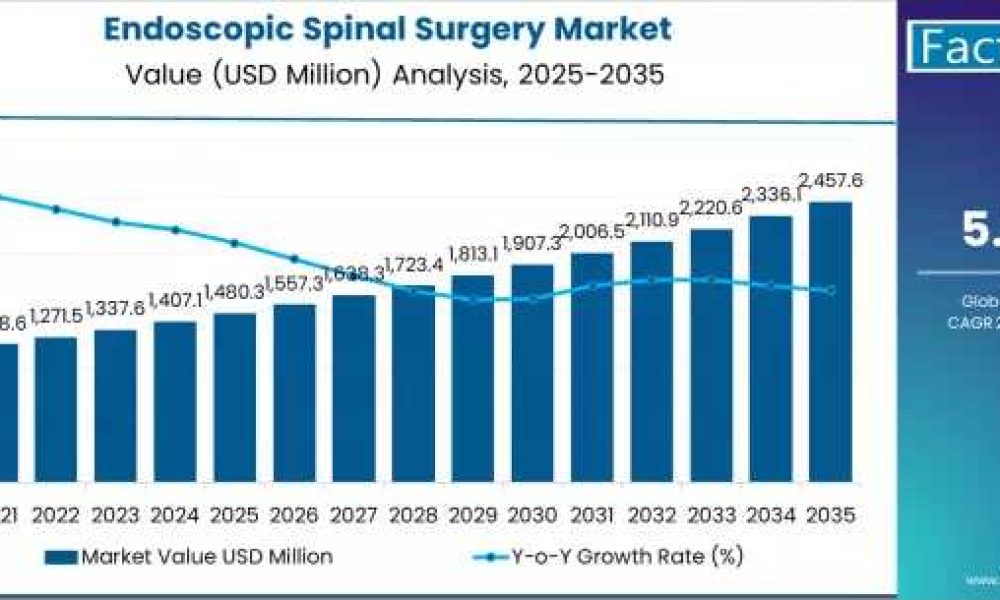
The global endoscopic spinal surgery market has entered a pivotal era of growth, driven by a fundamental shift toward ultra-minimally invasive interventions. As of early 2026, industry data indicates the market is valued at approximately $3.90 billion, with a projected trajectory to expand significantly through 2036. This growth is fueled by an aging global population, rapid integration of AI-guided navigation, and a rising clinical preference for outpatient surgical settings.
Request for Sample Report | Customize Report |purchase Full Report – https://www.factmr.com/connectus/sample?flag=S&rep_id=9373
Precision Medicine Meets Spinal Care: The 2026-2036 Outlook
The “Silver Economy” is no longer a future concept but a current market driver. With nearly 80% of the global population expected to encounter spinal issues in their lifetime, the demand for procedures that offer immediate mobilization has never been higher. Endoscopic techniques—specifically uniportal and biportal approaches—are transitioning from specialized niche alternatives to the primary standard of care for degenerative disc disease and spinal stenosis.
Technological milestones in 2026, including the widespread adoption of 4K ultra-high-definition visualization and 3D-printed patient-specific implants, have reduced the “learning curve” that previously hindered surgeon adoption. These advancements allow for “keyhole” surgeries that reduce hospital stays by nearly 50% and lower post-operative complication rates by up to 30% compared to traditional open surgeries.
Key Market Dynamics and Strategic Drivers
The market’s evolution over the 2026-2036 forecast period is defined by three core pillars:
Technological Convergence: The integration of Robotic-Assisted Surgery (RAS) and Augmented Reality (AR) is providing surgeons with millimeter-level accuracy. Industry experts anticipate a 30% increase in robotic-assisted endoscopic procedures over the next five years.
Shift to Ambulatory Surgical Centers (ASCs): Cost-conscious healthcare systems are migrating spinal procedures out of traditional hospitals. ASCs now account for a growing share of the market, favored for their high-throughput efficiency and reduced patient costs.
Geographic Expansion: While North America maintains a dominant 40% market share, the Asia-Pacific region—led by China and India—is identified as the fastest-growing corridor. This is attributed to massive healthcare infrastructure investments and a burgeoning middle class seeking advanced medical care.
Segmentation and Competitive Landscape
The market is categorized by several critical segments that reflect the industry’s focus on precision:
Product Type: Endoscopes (Rigid and Flexible), Visualization Systems, and High-Speed Shaver Systems.
Procedure: Transforaminal and Interlaminar approaches remain the most utilized, with Interlaminar techniques seeing a surge in cervical and thoracic applications.
Application: Herniated disc repair remains the leading indication, though spinal stenosis treatment is the fastest-growing sub-segment.
The competitive environment is characterized by intense R&D and strategic consolidation. Key players currently shaping the global landscape include Medtronic plc, Johnson & Johnson (DePuy Synthes), Stryker, Karl Storz SE & Co. KG, Joimax GmbH, and RIWOspine GmbH. These organizations are increasingly focusing on “smart” instrumentation and AI-driven preoperative planning tools to maintain market leadership.
“The transition we are seeing in 2026 is a move away from ‘one-size-fits-most’ surgical tools toward modular, procedure-specific systems,” notes a senior industry analyst. “The next decade will be defined by how well technology can minimize tissue disruption while maximizing long-term clinical outcomes.”
Challenges to Universal Adoption
Despite the optimistic forecast, the market faces hurdles. High initial capital investment for robotic systems and the requirement for specialized surgeon training remain barriers in developing economies. Furthermore, the volatility of global supply chains for specialty optics and medical-grade electronics continues to necessitate strategic resilience among manufacturers.
About the Endoscopic Spinal Surgery Market Report
This market analysis provides a comprehensive overview of the trends, technologies, and economic factors influencing the spinal surgery landscape from 2026 to 2036. It serves as a strategic roadmap for investors, healthcare providers, and medical device manufacturers aiming to navigate the complexities of modern spinal care.
Related Reports
Endoscopic Probe Disinfection Market
Contact Us –
11140 Rockville Pike, Suite 400, Rockville,
MD 20852, United States
Tel: +1 (628) 251-1583 | [email protected]
About Fact.MR
Fact.MR is a global market research and consulting firm, trusted by Fortune 500 companies and emerging businesses for reliable insights and strategic intelligence. With a presence across the U.S., UK, India, and Dubai, we deliver data-driven research and tailored consulting solutions across 30+ industries and 1,000+ markets. Backed by deep expertise and advanced analytics, Fact.MR helps organizations uncover opportunities, reduce risks, and make informed decisions for sustainable growth.



