
Global Gas Chromatography Market Poised for Strategic Expansion, Projected to Scale Significant Valuations by 2036
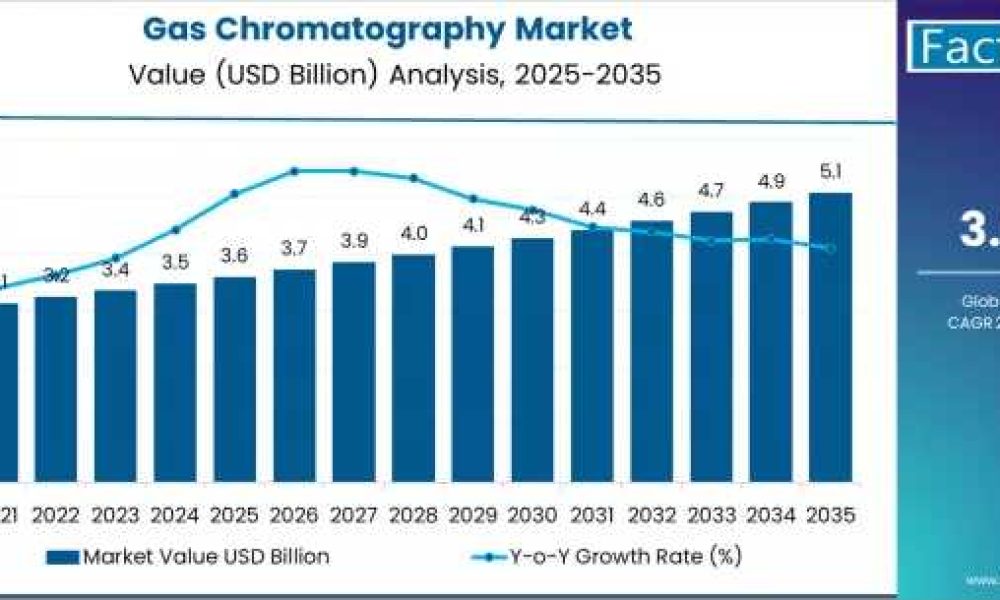
The global gas chromatography (GC) market is entering a transformative decade of growth, fueled by rigorous pharmaceutical safety mandates, a global shift toward sustainable laboratory practices, and the rapid integration of artificial intelligence in analytical workflows. New industry data indicates that the market, valued at approximately $4.22 billion in 2026, is on a trajectory to reach nearly $7.35 billion by 2036, sustained by a steady Compound Annual Growth Rate (CAGR) of 6.3%.
As industries transition from traditional benchtop setups to automated, “smart” chromatography systems, the next ten years will redefine how volatile compounds are identified and quantified in critical sectors such as drug development, environmental monitoring, and food safety.
Request for Sample Report | Customize Report |purchase Full Report – https://www.factmr.com/connectus/sample?flag=S&rep_id=193
Understanding the Shift: Who, What, and Why
Gas chromatography remains the “gold standard” for separating and analyzing complex mixtures. While the technology is decades old, its modern evolution is driven by three primary stakeholders:
Pharmaceutical & Biotech Leaders: Utilizing high-resolution GC for drug purity testing and metabolomics.
Environmental Agencies: Deploying portable GC units to monitor real-time air and water quality in response to tightening global emission standards.
Food Safety Regulators: Leveraging GC-MS (Mass Spectrometry) workflows to detect trace contaminants and ensure global supply chain integrity.
The market’s momentum is not merely a result of increased volume but a fundamental shift in how analysis is conducted. Laboratories are moving away from manual sample preparation toward fully integrated, cloud-enabled platforms that reduce human error and operational downtime.
Technological Catalysts: AI and Miniaturization
The forecast period of 2026–2036 marks the “Digital Era” of chromatography. Key innovations currently reshaping the landscape include:
AI-Driven Analytics: Integration of machine learning algorithms to automate peak identification and predictive maintenance, significantly reducing the “skill gap” caused by a global shortage of trained chromatographers.
The Hydrogen Transition: Amidst chronic helium shortages and rising costs, the industry is pivoting toward hydrogen-ready GC systems, which offer faster analysis times and a more sustainable environmental footprint.
Micro-GC and Portability: The rise of silicon-based micro-GC (µ-GC) technology allows for laboratory-grade analysis in the field—essential for the oil and gas industry’s transition toward carbon capture and hydrogen purity monitoring.
Regional Insights and Sector Dominance
North America continues to hold the largest revenue share, currently estimated at 38%, supported by a robust infrastructure of contract research organizations (CROs) and stringent FDA/EPA regulations. However, the Asia-Pacific region is identified as the fastest-growing market. Rapid industrialization in India and China, coupled with massive investments in biopharmaceutical manufacturing, is expected to drive double-digit growth in these territories through 2036.
From a product perspective, Consumables and Accessories—including high-performance capillary columns and specialized detectors—account for over 55% of the market share. This dominance is attributed to the recurring nature of these components and the continuous need for high-sensitivity replacements in high-throughput laboratories.
Strategic Outlook for Investors and Analysts
For investors and market professionals, the 2026–2036 window presents a unique opportunity in the “Analytical Intelligence” space. Companies like Agilent Technologies, Thermo Fisher Scientific, Shimadzu Corporation, and Waters Corporation are no longer just hardware manufacturers; they are becoming software-centric solution providers.
“The industry is no longer satisfied with just generating data,” says a senior market analyst. “The value now lies in the speed of insight. By 2036, we expect gas chromatography to be a seamless, automated part of the industrial ‘Internet of Things’ (IoT), where instruments diagnose themselves and report results directly to the cloud.”
About the Gas Chromatography Industry
Gas Chromatography (GC) is a sophisticated analytical technique used to separate the chemical components of a sample mixture and then detect them to determine their presence or quantity. It is a vital tool in medical diagnostics, forensic science, environmental protection, and industrial quality control.
Related Reports
Gastrointestinal Therapeutics Market
Contact Us –
11140 Rockville Pike, Suite 400, Rockville,
MD 20852, United States
Tel: +1 (628) 251-1583 | [email protected]
About Fact.MR
Fact.MR is a global market research and consulting firm, trusted by Fortune 500 companies and emerging businesses for reliable insights and strategic intelligence. With a presence across the U.S., UK, India, and Dubai, we deliver data-driven research and tailored consulting solutions across 30+ industries and 1,000+ markets. Backed by deep expertise and advanced analytics, Fact.MR helps organizations uncover opportunities, reduce risks, and make informed decisions for sustainable growth.



