
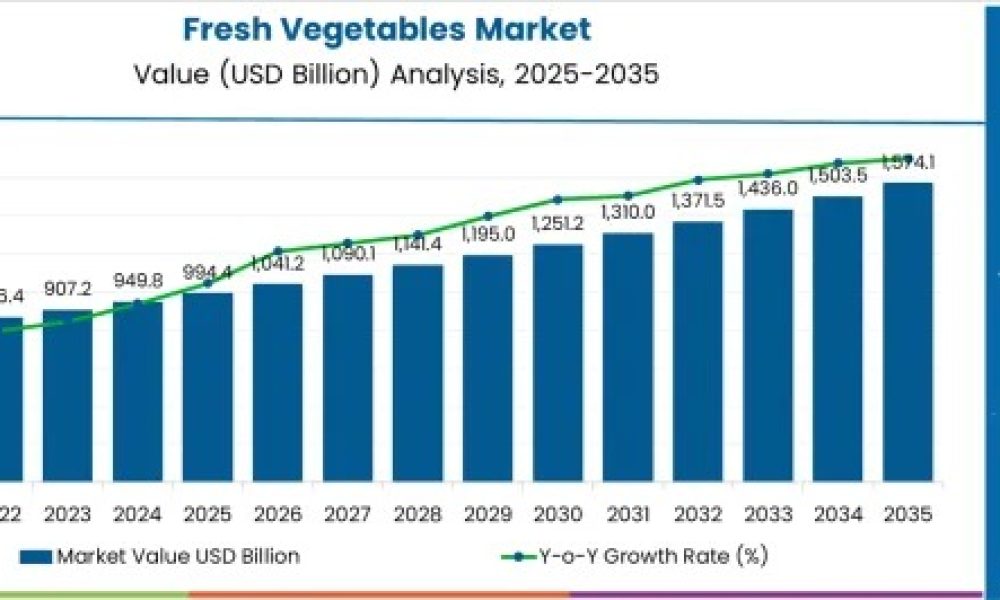
The global fresh vegetables market is projected to be valued at USD 994.4 billion in 2025 and is expected to reach USD 1,574.1 billion by 2035, expanding at a CAGR of 4.7% over the forecast period. This steady expansion reflects rising global demand for nutritious, minimally processed foods, alongside improvements in agricultural productivity and distribution efficiency.
A detailed peak-to-trough analysis highlights how the market has evolved through cyclical fluctuations toward long-term stability. In the early years, the market moves from USD 790.4 billion to USD 949.8 billion, shaped by seasonal production cycles, climate variability, and regional supply constraints. Despite these fluctuations, underlying demand fundamentals remain strong, supported by population growth and rising awareness of dietary health.
Explore trends before investing – request a sample report today!
As the market stabilizes between USD 994.4 billion and USD 1,195.0 billion, recovery from weather-related disruptions and logistical bottlenecks becomes evident. Investments in cold storage, refrigerated transport, and better inventory management help reduce post-harvest losses and smooth short-term volatility. These improvements create a more resilient supply chain, particularly across urban and semi-urban markets.
From the mid to late forecast period, market values rise from USD 1,251.2 billion to USD 1,436.0 billion, with more pronounced growth peaks. This phase is characterized by the adoption of mechanized harvesting, precision farming, and improved seed varieties, all of which enhance yield consistency and quality. By the final stage, reaching USD 1,574.1 billion, fluctuations narrow further, signaling a maturing global market supported by technology-led farming and expanding urban consumption.
Market Snapshot and Key Highlights
- Market Value (2025): USD 994.4 billion
- Forecast Value (2035): USD 1,574.1 billion
- Forecast CAGR (2025–2035): 4.7%
- Leading Segment (2025): Leafy Greens (26.9%)
- Largest End Use: Household Consumption (41.2%)
- Key Growth Regions: North America, Asia-Pacific, Europe
Interconnected Ecosystem Supporting Market Growth
The fresh vegetables market is anchored by a multi-industry ecosystem that ensures supply continuity and demand resilience. Commercial agriculture and farming account for nearly 40% of market influence, driven by large-scale cultivation and modern agronomic practices. Food retail and grocery channels contribute around 25%, supported by supermarkets, hypermarkets, and online grocery platforms.
Foodservice and hospitality represent close to 15%, while cold chain and logistics add nearly 12%, underscoring the importance of temperature-controlled handling. The remaining 8% is driven by the health and wellness food segment, as consumers increasingly associate fresh vegetables with preventive nutrition and long-term wellbeing.
Why the Fresh Vegetables Market Is Expanding
Growth is being fueled by a convergence of health awareness, urbanization, and supply chain modernization. Consumers are prioritizing fresh and nutrient-dense foods, while governments and health organizations promote vegetable-rich diets. Simultaneously, advancements in greenhouse cultivation and controlled environment agriculture are enabling year-round availability, reducing dependency on seasonal cycles.
Organized retail expansion and e-commerce adoption further enhance accessibility, while rising disposable incomes increase per-capita consumption across emerging and developed economies alike.
Segment Insights: Leafy Greens Lead the Market
Leafy greens account for approximately 26.9% of total market share, driven by their high nutritional value, short cultivation cycles, and versatility across household and foodservice applications. Demand is reinforced by urban dietary trends such as salads, smoothies, and plant-forward meals. Improved post-harvest handling and ready-to-use packaging formats continue to strengthen this segment’s leadership.
Household Consumption Remains the Demand Backbone
Household consumption dominates end-use demand with a 41.2% share. Vegetables remain a daily dietary staple across cultures, with home cooking trends, food safety awareness, and interest in organic and locally sourced produce reinforcing steady demand. This segment provides long-term stability, even during periods of economic uncertainty.
Regional and Country-Level Growth Outlook
Asia-Pacific leads growth momentum, with China (6.3% CAGR) and India (5.9% CAGR) benefiting from urbanization, income growth, and agricultural modernization. European markets such as Germany (5.4%) and the UK (4.5%) emphasize sustainability, quality standards, and traceability, while the U.S. (4.0%) focuses on controlled environment agriculture and convenience-driven consumption.
Access the full report for detailed market trends.
Competitive Landscape
The market remains competitive, shaped by supply chain efficiency, product freshness, and year-round availability. Leading players include Dole Food Company, Bonduelle Group, Fresh Del Monte Produce, Taylor Farms, Nestlé S.A., and The Kraft Heinz Company, among others. Companies are differentiating through organic offerings, ready-to-cook formats, advanced cold chain logistics, and farm-to-fork traceability, while regional players cater to niche and locally sourced demand.
Key Players in the Fresh Vegetables Market
- Dole Food Company
- Ardo Group
- Bonduelle Group
- Calavo Growers
- Conagra Brands
- Church Brothers Farms
- Fresh Del Monte Produce
- Green Giant
- Lipman Family Farms
- Mann Packing Company
- Nestlé S.A.
- SunFed
- Taylor Farms
- The Kraft Heinz Company
Why FMI
Discover why global enterprises trust FMI for strategic decision-making:
https://www.futuremarketinsights.com/why-fmi
About Future Market Insights (FMI)
Future Market Insights, Inc. (FMI) is an ESOMAR-certified and ISO 9001:2015 market research and consulting organization, trusted by Fortune 500 companies and global enterprises. With delivery centers in the U.S., UK, India, and Dubai, FMI provides data-backed insights across 30+ industries and 1,200+ markets worldwide.



