
The global manufacturing landscape is undergoing a fundamental transformation as additive manufacturing technologies move from prototyping to full-scale production. Among these technologies, binder jetting has emerged as one of the most promising solutions for high-volume, cost-efficient metal part production. Once viewed as a niche process, binder jetting services are now gaining strong traction across automotive, aerospace, industrial tooling, and emerging applications such as medical devices and on-demand spare parts.
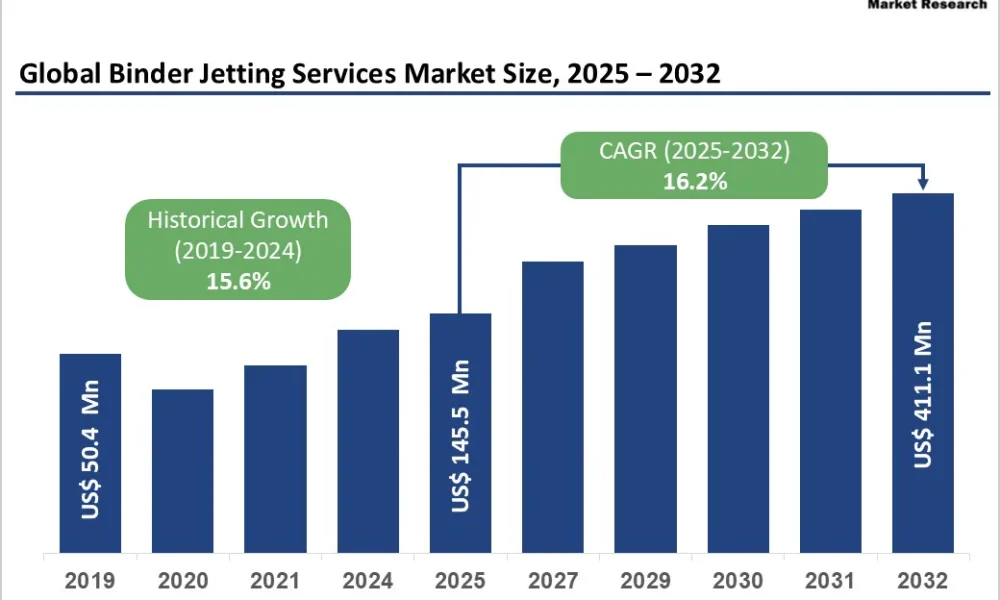
The global binder jetting services market is likely to be valued at US$145.5 million in 2025 and is expected to reach US$411.1 million by 2032, expanding at a robust CAGR of 16.2% during the forecast period. This rapid growth is driven by increasing adoption in aerospace and automotive manufacturing, material advancements, process reliability improvements, and the growing need for lightweight, complex, and sustainable production methods.
Understanding Binder Jetting Technology
Binder jetting is an additive manufacturing process in which a liquid binding agent is selectively deposited onto a powder bed, bonding particles layer by layer to form a “green” part. The printed part is subsequently cured, debound, and sintered to achieve near-full density. Unlike laser-based powder bed fusion processes, binder jetting does not rely on high-energy heat during printing, enabling faster build speeds, reduced thermal distortion, and scalability for batch production.
Binder jetting is particularly well suited for:
- Complex geometries with internal channels
- High-volume, repeatable production
- Materials such as stainless steels, Inconel alloys, and tool steels
- Applications requiring reduced material waste and lower cost per part
As service bureaus refine post-processing workflows and achieve tighter tolerances, binder jetting services are increasingly used for end-use production parts, not just prototypes.
Market Size Outlook and Growth Trajectory
The binder jetting services market is transitioning from early adoption to accelerated commercialization. Market growth is supported by both demand-side and supply-side dynamics.
- Market size (2025): US$145.5 million
- Forecast value (2032): US$411.1 million
- CAGR (2025–2032): 16.2%
Aerospace and automotive manufacturers are key contributors to demand, as binder jetting aligns closely with their goals of weight reduction, faster development cycles, and cost-effective serial production. In parallel, service providers are scaling capacity, improving material portfolios, and achieving certification-ready quality standards.
Key Growth Drivers Shaping the Market
Aerospace Adoption and Lightweighting Targets
The aerospace industry represents one of the most powerful growth engines for binder jetting services. Aircraft OEMs and tier suppliers are pursuing 15–30% weight reduction targets, where additive manufacturing offers a clear advantage over traditional subtractive methods.
Binder jetting enables:
- Production of complex turbine and structural components
- Lightweight topology-optimized designs
- Qualification of aerospace-grade alloys such as 316L stainless steel, 17-4PH, and Inconel 625
The ongoing qualification of Inconel 718 and publication of material allowables further strengthens confidence in binder-jetted components for flight-critical and near-critical applications.
Automotive and EV Manufacturing Expansion
The automotive industry currently dominates the binder jetting services market, accounting for 37.2% of total market share. OEMs and suppliers are adopting binder jetting to address key challenges in modern vehicle design, including lightweighting, thermal management, and shorter product development cycles.
Electric vehicle (EV) production is a major catalyst. Global EV output is forecast to reach 39 million units by 2030, driving demand for advanced components such as:
- Battery cooling plates
- Heat exchangers with internal channels
- Lightweight structural brackets
Binder jetting enables these complex geometries while delivering up to 30% lower material waste compared to conventional machining, supporting both cost efficiency and sustainability goals.
Shift Toward Serial Manufacturing
Historically, additive manufacturing services were primarily used for prototyping. Today, binder jetting is increasingly deployed for mid-volume serial production, bridging the gap between prototyping and mass manufacturing.
The ability to produce hundreds or thousands of identical parts in a single build, combined with predictable sintering outcomes, makes binder jetting highly attractive for production-oriented service customers.
Industry Segment Analysis
Automotive Industry: Market Leader
The automotive industry holds a 37.2% share of the global binder jetting services market. Key adoption drivers include:
- High-volume production requirements
- Rapid prototyping and design iteration
- Lightweight structural and thermal management components
Binder jetting supports the automotive industry’s push toward digital manufacturing and localized production, reducing tooling dependency and time-to-market.
Aerospace: Fastest-Growing Segment
While smaller in absolute size, the aerospace segment is the fastest-growing industry vertical. Growth is supported by:
- Increasing OEM qualification of binder-jetted parts
- Complex geometry requirements for turbines and brackets
- Adoption of high-temperature alloys such as Inconel 625 and 718
As certification frameworks mature, aerospace demand for binder jetting services is expected to accelerate significantly.
Application Segment Trends
Production Parts Dominate the Market
Production parts represent the largest application segment, accounting for 42.6% of total market share. This reflects the industry’s shift toward using binder jetting for end-use components rather than one-off prototypes.
Binder jetting delivers:
- Competitive economics at mid-volume production
- Consistent part quality across batches
- Reduced lead times compared to tooling-intensive processes
Tools and Fixtures: Fastest-Growing Application
Tools and fixtures are the fastest-growing application segment, driven by:
- 50–70% cost reduction versus conventional tooling
- 3–5× faster lead times
- Integration of conformal cooling, improving molding productivity by approximately 20%
These benefits are particularly attractive to automotive and industrial manufacturers seeking flexible, high-performance tooling solutions.
Elevate your business strategy with comprehensive market data. Request a sample report now: https://www.persistencemarketresearch.com/samples/32292
Regional Market Outlook
North America: Current Market Leader
North America leads the global binder jetting services market with a 30.9% share, representing approximately US$44 million in market value. Growth is supported by:
- Strong presence of aerospace and automotive OEMs
- Early adoption of additive manufacturing technologies
- Advanced service bureau ecosystems in the U.S.
Strategic partnerships, such as the Ford–Desktop Metal collaboration, have reinforced North America’s leadership in production-scale binder jetting.
Asia Pacific: Fastest-Growing Region
Asia Pacific is the fastest-growing regional market, led by China, which holds 34.5% of the regional share. Growth drivers include:
- Rapid expansion of automotive and EV manufacturing
- Government support for advanced manufacturing
- Increasing investments in metal additive manufacturing capacity
China, Japan, and South Korea are emerging as key hubs for binder jetting services in industrial and automotive applications.
Europe: Strong Automotive Adoption
Europe accounts for approximately 28% of the global market, driven by:
- Automotive OEM adoption in Germany and France
- Investments in production-scale additive manufacturing
- Focus on lightweighting and sustainability
European manufacturers are leveraging binder jetting to meet stringent emissions regulations and performance standards.
Technology and Material Developments
Technological progress is a critical enabler of binder jetting service market growth. Recent advancements include:
- Improved process stability and repeatability
- Optimized sintering profiles for higher part density
- Enhanced surface finish and dimensional accuracy
Material innovation remains a key focus area. The development of high-strength metal powders, including stainless steels, Inconel alloys, and tool steels, has expanded the suitability of binder-jetted parts for demanding end-use applications.
These improvements are enabling certification-ready components for aerospace, medical, and industrial markets.
Competitive Landscape and Strategic Developments
The binder jetting services ecosystem is supported by leading technology providers such as Desktop Metal, 3D Systems, and HP. Their platforms are widely adopted by service bureaus worldwide.
A major milestone in the market was the Ford–Desktop Metal partnership in 2024, which qualified production-scale binder jetting for automotive components. Such collaborations validate binder jetting as a viable alternative to conventional manufacturing at scale.
Emerging Opportunities Through 2032
Beyond traditional prototyping and production parts, new value pools are emerging:
- Medical device customization: Estimated market opportunity of US$60–90 million by 2032
- On-demand spare parts: Projected to reach US$75–120 million by 2032
These applications benefit from binder jetting’s ability to produce complex, customized components with short lead times and minimal inventory requirements.
Conclusion
The global binder jetting services market is entering a phase of sustained, high-growth expansion. With a projected CAGR of 16.2% through 2032, the technology is rapidly transitioning from experimental adoption to production-critical deployment.
Driven by aerospace lightweighting initiatives, automotive and EV manufacturing growth, material advancements, and regional investments, binder jetting services are reshaping how complex metal parts are designed and produced. As certification frameworks mature and new applications emerge, binder jetting is poised to become a cornerstone of next-generation digital manufacturing.
For manufacturers seeking scalable, cost-efficient, and high-performance production solutions, binder jetting services represent a compelling and increasingly proven pathway forward.
Related Reports:




