
The way people pay for goods and services has undergone a dramatic transformation over the past decade. From cash and plastic cards to smartphones and QR codes, mobile payment transactions have moved from a convenience feature to a foundational pillar of the global financial ecosystem. As digital-first consumers, e-commerce platforms, and government-backed payment infrastructures converge, the Mobile Payment Transaction Market is experiencing unprecedented growth.
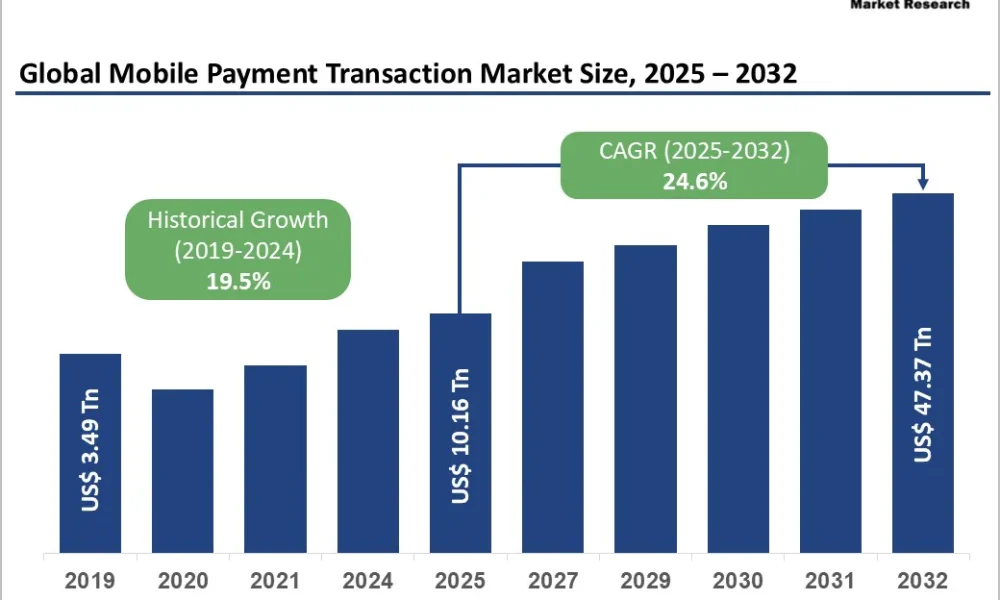
In 2025, the global mobile payment transaction market is valued at US$10.16 trillion. By 2032, it is projected to surge to US$47.37 trillion, expanding at a remarkable compound annual growth rate (CAGR) of 24.6%. This explosive expansion reflects not just technological innovation, but a broader shift in consumer behavior, regulatory frameworks, and financial inclusion strategies worldwide.
Understanding Mobile Payment Transactions
Mobile payment transactions refer to financial payments conducted through mobile devices such as smartphones and tablets. These payments may occur via digital wallets, NFC-enabled contactless payments, QR codes, mobile banking apps, or peer-to-peer (P2P) platforms. Unlike traditional card-based systems, mobile payments enable instant, seamless, and often cashless transactions across physical and digital environments.
Today, mobile payments are embedded in everyday activities—from grocery shopping and ride-hailing to utility payments, cross-border remittances, and in-app purchases. Their widespread adoption has positioned them as a critical driver of digital commerce and economic modernization.
Market Size and Growth Outlook
The mobile payment transaction market has demonstrated strong historical momentum. Between 2019 and 2024, the market expanded at a CAGR of 19.5%, driven by increasing smartphone usage, early digital wallet adoption, and the rise of online shopping.
Looking ahead, growth is expected to accelerate further:
- Market Size (2025E): US$10.16 trillion
- Market Forecast (2032F): US$47.37 trillion
- Projected CAGR (2025–2032): 24.6%
This near fivefold increase within seven years underscores the rapid shift from cash-based economies to mobile-first financial ecosystems.
Key Drivers Fueling Market Expansion
- Explosive Smartphone Penetration
Smartphones form the backbone of mobile payment adoption. With global smartphone penetration exceeding 7 billion devices, mobile payment platforms have access to an unprecedented user base. Affordable smartphones, improved internet connectivity, and expanding 4G and 5G networks are enabling even remote and underserved regions to participate in the digital economy.
In emerging markets, smartphones often serve as the primary financial interface, replacing traditional bank branches and physical cards altogether.
- Rapid Growth of E-commerce and Digital Marketplaces
E-commerce platforms are major catalysts for mobile payment transactions. In 2025, digital wallets account for approximately 50% of global e-commerce transactions, reflecting consumer preference for fast, frictionless checkout experiences.
Mobile payments reduce cart abandonment rates, support one-click purchases, and enable secure in-app transactions. As social commerce, quick commerce, and subscription-based services expand, mobile payments are becoming indispensable to online retail growth.
- Government-Backed Instant Payment Systems
One of the most powerful growth accelerators has been the rise of government-supported real-time payment infrastructures, particularly in emerging economies.
- India’s Unified Payments Interface (UPI) processes approximately 16.58 billion transactions every month, making it the world’s largest real-time payment system.
- Brazil’s PIX handles over 6 billion monthly transactions, transforming domestic payments with instant, low-cost transfers.
These platforms have dramatically reduced transaction costs, expanded financial inclusion, and encouraged small merchants and consumers to adopt mobile payments at scale.
- Shift Toward Cashless and Contactless Economies
The global push toward cashless transactions—accelerated by the pandemic—has permanently altered consumer payment habits. Contactless payments, enabled through NFC and QR codes, are now standard across retail, transportation, hospitality, and healthcare sectors.
Consumers increasingly associate mobile payments with speed, hygiene, convenience, and security, reinforcing long-term behavioral change.
Elevate your business strategy with comprehensive market data. Request a sample report now: https://www.persistencemarketresearch.com/samples/12937
Technology Trends Shaping the Market
NFC Dominates the Technology Segment
Near Field Communication (NFC) leads the mobile payment transaction market, accounting for 43% of the total technology share. NFC enables tap-and-pay functionality, making it ideal for high-volume environments such as retail stores, public transit systems, and quick-service restaurants.
Its dominance is driven by:
- Seamless user experience
- Strong security protocols
- Integration with smartphones, smartwatches, and POS terminals
Major global platforms like Apple Pay, Google Pay, and Samsung Pay rely heavily on NFC technology.
QR Codes: The Fastest-Growing Technology Segment
While NFC dominates mature markets, QR codes represent the fastest-growing technology segment, expanding at an estimated 30% growth rate. QR-based payments are particularly popular in emerging economies due to their low infrastructure costs and ease of deployment.
Small merchants can accept QR payments without expensive hardware, making this technology ideal for street vendors, microbusinesses, and rural markets. Countries such as China, India, and Southeast Asian nations have witnessed mass QR adoption across everyday transactions.
Digital Wallets and Super Apps
Digital wallets are evolving into comprehensive financial ecosystems. Many now offer services beyond payments, including:
- Savings and investment tools
- Insurance products
- Buy Now, Pay Later (BNPL) options
- Bill payments and subscriptions
In Asia Pacific, super apps integrate payments with messaging, shopping, transportation, and entertainment, driving extremely high user engagement and transaction volumes.
Regional Market Analysis
Asia Pacific: The Global Market Leader
Asia Pacific dominates the mobile payment transaction market, accounting for over 50% of global share. This leadership is fueled by:
- Massive populations and smartphone adoption
- Super apps in China and Southeast Asia
- Strong government digitalization initiatives
- Widespread QR and wallet-based payments
China remains a pioneer, while India’s UPI ecosystem has emerged as a global benchmark for scalable, interoperable digital payments.
North America: The Fastest-Growing Region
North America is the fastest-growing regional market, driven by:
- Rising adoption of QR codes and contactless payments
- Increasing penetration of mobile wallets among older demographics
- Strong e-commerce and omnichannel retail ecosystems
- Manufacturing hubs enabling affordable smart devices
The region is also witnessing growing acceptance of mobile payments in traditionally card-dominated sectors such as transit, healthcare, and B2B transactions.
Europe and Other Regions
Europe continues to see steady growth supported by regulatory harmonization, open banking initiatives, and increasing mobile wallet usage. Meanwhile, Latin America, Africa, and the Middle East are emerging as high-potential markets due to financial inclusion programs and mobile-first banking models.
Security, AI, and Blockchain: Unlocking the Next Growth Phase
As transaction volumes scale into trillions of dollars, security and trust are becoming critical differentiators. This is where emerging technologies play a transformative role.
AI-Powered Fraud Detection
Artificial intelligence enables real-time monitoring of transaction patterns, helping identify fraud, reduce false positives, and improve user trust. AI-driven personalization also enhances user experience by tailoring payment flows and rewards.
Blockchain for Transparency and Cross-Border Payments
Blockchain technology offers decentralized, tamper-proof transaction records, improving transparency and reducing settlement times. Its integration with mobile payments is expected to unlock up to US$5 trillion in emerging market transactions, particularly in cross-border payments and remittances.
Key Growth Opportunities
The mobile payment transaction market presents multiple growth avenues:
- Expansion into underbanked and unbanked populations
- Integration with IoT, wearables, and smart cities
- Growth of embedded finance and in-app payments
- Rising adoption of BNPL and micro-lending services
- Increased cross-border mobile payment interoperability
As ecosystems mature, mobile payments will increasingly function as gateways to broader digital financial services.
Competitive Landscape and Market Evolution
The market features a dynamic mix of global tech giants, fintech startups, banks, and telecom providers. Competition centers around user experience, security, ecosystem integration, and scalability.
Partnerships between governments, financial institutions, and technology providers are shaping interoperable platforms that accelerate adoption while maintaining regulatory compliance.
Conclusion: A Mobile-First Financial Future
The mobile payment transaction market is no longer just an alternative to traditional payments—it is becoming the default mode of financial exchange. With a projected market value of US$47.37 trillion by 2032, mobile payments are redefining commerce, inclusion, and economic participation worldwide.
Driven by smartphone ubiquity, e-commerce expansion, government-backed infrastructures, and rapid technological innovation, the market is poised for sustained, high-growth momentum. As AI and blockchain further enhance security and scalability, mobile payments will continue to unlock new opportunities across both developed and emerging economies.
In the years ahead, the question will not be whether mobile payments dominate global transactions—but how fast they reshape the future of money.
Related Reports:




