
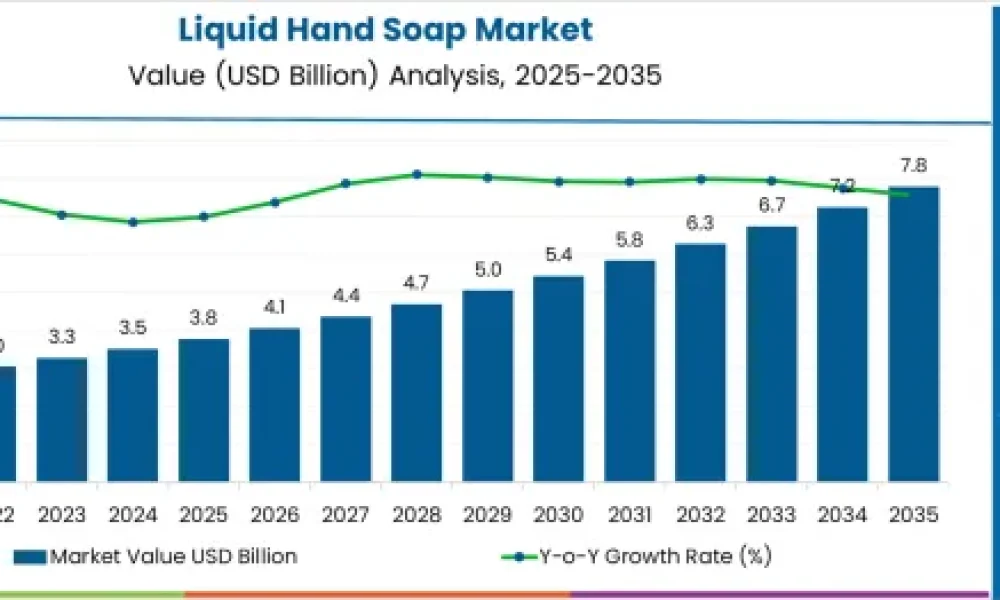
The global Liquid Hand Soap Market is entering a decade of sustained expansion, driven by rising hygiene awareness, diversified product innovation, and steady demand from both households and commercial institutions. According to the latest industry analysis, the market is valued at USD 3.8 billion in 2025 and is forecast to reach USD 7.8 billion by 2035, registering a compound annual growth rate (CAGR) of 7.5% over the forecast period.
Growth is being recorded across North America, Asia-Pacific, and Europe, supported by regulatory hygiene standards, evolving consumer preferences, and expanded retail and e-commerce access. The analysis spans more than 40 countries and covers packaging, formulation, application, and distribution trends shaping the global liquid hand soap industry.
Gain access to detailed segment-wise analysis and forecast statistics – Request the Sample Report Today
Market Context: Why Liquid Hand Soap Demand Is Rising
The liquid hand soap category continues to benefit from heightened awareness of personal and public hygiene across developed and emerging economies. Consumers and institutions are increasingly shifting from bar soaps to liquid formats due to perceived hygiene advantages, ease of dispensing, and reduced risk of cross-contamination.
Corporate disclosures and investor presentations indicate that institutional adoption in healthcare, hospitality, education, and foodservice remains a core growth engine. At the same time, residential usage is expanding as handwashing becomes a daily lifestyle habit rather than a situational response. Sustainability initiatives—including refill systems, recyclable packaging, and biodegradable formulations—are gaining traction as regulatory and consumer scrutiny intensifies.
Packaging and Distribution Trends Shape Market Structure
- Bottles Lead Packaging Formats in 2025By packaging type, bottles are expected to account for 61.3% of global revenue in 2025, maintaining their position as the dominant format. Industry publications attribute this leadership to durability, ease of use, and compatibility with pump dispensers and refill programs. Bottles also enable clear branding and labeling, supporting product differentiation in competitive retail environments.
- Supermarkets and Hypermarkets Remain the Primary Sales ChannelIn distribution, supermarkets and hypermarkets are projected to hold 47.8% of market revenue in 2025, making them the largest channel globally. High footfall, broad product assortment, and consumer trust continue to favor these outlets. Trade reports highlight the role of in-store promotions, bulk purchasing options, and strategic shelf placement in reinforcing channel dominance, even as online sales accelerate.
- Formulation Insights: Synthetic Products Maintain Market LeadershipThe synthetic segment is expected to capture 69.4% of market revenue in 2025, reflecting its cost efficiency, scalability, and proven antimicrobial performance. Synthetic formulations allow manufacturers to deliver consistent quality, longer shelf life, and a wide range of fragrances and textures. These attributes have supported widespread adoption across both household and commercial applications, particularly where regulatory compliance and supply reliability are critical.
Regional Outlook: Asia-Pacific Drives Above-Average Growth
While the market is expanding globally, growth rates vary by country:
- China leads with a projected 10.1% CAGR, driven by urban density, institutional procurement, and pharmacy-led premiumization.
- India follows at 9.4% CAGR, supported by rising household penetration, hospitality sector expansion, and localized manufacturing efficiencies.
- Germany (8.6%) and France (7.9%) benefit from strong pharmacy channels and demand for dermo-tested formulations.
- The United Kingdom (7.1%) and United States (6.4%) show steady growth linked to healthcare demand, dispenser upgrades, and e-commerce subscriptions.
These markets serve as benchmarks for innovation, retail strategy, and packaging localization across the broader industry.
Commercial and Institutional Demand Anchors Long-Term Stability
Commercial applications—particularly in hospitals, hotels, schools, airports, and offices—continue to provide stable, recurring revenue streams. Regulatory hygiene requirements have encouraged long-term supply contracts and bulk procurement, supporting innovation in high-capacity dispensers, concentrated refills, and fragrance-free formulations. Institutional buyers increasingly prioritize non-irritant and antimicrobial products to meet safety standards and operational efficiency goals.
Competitive Landscape and Recent Developments
The liquid hand soap market remains highly competitive, featuring multinational FMCG companies, regional manufacturers, and niche wellness-focused brands. Key players include Procter & Gamble, Unilever, Colgate Palmolive, Henkel AG & Co KGaA, Reckitt Benckiser, Johnson & Johnson, Kimberly-Clark, Kao Corporation, and Godrej Consumer Products Ltd, alongside institutional specialists such as Gojo Industries, Medline Industries, and Cleenol Group.
Competitive strategies focus on scaling refill systems, expanding e-commerce subscriptions, enhancing skin-friendly antibacterial formulations, and targeting emerging markets with localized packaging formats. In July 2025, Procter & Gamble announced price increases on approximately 25% of its U.S. product portfolio to offset tariff-related cost pressures, underscoring the impact of raw material and trade dynamics on pricing strategies.
Outlook Through 2035
With hygiene embedded as a long-term consumer and institutional priority, the liquid hand soap market is positioned for consistent growth through 2035. Expansion will be shaped by product diversification, retail and e-commerce integration, sustainability initiatives, and continued demand from commercial sectors. As manufacturers balance cost efficiency with formulation innovation and packaging evolution, liquid hand soap is expected to remain a core category within the global personal and professional hygiene landscape.
Have a specific Requirements and Need Assistant on Report Pricing or Limited Budget please contact us – [email protected]
About Future Market Insights (FMI)
Future Market Insights, Inc. (FMI) is an ESOMAR-certified, ISO 9001:2015 market research and consulting organization, trusted by Fortune 500 clients and global enterprises. With operations in the U.S., UK, India, and Dubai, FMI provides data-backed insights and strategic intelligence across 30+ industries and 1200 markets worldwide
Why Choose FMI: https://www.futuremarketinsights.com/why-fmi



