
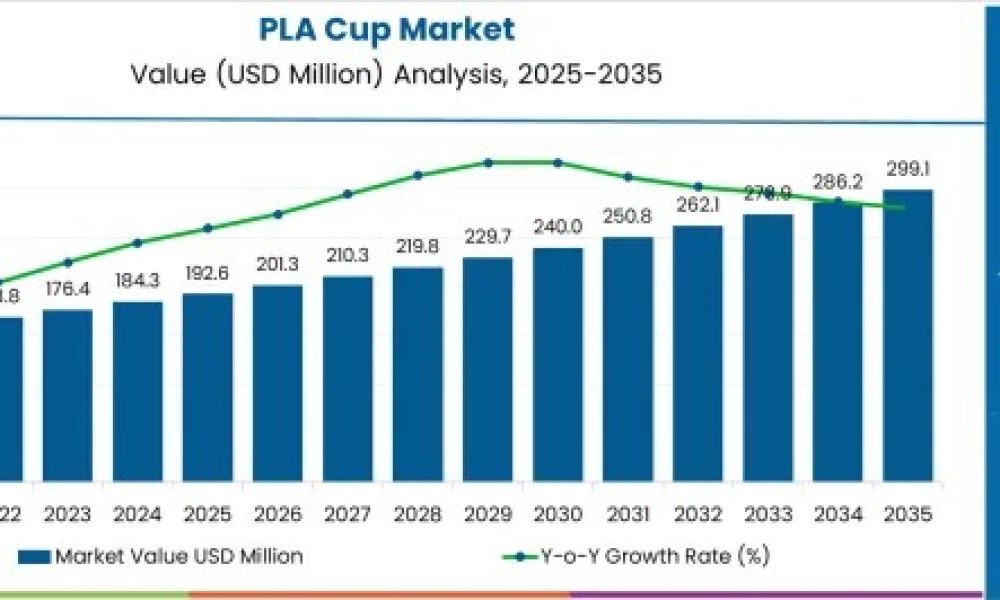
The PLA cup market is steadily gaining traction as sustainability becomes a central theme across global packaging and food service industries. With rising environmental concerns and stricter regulations on single-use plastics, businesses are actively seeking alternatives that reduce ecological impact without compromising functionality. Polylactic Acid (PLA) cups, made from renewable plant-based resources such as corn starch and sugarcane, are emerging as a practical solution that aligns with both consumer expectations and regulatory mandates.
In 2025, the global PLA cup market is valued at USD 192.6 million and is projected to reach USD 299.1 million by 2035, growing at a CAGR of 4.5%. This growth reflects a broader shift in packaging preferences, especially within food service outlets, cafes, and quick-service restaurants.
Meaning of PLA Cups
PLA cups are disposable drinking cups manufactured using polylactic acid, a biodegradable biopolymer derived from fermented plant sugars. Unlike conventional petroleum-based plastics, PLA is compostable under industrial conditions and offers a lower carbon footprint.
These cups are lightweight, transparent, and suitable for both hot and cold beverages. Their aesthetic appeal and compostability make them an ideal choice for businesses aiming to showcase sustainability credentials while maintaining customer convenience.
Market Outlook
The outlook for the PLA cup market remains positive over the next decade, supported by increasing eco-consciousness and expanding fast-food and beverage sectors. Governments in Europe, Asia, and North America are enforcing bans or taxes on plastic products, accelerating the adoption of biodegradable alternatives.
Manufacturers are also improving PLA formulations to enhance heat resistance, durability, and clarity, addressing earlier performance limitations. As a result, PLA cups are no longer restricted to niche eco-markets but are becoming mainstream in commercial food service.
Request For Sample Report | Customize Report | Purchase Full Report – Sample link
Market Overview
The PLA cup market is segmented by capacity, sales channel, end use, and region.
By Capacity:
- Up to 7 oz
- 8 to 14 oz
- 15 to 20 oz
- Above 20 oz
By Sales Channel:
- Online
- Offline
By End Use:
- Food Service Outlets
- Institutional
By Region:
- North America
- Europe
- Asia-Pacific
- Latin America
- Middle East & Africa
The up to 7 oz segment leads with 36.2% market share, driven by demand for single-serve beverages and portion control. Meanwhile, online sales channels dominate with 49.1% share, reflecting the digital shift in procurement behavior.
Market Growth Drivers
Several key factors are fueling market expansion:
- Increasing consumer preference for biodegradable products
- Regulatory bans on plastic cups
- Expansion of fast food and café culture
- Growth of e-commerce food delivery platforms
- Corporate sustainability commitments
PLA cups provide businesses with a way to meet sustainability targets while enhancing brand image. Their compatibility with automated dispensers and food packaging systems also supports operational efficiency.
Market Demand
Demand is strongest in food service outlets, which account for 53.3% of total consumption. Restaurants, cafes, hotels, and multiplexes rely heavily on disposable cups for beverages, desserts, and even salads.
PLA cups also appeal to institutional buyers such as schools, offices, and hospitals that aim to reduce plastic waste. Certifications like FSC and PEFC further strengthen trust among buyers by ensuring responsible sourcing.
However, challenges remain. PLA cups require industrial composting facilities and can take up to 90 days to decompose. Additionally, large-scale corn usage raises concerns about agricultural resource dependency.
Key Market Trends
The PLA cup industry is evolving through several trends:
- Customization & printing: Branding on eco cups for marketing.
- Digital procurement: Growth in online bulk ordering.
- Material innovation: Improved heat-resistant PLA blends.
- Eco-certifications: FSC, PEFC, and compostability labels.
- Hybrid usage: Cups for beverages, salads, and fresh produce.
These trends indicate a shift from basic disposables to value-added sustainable packaging products.
Regional Insights
PLA cup adoption varies significantly across regions:
Country-wise CAGR (2025–2035):
- India: 6.7%
- China: 5.9%
- Spain: 3.5%
- United States: 2.7%
- Germany: 2.1%
India and China show the fastest growth due to booming fast food culture and regulatory pressure against plastics. In contrast, Germany and the US represent mature markets driven by corporate sustainability policies.
Competitive Landscape
The PLA cup market is moderately fragmented, with players focusing on product innovation, e-commerce channels, and sustainable branding.
Key companies include:
- Dart Container Corporation
- Pactiv LLC
- Genpak, LLC
- Eco Products, Inc.
- Betterearth LLC
- Biopac Ltd
- Celebration Paper & Plastics Ltd
- Avani Eco Hub
- Green Paper Products
- Lollicup USA Inc.
- Go Pak UK LTD
These companies compete through eco-design, bulk pricing, and customization options. Many are also expanding their digital presence to capture online buyers.
Recent initiatives include Betterearth’s e-commerce platform launch, which allows restaurants and caterers to directly source biodegradable packaging with enhanced transparency and secure ordering.
Bullet Point Market Highlights
Market Size & Growth:
- Market value (2025): USD 192.6 million
- Market forecast (2035): USD 299.1 million
- CAGR: 4.5%
Leading Segments:
- Capacity: Up to 7 oz (36.2%)
- Sales channel: Online (49.1%)
- End use: Food service outlets (53.3%)
Key Growth Regions:
- Asia-Pacific
- North America
- Europe
Major Drivers:
- Plastic bans
- Eco-conscious consumers
- Growth of cafes and QSR chains
- E-commerce procurement
Key Challenges:
- Limited composting infrastructure
- High dependency on corn supply
- Short product lifecycle
Conclusion
The PLA cup market represents a critical shift toward sustainable food service packaging. While challenges exist around disposal infrastructure and raw material sourcing, the long-term benefits of biodegradability, regulatory compliance, and brand differentiation outweigh the limitations. As governments, corporations, and consumers continue to prioritize environmental responsibility, PLA cups are well-positioned to become a standard solution in the global disposable packaging ecosystem through 2035.
Why FMI: https://www.futuremarketinsights.com/why-fmi
About Future Market Insights (FMI)
Future Market Insights, Inc. (FMI) is an ESOMAR-certified, ISO 9001:2015 market research and consulting organization, trusted by Fortune 500 clients and global enterprises. With operations in the U.S., UK, India, and Dubai, FMI provides data-backed insights and strategic intelligence across 30+ industries and 1,200 markets worldwide.
Contact Us:
Future Market Insights Inc.
Christiana Corporate, 200 Continental Drive,
Suite 401, Newark, Delaware – 19713, USA
T: +1-347-918-3531
For Sales Enquiries: [email protected]



