
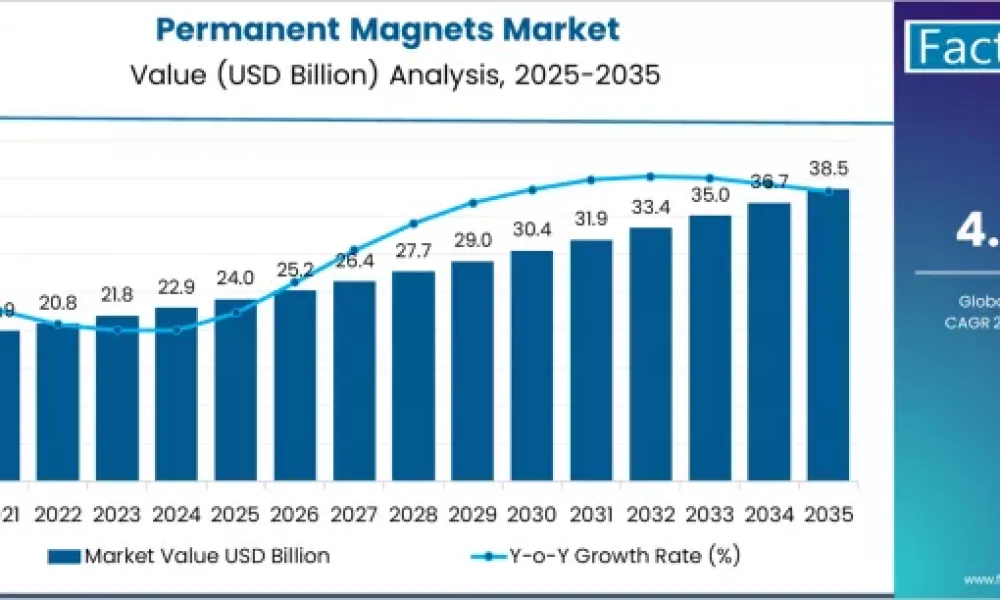
The global permanent magnet market is experiencing a period of accelerated demand, with industry valuations projected to climb from $56.8 billion in 2025 to $59.8 billion by the end of 2026. This steady growth, representing a compound annual growth rate (CAGR) of approximately 5.7%, is being fueled by the dual forces of global vehicle electrification and a historic expansion in renewable energy infrastructure.
As the backbone of high-efficiency motors and generators, permanent magnets—specifically Neodymium Iron Boron (NdFeB) variants—have become critical strategic assets for nations aiming to achieve carbon neutrality by mid-century.
Request for Sample Report | Customize Report |purchase Full Report – https://www.factmr.com/connectus/sample?flag=S&rep_id=4575
Market Dynamics: The Intersection of Mobility and Renewables
The 2026 market landscape is defined by the technical necessity of high-performance magnetic materials in the transition to a low-carbon economy:
- Automotive Electrification: The automotive sector remains the primary growth engine, commanding nearly 35% of the total market. With electric vehicle (EV) sales surging globally, the demand for NdFeB magnets for traction motors is expected to grow by 27% annually through 2030.
- Wind Energy Infrastructure: Offshore wind installations are driving a surge in the use of large-scale direct-drive generators. These systems rely on high-energy magnets to maximize power output while reducing mechanical complexity and maintenance costs.
- Miniaturization in Electronics: The consumer electronics segment continues to push for stronger magnetic fields in smaller footprints, essential for the next generation of smartphones, wireless wearables, and high-fidelity acoustic devices.
Strategic Regional Shifts and Supply Chain Resilience
In 2026, the geography of the permanent magnet industry is undergoing a significant reconfiguration as regions seek to “de-risk” their supply chains:
- Asia-Pacific Dominance: This region continues to lead the global market with a 75% share, underpinned by China’s control of roughly 92% of global rare earth refining. However, 2026 marks a turning point as significant localization efforts take root elsewhere.
- India’s Rare Earth Corridors: Following the Budget 2026 announcement, India is establishing dedicated “Rare Earth Corridors” in Odisha and Tamil Nadu. Backed by a $870 million incentive scheme, India aims to produce 6,000 metric tons of integrated magnets annually to reduce import dependency.
- North American & European Expansion: Driven by national security concerns, the U.S. and Europe are aggressively funding domestic mining and processing facilities, with a focus on recycling “short-loop” magnets to reclaim critical materials from end-of-life electronics.
Material Trends: From Rare Earths to Sustainable Alternatives
While NdFeB magnets dominate the value share (approx. 64%), 2026 is seeing increased innovation in alternative chemistries:
- NdFeB (Neodymium): Remains the “gold standard” for power density in EVs and robotics.
- Ferrite Magnets: Maintaining the highest volume of usage globally due to low cost and abundance, primarily in home appliances and low-end industrial motors.
- SmCo (Samarium Cobalt): Securing a specialized niche in aerospace and defense due to its unmatched thermal stability and resistance to demagnetization in extreme environments.
- Earth-Free Innovations: R&D is intensifying for “rare-earth-free” magnets to mitigate price volatility and environmental concerns associated with traditional mining.
“The permanent magnet market is no longer just a materials sector; it is a geopolitical benchmark,” says a leading industry analyst. “In 2026, the competitive advantage lies with companies that can secure raw material stability while innovating in grain-boundary diffusion to reduce heavy rare earth content.”
About the Permanent Magnet Market: Permanent magnets are materials that generate their own persistent magnetic field. They are indispensable components in modern technology, used in everything from medical MRI machines and industrial robotics to the sensors and motors that define 21st-century mobility and energy systems.
About Fact.MR
Fact.MR is a global market research and consulting firm, trusted by Fortune 500 companies and emerging businesses for reliable insights and strategic intelligence. With a presence across the U.S., UK, India, and Dubai, we deliver data-driven research and tailored consulting solutions across 30+ industries and 1,000+ markets. Backed by deep expertise and advanced analytics, Fact.MR helps organizations uncover opportunities, reduce risks, and make informed decisions for sustainable growth.



