
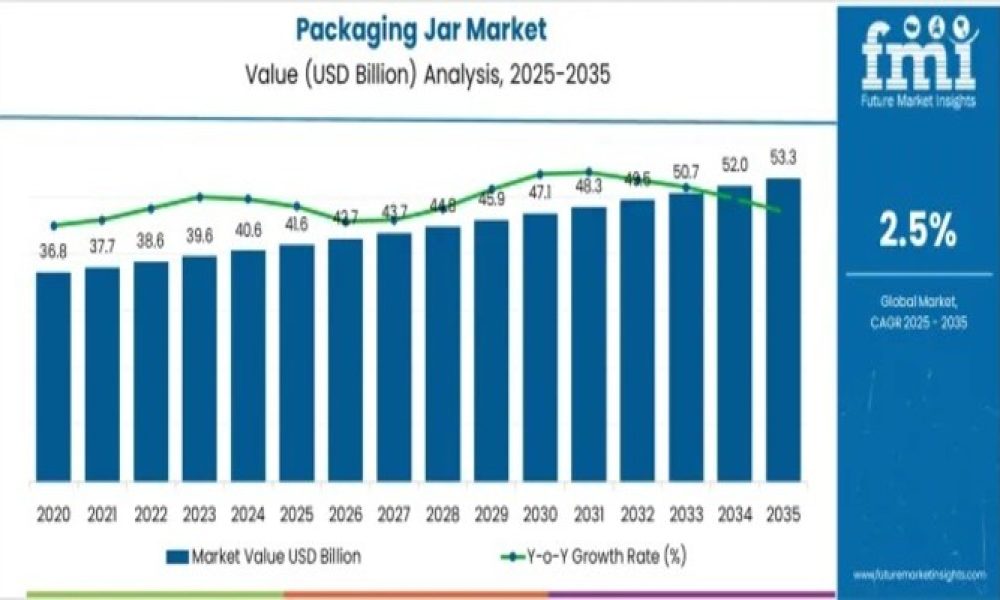
The global packaging jar market continues to evolve as brands and consumers place growing emphasis on convenience, hygiene, sustainability, and visual appeal. From food and beverages to cosmetics, pharmaceuticals, and homecare products, jars remain a preferred rigid packaging solution due to their durability, resealability, and premium presentation. Between 2025 and 2035, the market is expected to maintain steady expansion, supported by material innovation, e-commerce growth, and shifting consumer lifestyles.
Valued at USD 41.6 billion in 2025, the packaging jar market is projected to reach USD 53.3 billion by 2035, registering a CAGR of 2.5% during the forecast period.
Meaning and Market Scope
Packaging jars are rigid containers typically manufactured from plastic or glass, designed to store, protect, and preserve solid, semi-solid, or liquid products. Their wide-mouth structure allows easy access, portion control, and reusability, making them suitable for diverse end-use industries.
Discover Growth Opportunities in the Market – Get Your Sample Report Now
Key applications include:
- Food products such as sauces, jams, pickles, and spreads
- Cosmetics and personal care items like creams, balms, and lotions
- Pharmaceuticals and chemicals requiring contamination protection
- Homecare and specialty consumer products
Market Overview
The packaging jar industry operates at the intersection of functionality, branding, and sustainability. As urbanization and disposable incomes rise, particularly in emerging economies, demand for packaged and ready-to-use products continues to grow. Jars offer an ideal balance between protection and shelf visibility, enabling brands to enhance product differentiation.
Market highlights include:
- Plastic jars holding 53.2% market share in 2025
- Food packaging accounting for 41.3% of total demand
- Strong presence across North America, Europe, and Asia-Pacific
- Rising adoption in e-commerce-friendly packaging formats
Growth Drivers
Several structural factors are contributing to the long-term growth of the packaging jar market.
Major growth drivers include:
- Rising consumption of packaged and convenience foods
- Expansion of cosmetics and personal care industries
- Increased focus on hygiene, freshness retention, and contamination prevention
- Growth of organized retail and e-commerce platforms
- Customization and premium packaging trends
In addition, manufacturers are adopting automation and smart filling technologies to improve production efficiency while maintaining consistent quality.
Demand Analysis
Demand for packaging jars is shaped by evolving consumer behavior and regulatory expectations. Urban lifestyles, smaller household sizes, and on-the-go consumption patterns are driving the popularity of portion-controlled jars, particularly in the 51 to 250 ml capacity segment, which accounts for 35% of market revenue.
Key demand factors include:
- Preference for resealable and reusable packaging
- Growing demand for BPA-free and food-grade materials
- Increased consumption of organic, artisanal, and homemade food products
- Brand emphasis on transparency and product visibility
Food packaging remains the dominant end-use segment, as jars offer superior shelf life and compatibility with diverse food categories.
Key Market Trends
The packaging jar market is undergoing a transformation influenced by sustainability, design innovation, and material science advancements.
Notable trends shaping the industry:
- Shift toward recyclable plastics and lightweight glass alternatives
- Growing popularity of refillable and reusable jar designs
- Premiumization through unique shapes, textures, and labeling
- Rising use of mason jars and glass packaging for health-conscious consumers
- Adoption of bio-based closures and reduced wall-thickness designs
Gen Z and millennial consumers, in particular, are driving demand for eco-friendly and ethically produced packaging solutions.
Segment Insights
By Material: Plastic Jars
Plastic jars dominate the market due to their lightweight nature, durability, and cost efficiency. Their resistance to breakage makes them ideal for logistics-intensive applications such as e-commerce.
Plastic jar advantages include:
- Easy molding into customized shapes
- Lower transportation and handling costs
- Compatibility with recycled and BPA-free materials
- Convenience features like easy-open lids and resealability
By Capacity: 51 to 250 ml
This capacity range leads the market as it supports portion control, standardization, and reduced material usage, making it suitable for retail and personal care products.
By End Use: Food Packaging
Food packaging jars remain the largest revenue contributor, driven by rising demand for ready-to-eat meals, condiments, and preserved foods.
Regional Outlook
Regional growth patterns vary based on economic maturity, consumption habits, and regulatory frameworks.
Key regional insights include:
- United States: CAGR of 1.3%, driven by e-commerce and sustainable packaging demand
- India: Fastest growth at 4.6% CAGR, supported by population growth and FMCG expansion
- China: Strong demand growth at 4.2% CAGR
- United Kingdom: Innovation-led growth at 1.5% CAGR
India, in particular, presents lucrative opportunities as manufacturers introduce aesthetically appealing and sustainable jar designs aligned with government regulations on plastic reduction.
Competitive Landscape
The packaging jar market is moderately consolidated, with global and regional players competing through innovation, customization, and sustainability initiatives. Companies are expanding capacity, forming strategic partnerships, and investing in eco-friendly materials to strengthen market positioning.
Competitive strategies include:
- Product launches and design innovation
- Mergers and acquisitions to expand geographic reach
- Collaboration with brands for custom packaging solutions
- Investment in recyclable and bio-based materials
Leading companies such as Amcor, Berry Global, Ball Corporation, Silgan Holdings, and Gerresheimer AG continue to shape industry standards through advanced manufacturing and sustainable practices.
Why FMI: https://www.futuremarketinsights.com/why-fmi
About Future Market Insights (FMI)
Future Market Insights, Inc. (FMI) is an ESOMAR-certified, ISO 9001:2015 market research and consulting organization, trusted by Fortune 500 clients and global enterprises. With operations in the U.S., UK, India, and Dubai, FMI provides data-backed insights and strategic intelligence across 30+ industries and 1200 markets worldwide.



