
The inductive proximity sensors market is witnessing steady expansion as industries increasingly rely on non-contact sensing technologies for precision, safety, and efficiency. Inductive proximity sensors are widely used to detect metallic objects without physical contact, making them indispensable in harsh industrial environments. Their ability to operate reliably under dust, oil, vibration, and high temperatures positions them as a core component of modern automation systems.
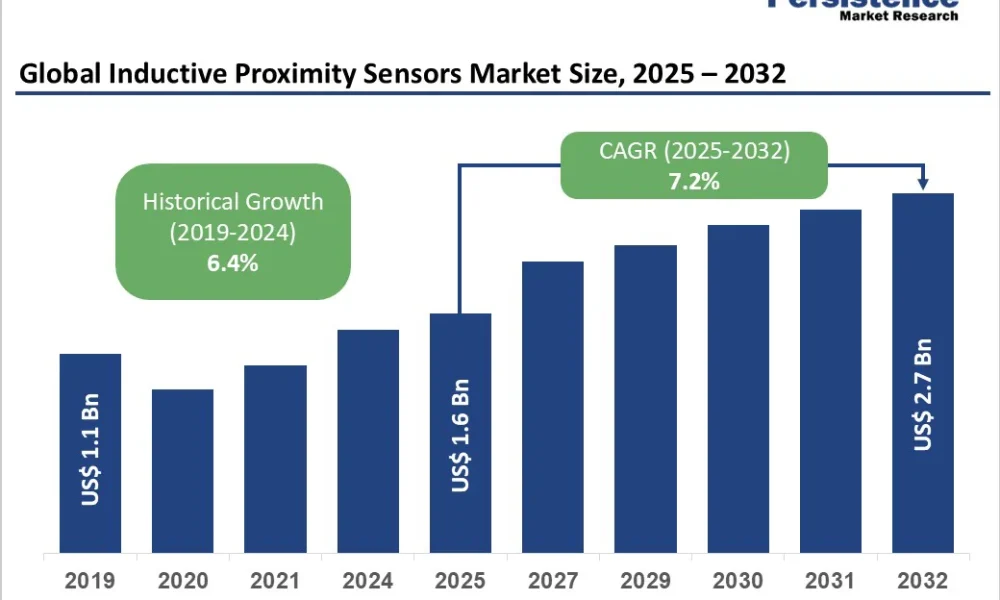
From a market size perspective, the global inductive proximity sensors market is valued at US$ 1.6 billion in 2025 and is projected to reach US$ 2.7 billion by 2032, growing at a CAGR of 7.2% during 2025–2032. Growth is primarily driven by rising automation in manufacturing, increased adoption of robotics, and the global shift toward Industry 4.0-enabled smart factories.
Market Statistics, Growth Drivers, and Leading Segments
Key growth drivers include expanding industrial automation, the rapid penetration of robotics in assembly lines, and the automotive industry’s transition toward electric vehicles. Inductive proximity sensors are critical in EV manufacturing for position detection, speed sensing, and torque monitoring. Additionally, demand from packaging, material handling, and semiconductor industries continues to strengthen the market outlook.
In terms of segmentation, cylindrical housing sensors dominate the market with nearly 43.5% share in 2025, owing to their flexibility in installation and suitability for rugged applications. Medium-range sensing devices lead the sensing range category, capturing about 46.3% market share, as they offer an optimal balance between detection accuracy and distance. Geographically, Asia Pacific leads the global market with a 39.2% share, supported by strong industrialization, government-backed smart manufacturing initiatives, and large-scale production hubs in China, Japan, and South Korea.
Key Highlights from the Inductive Proximity Sensors Market Report
- • The global market is projected to grow at a CAGR of 7.2% between 2025 and 2032.
- • Asia Pacific remains the leading region, accounting for over 39% of global demand.
- • Cylindrical housing sensors dominate due to installation flexibility and durability.
- • Medium-range inductive sensors are the most preferred sensing range globally.
- • Industrial machinery and robotics represent the largest end-user segment.
- • Continuous innovation in sensor ICs is enhancing accuracy and multifunctionality.
Inductive Proximity Sensors Market Segmentation Analysis
The inductive proximity sensors market is segmented based on product type, sensing range, housing type, and end-user industry. By product type, the market includes shielded (flush) and unshielded (non-flush) sensors. Shielded sensors are widely adopted in confined installations, while unshielded variants are preferred for longer detection distances, particularly in heavy industrial applications.
Based on end-user industries, industrial machinery and robotics account for the largest share, approximately 37.8% in 2025. These sensors enable real-time equipment monitoring, predictive maintenance, and automated quality control. Other key end users include automotive manufacturing, food and beverage processing, packaging, aerospace, and logistics, all of which increasingly depend on reliable metal detection for operational efficiency.
Regional Insights and Market Trends
Asia Pacific continues to dominate the inductive proximity sensors market, driven by aggressive industrial automation investments and government-led digital manufacturing programs. Countries such as China, Japan, and South Korea are investing heavily in smart factories, robotics, and advanced manufacturing infrastructure, which significantly boosts sensor demand.
North America is emerging as the fastest-growing region, supported by the modernization of legacy manufacturing facilities and the adoption of Industry 4.0 technologies. Europe maintains a strong presence due to its advanced automotive sector and focus on industrial safety and precision engineering, particularly in Germany and France.
Market Drivers Fueling Growth
One of the primary drivers of the inductive proximity sensors market is the rapid adoption of automation across industries. As manufacturers aim to improve productivity, reduce downtime, and enhance safety, the demand for reliable non-contact sensing solutions continues to rise. Inductive sensors play a critical role in detecting metallic components with high precision.
The global shift toward electric vehicles is another powerful growth catalyst. EV production requires advanced sensing solutions for motor control, battery assembly, and torque measurement. Additionally, the integration of robotics and AI-driven manufacturing systems further accelerates sensor deployment across production lines.
Market Restraints Impacting Adoption
Despite strong growth prospects, the inductive proximity sensors market faces certain challenges. One key restraint is the limited detection capability for non-metallic objects, which restricts usage in applications requiring multi-material sensing. This limitation often necessitates the integration of complementary sensor technologies, increasing system complexity and cost.
Another challenge is price sensitivity in developing economies, where cost constraints can limit the adoption of advanced sensor solutions. Small and medium-sized manufacturers may opt for lower-cost alternatives, slowing penetration in price-sensitive markets.
Elevate your business strategy with comprehensive market data. Request a sample report now: https://www.persistencemarketresearch.com/samples/23737
Market Opportunities and Future Outlook
The market presents significant opportunities with the growing adoption of smart factories and digital twins. As predictive maintenance and real-time monitoring gain importance, advanced inductive proximity sensors with embedded intelligence are expected to see strong demand. Integration with IoT platforms is opening new avenues for sensor-based analytics.
Additionally, innovation in sensor ICs and miniaturization is creating opportunities in compact and high-precision applications. Emerging sectors such as collaborative robotics, autonomous material handling, and renewable energy systems are expected to further expand the addressable market through 2032.
Reasons to Buy the Inductive Proximity Sensors Market Report
✔ Comprehensive market size and forecast analysis through 2032
✔ In-depth segmentation insights across product types and end-user industries
✔ Detailed regional analysis highlighting growth hotspots and trends
✔ Competitive landscape with key player strategies and innovations
✔ Actionable insights for investors, manufacturers, and technology providers
Frequently Asked Questions (FAQs)
How Big is the Inductive Proximity Sensors Market globally?
Who are the Key Players in the Global Market for Inductive Proximity Sensors?
What is the Projected Growth Rate of the Inductive Proximity Sensors Market?
What is the Market Forecast for Inductive Proximity Sensors for 2032?
Which Region is Estimated to Dominate the Industry through the Forecast Period?
Company Insights
Key players operating in the inductive proximity sensors market include:
- Siemens AG
- Rockwell Automation, Inc.
- Schneider Electric SE
- Omron Corporation
- IFM Electronic GmbH
- Pepperl+Fuchs GmbH
- Balluff GmbH
- SICK AG
Recent Developments:
In October 2025, Melexis launched a dual-input inductive sensor IC designed to simultaneously read signals from two coil inputs, enabling high-precision angle and torque measurement in advanced vehicle systems. Additionally, leading sensor manufacturers are increasingly investing in smart sensor platforms with embedded diagnostics to support predictive maintenance and Industry 4.0 integration.
Related Reports:




