
The global Thermal Insulation Material Market is poised for substantial growth, with an estimated market value of USD 83.3 billion in 2026, accelerating to USD 143.7 billion by 2036 at a strong compound annual growth rate (CAGR) of 5.6 % through the forecast period. This expansion is driven by rising demand for energy-efficient solutions in residential, commercial and industrial sectors, increased regulatory emphasis on energy conservation and heightened adoption of advanced insulation applications across global construction and industrial landscapes.
Key Market Insights at a Glance
Thermal insulation materials continue to gain traction due to their critical role in enhancing energy performance, reducing heat loss, and improving sustainability in building envelopes and industrial systems. The construction industry leads demand, accounting for approximately 58 % of global consumption as builders and developers prioritize thermal performance in new build and retrofit projects. Industrial applications also contribute significantly, especially in energy-intensive sectors such as power generation, petrochemical processing and manufacturing, where insulation supports process control and equipment protection.
Segment Overview
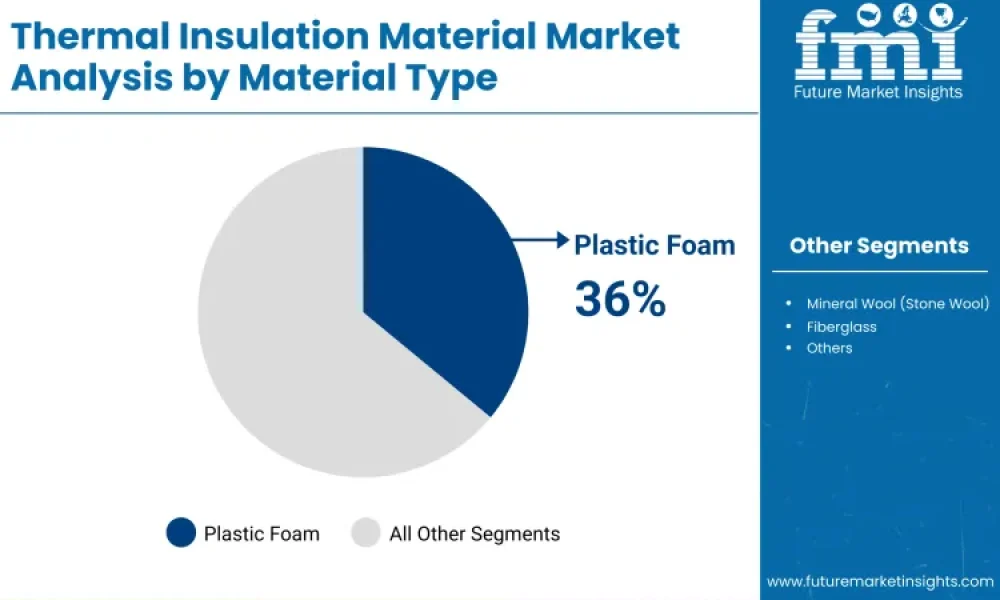
By material type, the market encompasses plastic foams (including expanded and extruded polystyrene, polyurethanes and polyisocyanurates), mineral wool (such as stone wool), fiberglass and advanced materials like aerogels and vacuum insulation panels. Each material segment offers unique advantages in thermal resistance, fire performance, moisture control and sustainability—which are critical to meeting stringent building codes and environmental standards. By end-use application, building and construction dominate, followed by industrial, HVAC and refrigeration, and transportation sectors.
Regional Overview
The Asia Pacific region emerges as the largest market, driven by rapid urbanization, infrastructure investments and expanding construction activity in countries such as China and India. Europe and North America also demonstrate robust demand, supported by energy efficiency mandates and retrofit initiatives for aging building stock. In Asia Pacific, building codes increasingly emphasize thermal performance, creating durable demand for high-performance insulation materials across both residential and commercial projects.
To access the complete data tables and in-depth insights, request a sample report here
Competitive Landscape
Market competition is anchored by several global leaders and innovative specialists. Major players include Owens Corning, Saint-Gobain, Kingspan Group, Rockwool International, BASF SE, Knauf Insulation, Johns Manville, Dow Inc. and Armacell International. These companies leverage global manufacturing footprints and invest in product development to enhance performance features—such as fire resistance, moisture management and eco-friendly compositions—that meet evolving market needs and regulatory requirements.
Market Outlook: Powering the Next Decade
Looking ahead, the thermal insulation material market is expected to continue its upward trajectory through 2036, propelled by the twin forces of global construction growth and sustainability imperatives. Increasingly stringent energy regulations and green building certifications are catalyzing demand for advanced insulation solutions that reduce thermal bridging and operational costs while contributing to carbon reduction targets. Additionally, innovation in material science—such as recyclable insulation products, smart thermal systems and materials tailored for specialized industrial environments—will shape new growth avenues.
Key Players of Sustainable Label Industry
As sustainability becomes central to procurement decisions, industry leaders are integrating eco-friendly practices across product portfolios. Companies are enhancing the environmental profile of their offerings through the use of recycled content, reductions in embodied carbon, and alignment with global sustainability frameworks. Increasing investment in low-VOC insulation materials and bio-based alternatives further underscores the shift toward greener construction.
Recent Strategic Developments
Recent strategic initiatives in the market include capacity expansions in high-growth regions, partnerships with construction technology providers, and targeted acquisitions to broaden geographic reach and product capabilities. Manufacturers are also strengthening distribution networks and technical support services, enabling faster adoption of high-performance insulation solutions in markets with stringent thermal performance requirements.
As global investment in infrastructure and green buildings continues to accelerate, the thermal insulation material market is uniquely positioned to deliver both economic value and environmental impact—fuelling energy efficiency and sustainability goals across industries worldwide.
Have a specific Requirements and Need Assistant on Report Pricing or Limited Budget please contact us – [email protected]
About Future Market Insights (FMI)
Future Market Insights, Inc. (FMI) is an ESOMAR-certified, ISO 9001:2015 market research and consulting organization, trusted by Fortune 500 clients and global enterprises. With operations in the U.S., UK, India, and Dubai, FMI provides data-backed insights and strategic intelligence across 30+ industries and 1200 markets worldwide.
Why Choose FMI: https://www.futuremarketinsights.com/why-fmi



