
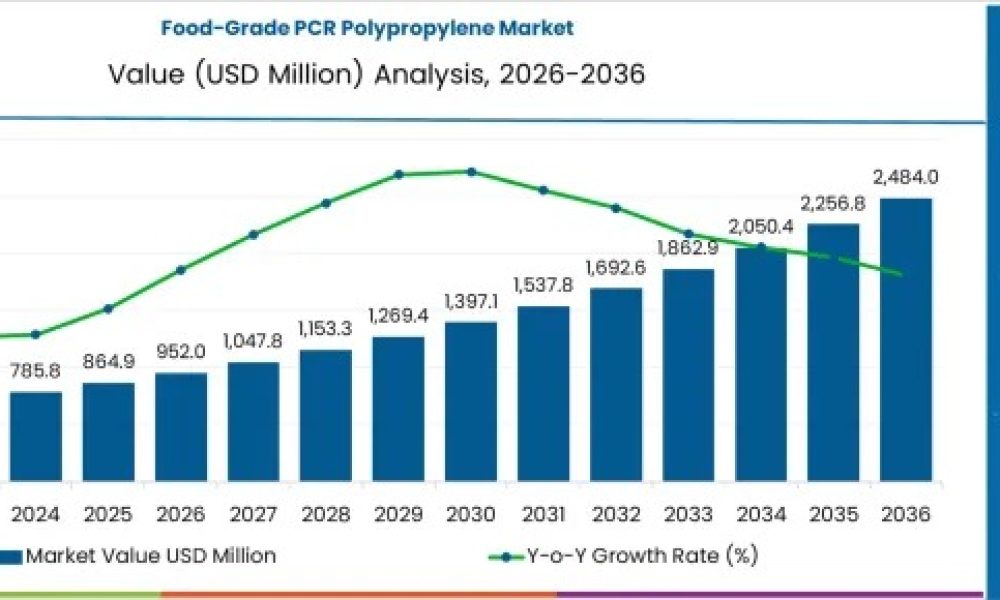
The global food-grade PCR polypropylene market is entering a decisive growth phase as sustainability commitments converge with regulatory certainty. Valued at USD 952 million in 2026, the market is projected to expand to USD 2,484 million by 2036, registering a robust 10.1% CAGR. Growth is underpinned by rising demand for FDA- and EFSA-approved recycled content in food-contact packaging, alongside rapid adoption of super-clean recycling, advanced melt filtration, and decontamination technologies that ensure product safety and material purity.
Food-grade PCR polypropylene is no longer a niche sustainability experiment. It is becoming a structural material choice across food containers, closures, dairy packaging, ready meals, and value food packs. As global food brands face increasing pressure to meet recycled content mandates without compromising safety, PCR-PP is gaining acceptance as a compliant, scalable alternative to virgin polymers.
Explore trends before investing – request a sample report today!
Market Growth Trajectory Reflects Structured Adoption
Between 2026 and 2031, the market is expected to grow from USD 952 million to approximately USD 1,428 million, marking an early adoption phase. During this period, annual value additions rise from USD 57 million to USD 112 million, driven by pilot programs and selective commercial deployment. North America and Europe account for nearly 65% of market value, as brands validate optical clarity, migration safety, and compatibility with thermoforming, injection molding, and blow molding.
From 2031 to 2036, growth accelerates sharply. Market value increases from USD 1,428 million to USD 2,484 million, with annual increments reaching USD 174 million. This late adoption phase reflects portfolio-wide integration, repeat procurement, and normalization of food-grade PCR polypropylene across mass-market food packaging and consumer product lines. Regulatory mandates for recycled content and standardized approval pathways reinforce long-term demand visibility.
Demand Shifts Driven by Compliance, Not Availability
Historically, PCR polypropylene use in food-contact applications was constrained by contamination risks, inconsistent polymer properties, and uncertain traceability. Early demand was limited to pilot trials, often requiring blending with virgin resin to meet safety thresholds. Cost inefficiencies and uneven compliance restricted scale.
Today, demand dynamics have fundamentally changed. Food safety authorities now define clear compliance frameworks covering decontamination efficiency, input stream control, and migration testing. Compounders and recyclers have aligned processes accordingly, enabling PCR polypropylene to achieve food-grade status consistently. Demand growth is increasingly driven by procurement mandates, circular economy commitments, and documented compliance, rather than voluntary sustainability claims.
End-Use and Packaging Formats Shape Market Structure
Food containers and closures represent the largest end-use segment, accounting for approximately 42% of total demand. These applications require consistent material quality, repeatability, and audit-ready traceability.
By packaging format, demand is concentrated in familiar, high-volume components:
- Tubs, lids, and caps dominate with a 45% share, widely used in dairy, spreads, and prepared foods.
- Thermoformed containers scale gradually where clarity and thickness control meet compliance standards.
- Rigid food packs and small containers adopt selectively due to cost and appearance sensitivity.
Once food safety validation is completed, packaging formats rarely change, resulting in stable, predictable demand patterns rather than rapid design-driven shifts.
Regional Growth Anchored in Regulation and Infrastructure
Growth rates vary by country based on recycling maturity, food safety enforcement, and packaging demand:
- India (12.5% CAGR) leads growth, supported by expanding urban consumption, recycling investments, and sustainability initiatives.
- China (11.5%) follows, driven by large-scale food packaging production and integrated PCR supply chains.
- USA (8.6%) shows steady expansion through regulated adoption in food and beverage packaging.
- Brazil (8.0%) and Germany (7.8%) grow through structured recycling systems and compliance-driven procurement.
Mature markets emphasize risk management and regulatory assurance, while emerging markets combine volume growth with expanding recycling capacity.
Competitive Landscape Defined by Regulatory Pathways
Competition in the food-grade PCR polypropylene market is shaped less by scale and more by regulatory acceptance and feedstock control.
- PureCycle differentiates itself through purification-based recycling capable of meeting direct food-contact approvals.
- Mitsui Chemicals and Borealis influence adoption through polymer science, additive compatibility, and food-grade specification support.
- Braskem advances circular polymer initiatives with controlled material performance.
- ALPLA, Berry Global, Kingfa, and Manjushree drive downstream adoption by validating PCR-PP at the finished packaging level.
Traceability, audit readiness, and consistency across production lots define competitive advantage more than pricing leverage.
To Access The Full Market Analysis, Strategic Recommendations, And Analyst Support, Purchase The Complete Report Here.
Outlook: Compliance-Driven Growth with Long-Term Visibility
Food-grade PCR polypropylene is transitioning from selective deployment to mainstream integration in regulated food packaging. As approval pathways mature and recycling technologies scale, the material is positioned to deliver sustained growth through 2036, anchored in safety, compliance, and circular material economics.
About Future Market Insights (FMI)
Future Market Insights, Inc. (FMI) is an ESOMAR-certified, ISO 9001:2015 market research and consulting organization, trusted by Fortune 500 clients and global enterprises. With operations in the U.S., UK, India, and Dubai, FMI provides data-backed insights and strategic intelligence across 30+ industries and 1,200 markets worldwide.



