
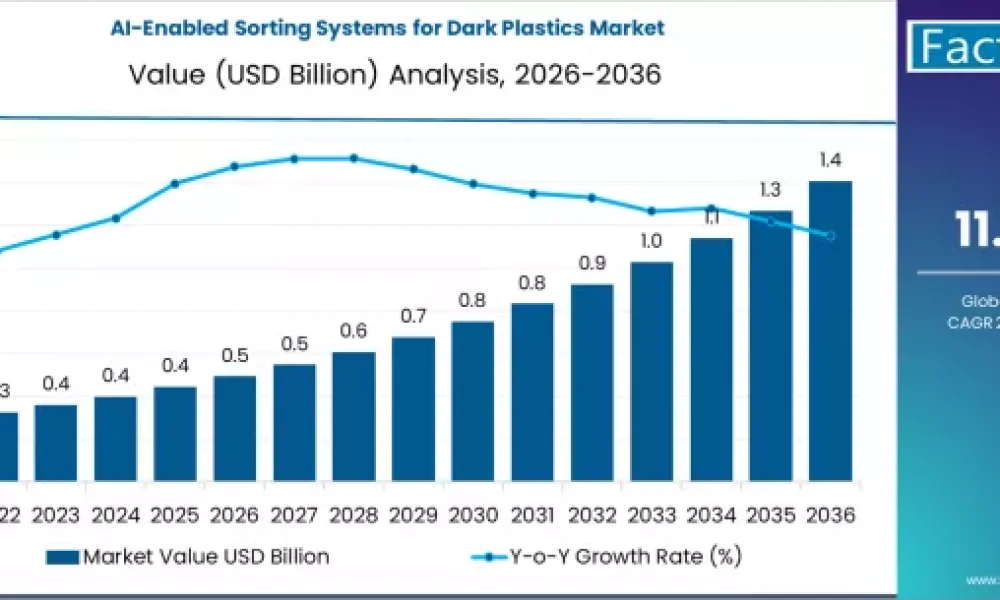
The global AI-Enabled Sorting Systems for Dark Plastics Market is projected to expand significantly through 2036 as demand for more efficient, automated plastic recycling solutions rises. Dark plastics — often used in packaging, automotive parts, electronics housings, and industrial applications — have historically been difficult to detect and sort using traditional near-infrared (NIR) systems due to their light-absorbing properties. AI-enabled sorting systems, combining artificial intelligence, machine vision, and advanced sensor technologies, overcome these limitations by accurately identifying, classifying, and separating dark plastic materials. This capability helps recycling facilities improve recovery rates, produce higher-quality recycled resins, and drive more sustainable circular economy outcomes.
Growing regulatory pressure for increased recycling rates, rising corporate sustainability commitments, and the need to reduce environmental impact from plastic waste are driving investment in intelligent recycling infrastructure. AI-enabled systems support these objectives by enabling automated, high-speed, precise sorting that reduces manual labor, minimizes contamination, and enhances overall process efficiency in materials recovery facilities.
Market Outlook (2026–2036)
Market Value in 2026: Approximately USD 0.65 Billion
Market Value in 2036: Around USD 2.1 Billion
Forecast CAGR (2026–2036): About 12.5%
Key Technology: Machine Vision with Deep Learning Algorithms
Primary End Users: Materials Recovery Facilities, Plastics Recyclers, Waste Management Providers
The robust forecasted growth reflects increasing adoption of AI-based sorting to address recycling challenges posed by multi-material and dark plastic waste streams, as well as the expanding global emphasis on sustainable materials management.
To Access the Complete Data Tables & in-depth Insights, Request a Discount on this report: https://www.factmr.com/connectus/sample?flag=S&rep_id=13484
Market Overview
Dark plastics are difficult to sort with conventional optical technologies because they absorb the wavelengths typically used in NIR detection, leading to lower recovery rates and higher contamination in recycled plastic streams. AI-enabled sorting systems overcome this by integrating advanced machine vision, deep learning models, and multi-sensor configurations — such as hyperspectral imaging, structured light, and high-resolution cameras — to learn and distinguish the visual and spectral signatures of dark plastics.
These systems are capable of real-time classification and high-speed separation, directing dark plastic fractions accurately for further processing. As a result, recycling operations can achieve improved purity in sorted bales, higher throughput, and better end-product quality, increasing economic viability.
Key Market Drivers
1. Regulatory and Policy Push on Plastic Recycling
Governments worldwide are strengthening recycling mandates, extended producer responsibility frameworks, and waste diversion targets. These policies create momentum for advanced sorting technologies that can meet increasingly ambitious recovery and material quality requirements.
2. Corporate Sustainability Initiatives
Brand owners and manufacturers are committing to higher recycled content targets and reduced plastic footprint goals. AI-enabled sorting systems help recyclers deliver cleaner, more consistent recycled resins that meet specifications for reuse in consumer and industrial products.
3. Technological Advancements in AI and Imaging
Ongoing improvements in artificial intelligence, machine learning algorithms, and imaging sensor technologies are increasing the accuracy, speed, and adaptability of sorting systems. These enhancements make deployment more cost-effective and scalable across facilities of varying sizes.
4. Expansion of Recycling Infrastructure
Investment in modern materials recovery facilities and upgrades to existing sorting lines is expanding globally in response to rising waste volumes and industry commitments to circular economy principles. AI-driven sorting is increasingly viewed as a core component of future-proof recycling infrastructure.
Market Segmentation Insights
By Technology Type:
Machine Vision with Deep Learning Classification – Enables adaptive identification of dark plastics based on learned features.
Hyperspectral Imaging Systems – Captures spectral signatures across a wide range of wavelengths for precise material discrimination.
3D Imaging and Structured Light Sorting – Adds geometric analysis to support material classification.
Sensor Fusion Platforms – Integrates multiple sensing modalities for enhanced accuracy.
Robotic Diverter Integration – High-speed mechanical systems that act on AI classification outputs for automated separation.
By Application:
Post-Consumer Packaging Sorting
Post-Industrial Recycling Streams
Automotive Plastics Recovery
Electronics and E-Waste Plastics Separation
Specialty and Mixed Waste Sorting
By End User:
Materials Recovery Facilities (MRFs)
Plastics Recycling Companies
Waste Management Service Providers
Industrial Sorting Service Providers
Municipal and Regional Recycling Programs
Regional Demand Dynamics
North America is expected to hold a significant share of the market due to strong regulatory frameworks, high recycling standards, and early adoption of intelligent recycling technologies. Investments by both private and public sectors in modern waste processing infrastructure continue to boost demand for advanced sorting solutions.
Europe remains a major regional market, supported by comprehensive circular economy policies, stringent waste diversion targets, and proactive industry initiatives aimed at improving recycled content quality. Advanced regulations and producer responsibility schemes encourage deployment of AI-enabled sorting across recycling networks.
Asia Pacific is poised to register rapid growth as increasing urbanization, rising plastic consumption, and expanding recycling infrastructure drive adoption. Governments in key markets are promoting technology upgrades and sustainability programs that support intelligent sorting solutions.
Emerging growth is also visible in Latin America and Middle East & Africa, where waste management modernization and increased environmental awareness lead to incremental investment in advanced recycling technologies.
Competitive Landscape
The AI-enabled sorting systems for dark plastics market is moderately competitive, with participation from robotics and automation firms, sensor and imaging technology providers, software developers specializing in AI and machine learning, and full-service recycling technology integrators. Companies are focusing on enhancing AI model accuracy, reducing capital and operating costs, and expanding support for integration with existing sorting lines.
Strategic alliances, partnerships with recycling operators, and pilots with industry consortia are helping vendors validate performance and accelerate commercial deployment. Continuous innovation in embedded analytics, remote performance monitoring, and automated calibration tools further strengthens competitive positioning.
Future Outlook
The AI-Enabled Sorting Systems for Dark Plastics Market is expected to maintain strong momentum through 2036 as recycling stakeholders seek to improve material recovery rates, reduce environmental impact, and achieve circular economy goals. Continued advancements in artificial intelligence, imaging technologies, and automation will further enhance system capabilities, enabling wider adoption across diverse waste streams.
As industry focus intensifies on cleaner material streams and higher-value recycled products, AI-driven sorting solutions will play a critical role in transforming plastic recycling — particularly for challenging material fractions such as dark plastics — and supporting sustainable manufacturing and consumption models worldwide.
Have specific requirements or need assistance on report pricing or have a limited budget? Please contact [email protected]
About Fact.MR:
Fact.MR is a global market research and consulting firm, trusted by Fortune 500 companies and emerging businesses for reliable insights and strategic intelligence. With a presence across the U.S., UK, India, and Dubai, we deliver data-driven research and tailored consulting solutions across 30+ industries and 1,000+ markets. Backed by deep expertise and advanced analytics, Fact.MR helps organizations uncover opportunities, reduce risks, and make informed decisions for sustainable growth



