
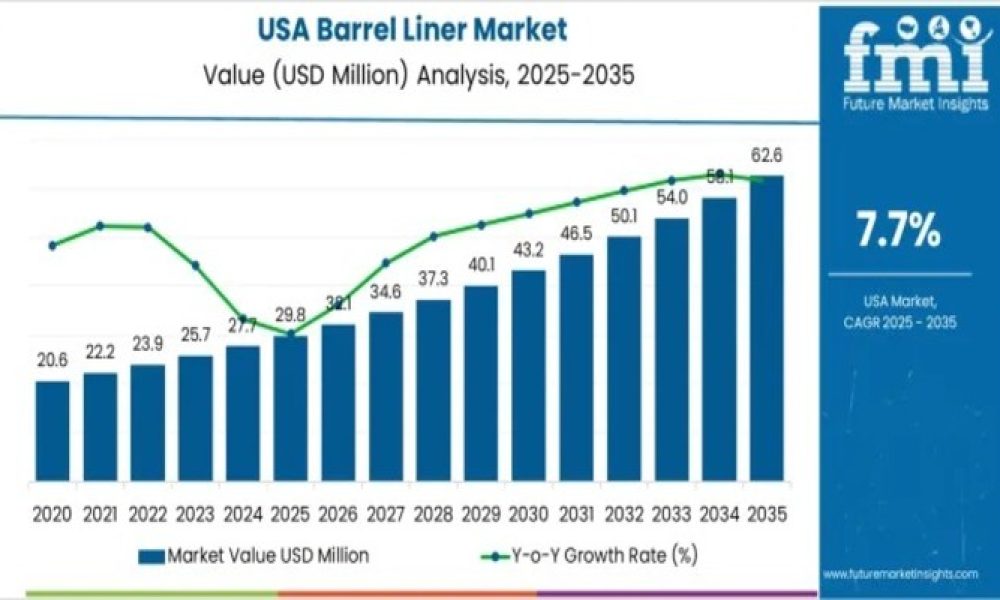
The demand for barrel liners in the United States is entering a decade of steady and structurally supported growth, reflecting deeper shifts in industrial packaging, regulatory compliance, and bulk material logistics. Valued at USD 29.8 million in 2025, the U.S. barrel liner market is projected to more than double to USD 62.6 million by 2035, expanding at a compound annual growth rate (CAGR) of 7.7%. This upward trajectory highlights the essential role barrel liners play in contamination control, moisture protection, and safe handling across a wide range of industrial and regulated end-use sectors.
Early-Stage Growth Anchored in Regulated Industries
During the first half of the forecast period, growth in barrel liner demand is primarily production-driven. Increasing use in chemical processing, food ingredients, pharmaceutical intermediates, nutraceuticals, and hazardous material transport has elevated liners from optional packaging accessories to core safety infrastructure. Industries dealing with powders, semi-liquids, corrosive substances, and sensitive formulations rely on liners to prevent direct contact between barrel walls and contents, reducing contamination risks and extending container usability.
Discover Growth Opportunities in the Market – Get Your Sample Report Now
Specialty chemicals and nutraceutical ingredients are emerging as particularly strong demand centers. In these segments, purity standards, shelf-life stability, and traceability requirements are tightly regulated, making single-use or high-integrity liners a preferred solution. Polyethylene-based liners, especially high-density polyethylene (HDPE), dominate the market due to their balance of chemical resistance, mechanical strength, and cost efficiency. Contract packaging firms and industrial distributors remain the primary demand channels in this phase, supporting steady year-on-year value accumulation.
Post-2030: Logistics-Led Expansion Takes Over
After 2030, barrel liner demand in the USA becomes increasingly logistics-driven rather than production-driven. Market value is expected to rise from approximately USD 43.2 million in 2030 to USD 62.6 million by 2035, supported by growing bulk handling volumes in agrochemicals, resins, specialty additives, and bio-based chemicals. Export-oriented manufacturers are expanding liner usage to minimize cross-batch contamination risks during long-distance and international shipments.
Pharmaceutical and biotechnology sectors further strengthen demand through higher compliance standards for sterile, low-extractable, and high-barrier packaging. To meet these evolving requirements, suppliers are investing in multilayer film constructions, antistatic properties, and tighter dimensional consistency, enabling seamless integration with automated drum and barrel filling lines. Regulatory scrutiny, higher material traceability expectations, and the outsourcing of bulk packaging operations across the USA continue to underpin long-term growth.
Quick Stats: U.S. Barrel Liner Market Outlook
- Market Value (2025): USD 29.8 million
- Forecast Value (2035): USD 62.6 million
- Forecast CAGR (2025–2035): 7.7%
- Leading Material: High-Density Polyethylene (34% share)
- Dominant Packaging Type: Flexible Barrel Liners (51.0% share)
- Key Growth Regions: West, South, Northeast, Midwest
Material and Packaging Trends Reshaping Demand
Material choice remains central to barrel liner performance. HDPE leads with a 34% share, followed by low-density polyethylene (LDPE), linear low-density polyethylene (LLDPE), metallocene polyethylene, and ethylene vinyl acetate (EVA). HDPE’s dominance reflects its high tensile strength, low moisture permeability, and reliable performance under variable temperature conditions, making it suitable for solvents, acids, viscous liquids, and powders.
By packaging type, flexible barrel liners account for 51.0% of total usage. Their popularity stems from ease of installation, compatibility with standard steel, fiber, and plastic drums, and space efficiency during storage and transport. Flexible liners also reduce residue during discharge, simplify sanitation between batches, and lower freight and inventory costs—critical advantages for food ingredients, resins, agrochemicals, and specialty powders.
Regional Growth Patterns Across the USA
Barrel liner demand shows a clear regional gradient:
- West (8.8% CAGR): Driven by chemical processing, food ingredients, pharmaceuticals, port-based logistics, and export-oriented industries.
- South (7.9% CAGR): Supported by large-scale food processing, agricultural chemicals, resin manufacturing, and humidity-driven barrier protection needs.
- Northeast (7.1% CAGR): Anchored in pharmaceutical production, specialty chemicals, and high-specification packaging requirements under strict regulatory oversight.
- Midwest (6.2% CAGR): Characterized by stable demand from agricultural chemicals, food ingredients, industrial resins, and predictable manufacturing cycles.
Sustainability and Technology as Strategic Differentiators
Sustainability considerations are increasingly shaping product development. Manufacturers are focusing on thinner-gauge, high-strength films, recyclable mono-material liners, and precision-fit designs that reduce plastic usage without compromising performance. Antistatic and conductive liners are gaining traction for fine powders and flammable materials, while form-fit and gusseted-bottom liners improve filling efficiency and reduce material loss. These innovations position barrel liners as engineered components within more sustainable bulk packaging systems rather than disposable consumables.
Competitive Landscape: Established Leaders and Emerging Innovators
The U.S. barrel liner market benefits from a balanced mix of established manufacturers and specialized innovators:
Key Players in the Barrel Liners Industry in the USA
- Greif, Inc.
- Berry Global Inc.
- Protective Lining Corp.
- CDF Corporation
- International Plastics, Inc.
Large players such as Greif and Berry Global leverage extensive film manufacturing capabilities and national distribution networks to serve high-volume and high-barrier applications. Specialized firms like Protective Lining Corp. and CDF Corporation focus on heavy-duty, chemical-resistant, and hazardous material liners, while International Plastics addresses general-purpose and food-grade requirements. Together, these companies are expanding capacity, forming new technologies, and enabling both established and emerging manufacturers to scale their bulk packaging operations efficiently.
Why FMI: https://www.futuremarketinsights.com/why-fmi
About Future Market Insights (FMI)
Future Market Insights, Inc. (FMI) is an ESOMAR-certified, ISO 9001:2015 market research and consulting organization, trusted by Fortune 500 clients and global enterprises. With operations in the U.S., UK, India, and Dubai, FMI provides data-backed insights and strategic intelligence across 30+ industries and 1200 markets worldwide.



