
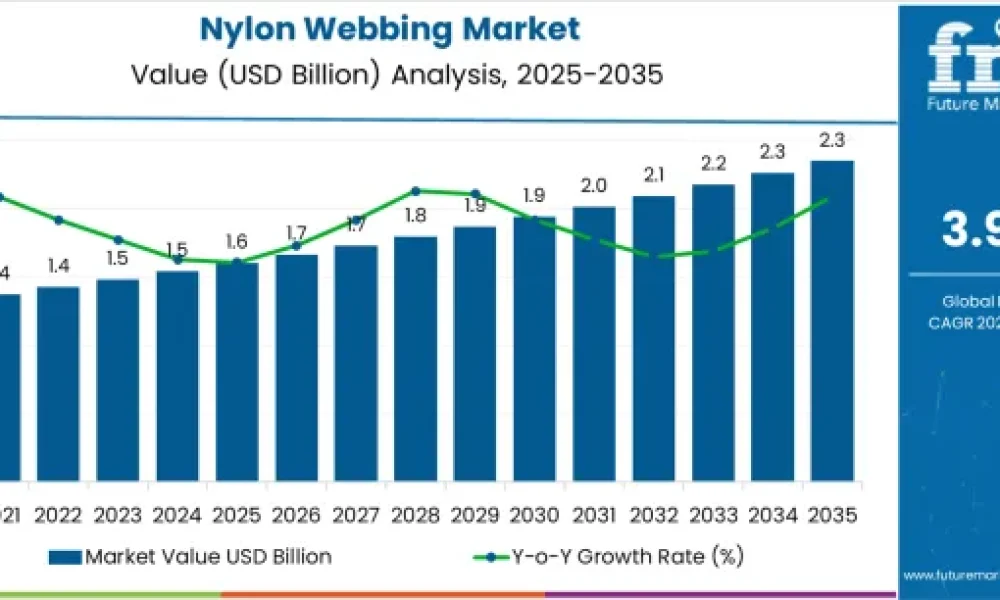
The Nylon Webbing Market is projected to expand from approximately USD 1.6 billion in 2025 to USD 2.3 billion by 2035, representing a robust compound annual growth rate through the decade ahead. This growth trajectory reflects escalating demand for high-performance webbing solutions across automotive, industrial safety, and outdoor equipment applications, underscored by technological advancements in textile engineering and heightened safety compliance standards.
Key Market Insights at a Glance reveal that nylon webbing continues to gain traction due to its tensile strength, abrasion resistance, and versatility, making it a core component in seat belts, harness systems, cargo restraints, and recreational gear. With the automotive sector alone contributing a significant portion of current demand, evolving requirements for lighter, stronger, and more reliable components are catalyzing market expansion across advanced manufacturing hubs globally.
As industrial and consumer expectations rise, manufacturers are innovating through enhanced weaving processes and specialized coatings that improve performance under extreme conditions. These advancements are increasingly important as end-use industries, including transportation and safety equipment providers, emphasize product reliability and lifecycle durability.
Segment Overview
The nylon webbing market encompasses a diverse range of product formats and applications. Flat webbing holds a commanding position due to its widespread use in automotive safety systems, outdoor gear, and industrial lifting equipment. In contrast, tubular webbing remains vital for load-bearing and fall-protection applications where flexibility and strength convergence are essential.
From an application standpoint, automotive continues to dominate, capturing the largest share of consumption as manufacturers adopt nylon webbing to meet stringent safety standards and performance benchmarks. Outdoor and recreational equipment manufacturers are ramping up usage of high-strength webbings in backpacks, camping gear and adventure sports equipment. Safety and rescue gear segments are also witnessing consistent growth as industrial safety regulations tighten worldwide.
Regional Overview
Geographically, Asia Pacific stands as the fastest expanding region, propelled by surging automotive production and expanding manufacturing capacities in China, India, and Southeast Asia. European markets maintain steady adoption, driven by premium automotive OEMs and rigorous safety compliance frameworks, while North America continues to invest in advanced production technologies and webbing integration within modern assembly lines.
Emerging markets across Latin America and the Middle East & Africa are also showing signs of accelerated adoption, buoyed by infrastructure development and increased foreign investment in manufacturing sectors. These regions are expected to contribute incremental growth as demand for high-performance textiles becomes more widespread.
To access the complete data tables and in-depth insights, request a sample report here
Competitive Landscape
The competitive environment in the nylon webbing market features a mix of global leaders and specialized manufacturers. A few established players collectively hold a meaningful share of revenue, leveraging broad distribution networks, deep technical expertise, and strong brand equity. Market leaders focus on expanding product portfolios through R&D investments that enhance webbing performance characteristics and support integration with automated production systems.
Innovation remains a central theme in differentiation strategies, with leading companies prioritizing advanced materials, quality certification programs, and responsive customer service offerings that address the evolving needs of OEMs and end-users. Mid-tier and emerging players are capitalizing on niche product segments and regional demand hotspots to increase competitive presence.
Market Outlook: Powering the Next Decade
The nylon webbing market outlook through 2035 is anchored in steady demand growth underpinned by broad industrialization and enhanced performance requirements across key end-use sectors. Decade-long momentum will likely be supported by accelerated adoption of smart textile integrations, such as webs embedded with sensor technologies for real-time performance monitoring and condition-based safety protocols.
Automotive electrification trends are also expected to influence nylon webbing applications, as lightweight materials align with efficiency goals in electric vehicle design. In parallel, the safety equipment sector will continue to emphasize high-strength, compliant solutions for occupational and recreational contexts. Sustainability will gain strategic importance as material sourcing and lifecycle impacts become integral to procurement decisions.
Additionally, digital manufacturing technologies and Industry 4.0 adoption will streamline production workflows, reduce lead times, and enhance customization capabilities, enabling manufacturers to rapidly respond to dynamic market requirements.
Key Players of Nylon Webbing Industry
Leading stakeholders in the global nylon webbing market include a mix of longstanding textile and webbing specialists. These companies are recognized for their technical capabilities, comprehensive product lines, and global distribution infrastructures. Competitive positioning is increasingly determined by innovation, quality assurance, and the ability to scale solutions across multiple regional markets.
Recent Strategic Developments in the market demonstrate continued investments in capacity expansions, partnerships with automotive OEMs, and accelerated deployment of performance testing facilities. Strategic collaborations that combine material science expertise with textile engineering are unlocking new growth avenues, particularly in high-end and safety-critical applications.
Have a specific Requirements and Need Assistant on Report Pricing or Limited Budget please contact us – [email protected]
About Future Market Insights (FMI)
Future Market Insights, Inc. (FMI) is an ESOMAR-certified, ISO 9001:2015 market research and consulting organization, trusted by Fortune 500 clients and global enterprises. With operations in the U.S., UK, India, and Dubai, FMI provides data-backed insights and strategic intelligence across 30+ industries and 1200 markets worldwide.
Why Choose FMI: https://www.futuremarketinsights.com/why-fmi



