
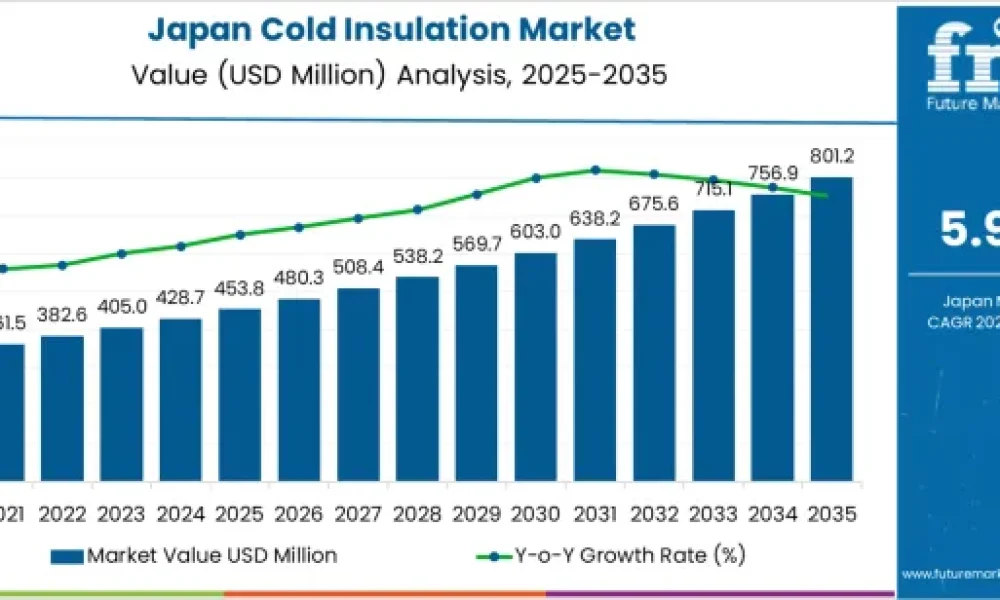
The Japan cold insulation market is projected to increase from an estimated USD 453.8 million in 2025 to approximately USD 801.2 million by 2035, reflecting a sustained growth trajectory driven by the expansion of cold-chain logistics, rising industrial energy efficiency requirements, and continued investment in low-temperature infrastructure. The market is expected to grow at a CAGR of about 5.9 percent over the forecast period as Japan strengthens regulatory standards for energy conservation and modernizes thermal systems across manufacturing, refrigeration, and cryogenic operations.
Key Market Insights at a Glance
Market growth is primarily supported by demand from food storage and distribution, pharmaceuticals, industrial refrigeration, and chemical processing, where precise temperature control is essential for safety and operational reliability. Polyurethane foam remains the leading cold-insulation material due to its strong thermal resistance and durability, accounting for the largest material share in Japan’s market. The oil and gas and industrial processing sectors continue to represent a major share of end-use demand, supported by increased maintenance, retrofitting, and performance optimization of temperature-sensitive equipment.
Segment Overview
The market is structured across material, application, and end-use categories that reflect Japan’s diversified industrial landscape. Polyurethane foam leads material demand, followed by fiberglass, phenolic foam, polystyrene foam, and specialty insulation designed for cryogenic environments. Key application areas include HVAC systems, industrial refrigeration, chilled water pipelines, cryogenic storage, and low-temperature process equipment. End-use industries such as oil and gas, chemicals, food and beverage, pharmaceuticals, power generation, commercial construction, and logistics collectively reinforce stable, multichannel market growth as facilities upgrade insulation for efficiency and system longevity.
Regional Overview
Regional market performance varies according to industrial density, infrastructure investment, and climatic conditions. Kyushu and Okinawa are witnessing the fastest growth as large-scale industrial and logistics projects integrate energy-efficient cold systems. The Kanto region maintains a significant market share supported by major urban, commercial, and logistics centers that rely heavily on cold storage and temperature-controlled facilities. Kinki and Chubu continue to record steady growth linked to manufacturing expansion and warehousing networks, while northern regions show consistent adoption through agricultural storage and regional industrial operations.
To access the complete data tables and in-depth insights, request a sample report here
Competitive Landscape
The competitive environment features leading global and domestic insulation material manufacturers specializing in high-performance thermal products for low-temperature and cryogenic conditions. Market participants are focused on enhancing moisture resistance, lowering thermal conductivity, and improving long-term structural stability under fluctuating temperatures. Companies are strengthening value propositions through localized technical support, engineered system design assistance, and solutions tailored to the demanding reliability requirements of Japanese industrial facilities.
Market Outlook: Powering the Next Decade
Over the coming decade, the market is expected to benefit from tighter sustainability mandates, lifecycle cost optimization initiatives, and modernization of aging cold-storage and processing infrastructure. Growth opportunities are also emerging in hydrogen energy projects, LNG handling, precision manufacturing, and pharmaceutical storage, where advanced insulation is critical for safety and energy performance. Innovations in foam chemistry, eco-efficient formulations, and high-density composite materials are expected to extend application scope and improve operational efficiency across next-generation low-temperature systems.
Key Players of the Sustainable Insulation Industry
Key companies participating in Japan’s cold insulation sector include major multinational chemical and materials manufacturers alongside specialized insulation system providers. These organizations are investing in sustainable product development, lightweight and low-emission material technologies, and service-based engineering support models that help industrial operators meet performance, regulatory, and decarbonization objectives.
Recent Strategic Developments
Recent industry activity includes capacity expansion for insulation material production, collaboration between material suppliers and engineering contractors on large infrastructure projects, and enhanced distribution networks to support regional demand growth. Manufacturers are also prioritizing product lines aligned with environmental compliance targets and lifecycle efficiency metrics, reflecting Japan’s broader industrial sustainability transition.
Have a specific Requirements and Need Assistant on Report Pricing or Limited Budget please contact us – [email protected]
About Future Market Insights (FMI)
Future Market Insights, Inc. (FMI) is an ESOMAR-certified, ISO 9001:2015 market research and consulting organization, trusted by Fortune 500 clients and global enterprises. With operations in the U.S., UK, India, and Dubai, FMI provides data-backed insights and strategic intelligence across 30+ industries and 1200 markets worldwide.
Why Choose FMI: https://www.futuremarketinsights.com/why-fmi



