
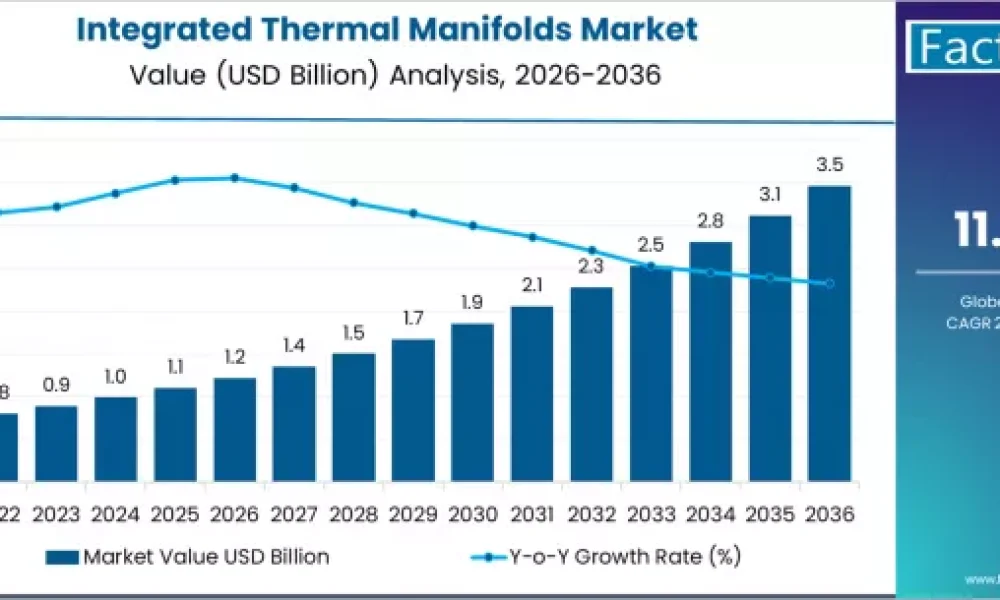
The integrated thermal manifolds market is poised for strong growth over the next decade as industries increasingly adopt advanced thermal management solutions to support compact electronics, electrified powertrain systems, and high-efficiency energy systems. In 2025, the integrated thermal manifolds market is valued at USD 2.4 billion, and it is projected to reach USD 6.8 billion by 2035, reflecting an absolute increase of USD 4.4 billion over the forecast period. This growth represents a compound annual growth rate (CAGR) of approximately 10.8% between 2025 and 2035, supported by rising integration of thermal solutions in electric vehicles (EVs), renewable energy systems, data centers, and industrial processes.
Integrated thermal manifolds, which combine fluid channels, heat exchangers, and structural support into compact, multi-functional components, are becoming essential in applications requiring efficient heat transfer, reduced system complexity, and improved energy efficiency. These systems help manage temperature fluctuations, improve reliability, and optimize performance in demanding thermal environments.
Quick Market Snapshot (2025–2035)
Market Value (2025): USD 2.4 billion
Market Forecast Value (2035): USD 6.8 billion
Market Forecast CAGR: 10.8%
Primary End Uses: Electric Vehicles, Data Centers, Industrial Machinery
Leading Material Types: Aluminum and Copper Alloys
Key Regions: North America, Europe, Asia Pacific
Primary Drivers: Electrification of transportation, growth in data centers, industrial automation, renewable energy deployment
To Access the Complete Data Tables & in-depth Insights, Request a Discount on this report: https://www.factmr.com/connectus/sample?flag=S&rep_id=12920
Market Overview
Integrated thermal manifolds are engineered components designed to channel cooling fluids through embedded pathways that efficiently manage heat generated in electronic systems, power electronics, battery packs, and industrial heat sources. The design of these manifolds reduces the need for multiple discrete parts, enabling lower weight, enhanced reliability, and streamlined manufacturing.
The rising adoption of electrification across automotive and industrial sectors has intensified the need for robust thermal management solutions. EVs, in particular, rely on integrated thermal systems to regulate battery temperatures, power electronics, and motor cooling — all of which directly impact performance, longevity, and safety. Meanwhile, rapid growth in data center infrastructure due to cloud computing, artificial intelligence, and edge computing is generating significant heat loads that must be managed effectively to maintain uptime and performance.
Key Demand Drivers`
Electrification of Automotive Systems
The electric vehicle market is one of the most significant drivers of integrated thermal manifolds. Thermal management is essential for maintaining optimal battery and power electronics temperatures, especially under high load conditions or in extreme ambient environments. Integrated manifolds offer efficient heat dissipation, reduced system complexity, and enhanced packaging flexibility — all critical for EV system design.
Expansion of Data Centers and High-Performance Computing
Data centers are key global infrastructure supporting modern digital ecosystems. As server densities increase, so too does the heat generated by computing hardware. Integrated thermal manifolds are being deployed in liquid cooling architectures to remove heat more efficiently than traditional air cooling methods, reducing energy consumption and improving overall system performance.
Industrial and Renewable Energy Applications
Industrial machinery, power converters, and renewable energy systems such as photovoltaic inverters and energy storage modules generate substantial heat during operation. Integrated thermal manifolds help manage these thermal loads, ensuring system stability, reducing downtime, and extending component life.
Demand for Energy Efficiency and Compact Design
Across sectors, designers are seeking compact, energy-efficient thermal solutions to improve system performance while conserving space. Integrated manifolds reduce the number of individual components, simplify assembly, and lower overall system weight, making them attractive in applications where space and efficiency are at a premium.
Market Segmentation Insights
By Material Type
Aluminum Alloys: Widely used due to favorable strength-to-weight ratio, corrosion resistance, and thermal conductivity.
Copper Alloys: Preferred for high thermal conductivity applications, particularly where heat removal efficiency is critical.
Advanced Composites and Hybrid Materials: Emerging as specialized solutions combining lightweight design and performance advantages.
By End-Use Industry
Automotive: Leading application area, particularly in electric and hybrid vehicles where thermal management is critical.
Data Centers & IT Infrastructure: Rapidly growing as liquid cooling adoption increases for high-performance computing.
Industrial Equipment: Includes machine tools, power electronics, and process systems requiring reliable cooling solutions.
Renewable Energy Systems: Thermal management for inverters, storage systems, and power converters.
Consumer Electronics: Emerging use in high-performance devices requiring compact heat management.
By Region
North America: Holds a significant share due to strong EV adoption, robust data center infrastructure, and advanced industrial base.
Europe: Growth supported by stringent energy efficiency norms, rapid EV penetration, and expanding renewable energy deployment.
Asia Pacific: Expected to register the fastest growth, driven by booming automotive production, expanding data centers, and increasing industrial automation across China, India, Japan, and Southeast Asia.
Rest of World: Gradual uptake as emerging economies expand infrastructure and adopt advanced thermal solutions.
Competitive Landscape
The integrated thermal manifolds market is moderately competitive, with global and regional manufacturers focusing on innovation, material advancements, and strategic collaborations with end-use industries. Key competitive strategies include development of tailor-made solutions for specific applications, investment in automated manufacturing capabilities, and partnerships with automotive OEMs, data center operators, and industrial equipment suppliers.
Market participants are also emphasizing research and development to enhance thermal conductivity, reduce production costs, and integrate smart monitoring capabilities within thermal systems. Increased focus on sustainability and recyclability of materials further influences product development roadmaps.
Future Outlook
The integrated thermal manifolds market is poised for sustained growth through 2035 as industries continue to prioritize thermal performance, energy efficiency, and system integration. Emerging trends such as electrification of transportation, rise of liquid cooling in high-performance computing, and growth in industrial automation will continue to drive demand for advanced thermal management solutions.
As global energy and technology infrastructure becomes more complex and performance demands increase, integrated thermal manifolds will remain a key enabling component across sectors that require reliable, compact, and efficient heat management technologies.
Have specific requirements or need assistance on report pricing or have a limited budget? Please contact [email protected]
About Fact.MR:
Fact.MR is a global market research and consulting firm, trusted by Fortune 500 companies and emerging businesses for reliable insights and strategic intelligence. With a presence across the U.S., UK, India, and Dubai, we deliver data-driven research and tailored consulting solutions across 30+ industries and 1,000+ markets. Backed by deep expertise and advanced analytics, Fact.MR helps organizations uncover opportunities, reduce risks, and make informed decisions for sustainable growth



