
The global light rail traction converter market is entering a decisive growth phase, as rapid urbanization, public transport electrification, and sustainability-driven infrastructure investments reshape metropolitan mobility worldwide. Valued at USD 1,058.3 million in 2025, the market is projected to reach USD 1,740.3 million by 2035, registering a compound annual growth rate (CAGR) of 5.1% and an absolute value increase of USD 682.0 million over the forecast period. This represents a 64.4% total expansion, with the market expected to grow nearly 1.64X during the decade.
Light rail systems are increasingly positioned as a cornerstone of sustainable urban mobility strategies, offering lower emissions, reduced congestion, and improved energy efficiency compared with conventional transportation modes. Within this ecosystem, traction converters are evolving from basic power conversion components into intelligent energy management systems that optimize vehicle performance, energy recovery, and grid interaction.
Regenerative Braking and Energy Optimization Drive Technology Adoption
One of the most influential growth drivers is the accelerating adoption of regenerative braking technologies, which allow light rail vehicles to capture and reuse braking energy. Modern traction converters enable bidirectional power flow, significantly reducing energy consumption while lowering operational costs for transit authorities. These capabilities are particularly valuable in high-frequency urban transit networks, where stop-and-go operation creates continuous opportunities for energy recovery.
In parallel, lightweight converter architectures and advanced thermal management solutions are improving system efficiency, vehicle acceleration, and component longevity. Transit operators increasingly prioritize compact, high-efficiency designs that support long service life and reduced maintenance requirements—making next-generation converters a critical investment in fleet modernization programs.
Get access to comprehensive data tables and detailed market insights — request your sample report today!
Market Expansion Accelerates Between 2025 and 2030
Between 2025 and 2030, the market is expected to expand from USD 1,058.3 million to USD 1,357.1 million, generating USD 298.8 million in incremental value—equivalent to 43.8% of total decade growth. This phase will be driven primarily by large-scale infrastructure expansion across Asia-Pacific, where countries such as China, India, and Southeast Asia are prioritizing light rail development to address megacity congestion and urban air quality concerns.
During this period, demand will be largely volume-driven, with transit authorities seeking cost-effective yet high-efficiency traction solutions. Meanwhile, Europe and North America will fuel growth through fleet replacement and energy-efficiency retrofitting initiatives targeting aging rail systems.
Wide Bandgap Semiconductors Reshape the Competitive Landscape
From 2030 to 2035, technological differentiation will become a defining market theme. The increasing integration of silicon carbide (SiC) and gallium nitride (GaN) power semiconductors is expected to significantly enhance converter efficiency, reduce system size, and improve heat dissipation. These wide bandgap materials enable higher switching frequencies and lower power losses, allowing suppliers to deliver superior performance while meeting increasingly stringent energy efficiency standards.
Manufacturers that successfully integrate advanced semiconductors, digital control algorithms, and predictive maintenance capabilities are expected to capture premium positioning and long-term customer contracts.
Overground Applications and Roof Installations Lead Demand
By application, overground light rail systems account for 63% of total converter demand, reflecting the dominance of surface-level and elevated transit networks in urban transportation planning. These systems require converters capable of withstanding variable environmental conditions while maintaining stable traction performance.
By installation type, roof-mounted traction converters hold a 57% market share, favored for their superior cooling efficiency, maintenance accessibility, and space optimization within rail vehicles. Roof installations have become a standard design choice for modern light rail platforms, supporting modular integration and high-duty-cycle operation.
Personalize Your Experience: Ask for Customization to Meet Your Requirements
Asia-Pacific Leads Growth, Europe Anchors Innovation
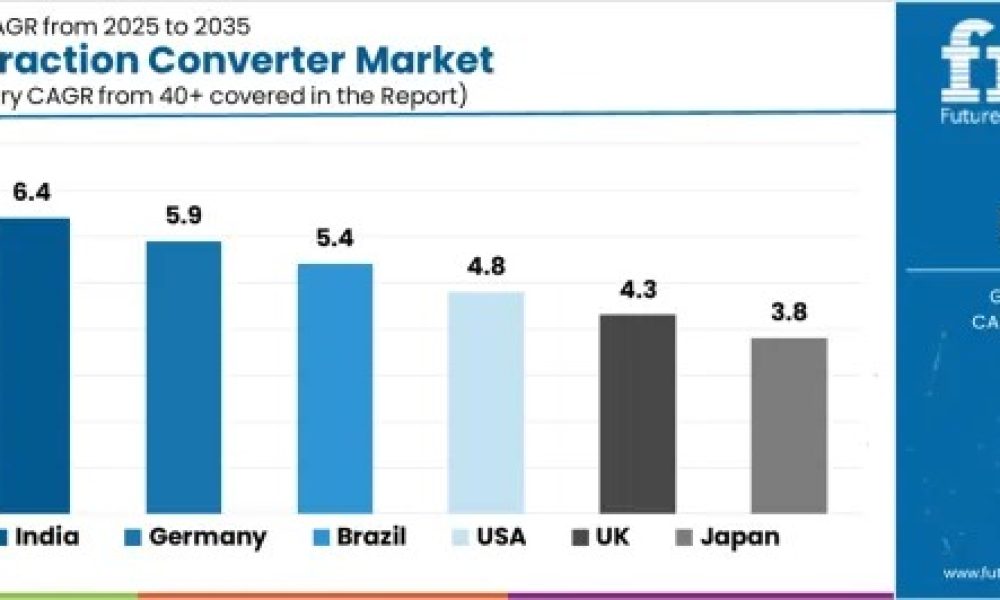
Regionally, Asia-Pacific is the largest growth contributor, supported by aggressive urban rail investments and expanding metropolitan transit networks. China leads global growth with a 6.9% CAGR, followed by India at 6.4%, driven by metro expansion and domestic manufacturing initiatives.
Europe remains a global hub for sustainable transit innovation, with Germany growing at 5.9% CAGR, supported by advanced rail engineering, energy efficiency regulations, and digitalization initiatives. North America, led by the United States (4.8% CAGR), continues to expand through infrastructure renewal programs and transit electrification mandates.
Emerging opportunities are also visible in Brazil (5.4%), the Middle East, and parts of Africa, where urban rail projects are gaining policy and financial backing.
Competitive Landscape Focuses on Efficiency and Integration
The light rail traction converter market is highly competitive, with leading players including ABB, Siemens, Ingeteam, Medha, CRRC, Toshiba, Mitsubishi Electric, and CAF Power & Automation. Companies are investing heavily in semiconductor innovation, modular architectures, integrated diagnostics, and grid-interactive converter designs to strengthen market position.
Strategic differentiation increasingly hinges on energy efficiency, reliability, digital monitoring, and lifecycle cost optimization, rather than purely on hardware supply.
Market Outlook
As urban centers accelerate the transition toward electrified public transportation, traction converters are emerging as strategic enablers of energy efficiency, sustainability, and operational reliability. With continued advancements in power electronics, digital intelligence, and regenerative energy systems, the light rail traction converter market is set to play a pivotal role in shaping the future of urban mobility worldwide.
About Future Market Insights (FMI)
Future Market Insights, Inc. (FMI) is an ESOMAR-certified, ISO 9001:2015 market research and consulting organization, trusted by Fortune 500 clients and global enterprises. With operations in the U.S., UK, India, and Dubai, FMI provides data-backed insights and strategic intelligence across 30+ industries and 1200 markets worldwide.



