
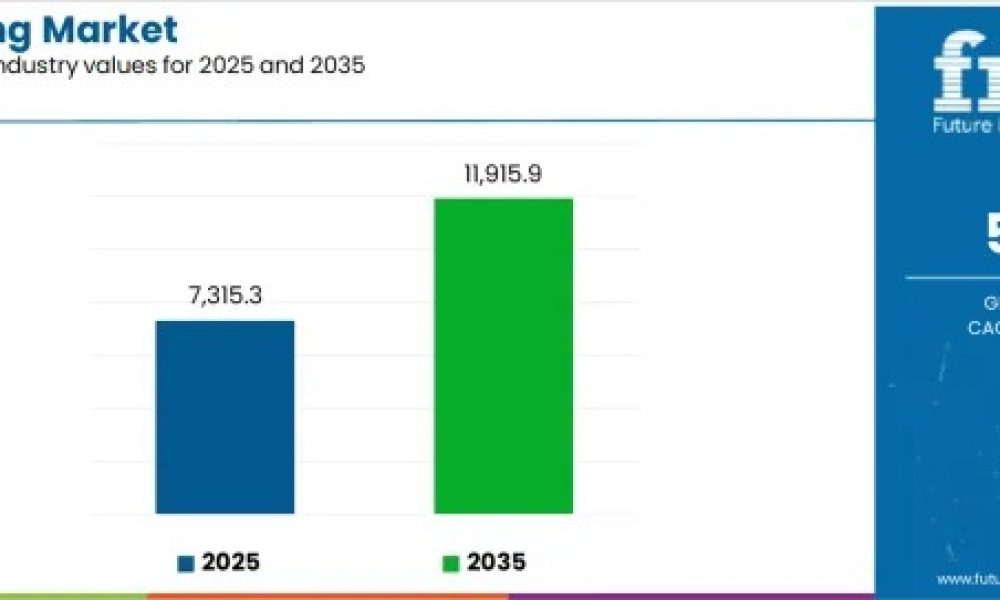
The global car bushing market is on a trajectory of consistent expansion, reflecting the automotive industry’s growing focus on ride comfort, durability, and evolving powertrain architectures. Valued at USD 7,315.3 million in 2025, the market is projected to reach USD 11,915.9 million by 2035, advancing at a compound annual growth rate (CAGR) of 5.0% over the forecast period.
Bushings are foundational components in modern vehicles, serving as critical interfaces that isolate vibration, reduce noise, and enable controlled movement within suspension, engine, and transmission systems. As vehicle designs become more refined and performance expectations rise, demand for precision-engineered bushing solutions continues to strengthen across both passenger and commercial vehicle segments.
Ride comfort and durability shape core demand
Passenger vehicles remain the largest application segment, accounting for 74.0% of total market demand in 2025. Rising consumer expectations for smoother ride quality, enhanced handling precision, and reduced noise vibration harshness (NVH) are driving automakers to specify higher-quality bushing systems across mass-market and premium vehicle platforms.
Commercial vehicles represent another structurally important segment. In heavy-duty applications, bushings play a vital role in reducing component wear, improving load distribution, and extending service life under demanding operating conditions. Fleet operators increasingly prioritize durability and reliability, reinforcing demand for bushings that can withstand prolonged stress cycles while supporting lower total cost of ownership.
Get access to comprehensive data tables and detailed market insights — request your sample report today!
Material innovation reflects changing vehicle architectures
Material selection remains a defining factor in bushing performance and market segmentation. Rubber bushings dominate with a 68.0% market share, supported by their cost efficiency, flexibility, and broad compatibility with standard vehicle applications. Rubber solutions continue to anchor high-volume OEM demand, particularly in passenger vehicles.
At the same time, polyurethane bushings, holding approximately 24.5% share, are gaining traction in performance-oriented and premium vehicle segments. Their superior stiffness, durability, and resistance to deformation make them well suited for sports cars and aftermarket upgrades, where handling precision and longevity outweigh cost considerations.
Emerging material categories are also gaining strategic relevance. Metal-backed and composite bushings are being evaluated for electric vehicle (EV) platforms, where higher torque loads and instantaneous acceleration place new stresses on suspension and mounting systems. This diversification highlights a shift from standardized components toward application-specific solutions tailored to varied propulsion systems and driving profiles.
Electrification reshapes bushing performance requirements
The transition toward electric and hybrid vehicles is introducing new demand dimensions for the car bushing market. Silent electric drivetrains amplify sensitivity to minor vibrations and road noise, elevating the importance of high-performance bushing designs. Manufacturers are responding with lightweight, durable solutions optimized for battery-electric architectures and regenerative braking dynamics.
Hybrid vehicles further contribute to growth by requiring customized damping solutions that accommodate dual propulsion systems. This convergence of mechanical engineering and advanced materials science is opening opportunities for suppliers capable of delivering precision-engineered bushings aligned with next-generation mobility platforms.
OEM and aftermarket channels provide balanced growth
Distribution dynamics underscore the market’s structural stability. OEM channels account for 62% of total demand, driven by steady global vehicle production and stringent quality requirements from automakers. Long-term supplier relationships, standardized specifications, and volume contracts support predictable OEM demand patterns.
The aftermarket, however, represents a critical and resilient revenue stream. Bushing replacement cycles typically occur after three to five years of vehicle usage, creating sustained demand in aging vehicle fleets across developed markets. In parallel, developing economies continue to see strong OEM-driven adoption, creating a dual demand engine that balances cyclical risks and supports long-term growth.
Asia Pacific leads global demand, with Europe and North America reinforcing stability
Regionally, Asia Pacific leads in absolute demand, supported by large-scale vehicle production in China, India, Japan, and South Korea. Expanding middle-class vehicle ownership and rapidly growing EV manufacturing capacities reinforce the region’s dominance.
Europe remains a key market, driven by stringent noise, safety, and comfort regulations that encourage adoption of premium bushing solutions across passenger and commercial fleets. North America demonstrates consistent growth, where aftermarket replacement demand complements OEM supply in a mature automotive landscape.
Latin America and the Middle East & Africa exhibit slower growth rates but represent emerging opportunities tied to expanding vehicle assembly operations and aging vehicle fleets requiring replacement components.
Personalize Your Experience: Ask for Customization to Meet Your Requirements
Competitive landscape favors precision and specialization
The competitive environment is evolving as value migrates from basic rubber bushing production toward specification-driven, application-ready solutions. Established suppliers defend market share through manufacturing excellence, OEM relationships, and global scale, while performance-focused specialists leverage advanced polyurethane technology and aftermarket expertise.
Leading players such as Prothane, Whiteline, and Moog benefit from strong brand recognition and technical credibility, while global automotive suppliers and material technology leaders continue to invest in compound chemistry, precision molding, and application-specific engineering. Consolidation is accelerating as manufacturers seek economies of scale and tighter control over quality and supply chains.
Market outlook remains structurally positive
The car bushing market’s projected 5.0% CAGR through 2035 reflects a balance between OEM-driven vehicle production and sustained aftermarket replacement demand. Material diversification, electrification-led innovation, and regional manufacturing clusters will continue to shape competitive dynamics.
As vehicles evolve toward higher comfort standards, electrified drivetrains, and longer service lives, bushings will remain essential components underpinning performance, durability, and driving experience. Suppliers that align advanced materials expertise with application-specific engineering are best positioned to capture long-term value in this steadily expanding global market.
About Future Market Insights (FMI)
Future Market Insights, Inc. (FMI) is an ESOMAR-certified, ISO 9001:2015 market research and consulting organization, trusted by Fortune 500 clients and global enterprises. With operations in the U.S., UK, India, and Dubai, FMI provides data-backed insights and strategic intelligence across 30+ industries and 1200 markets worldwide.



