
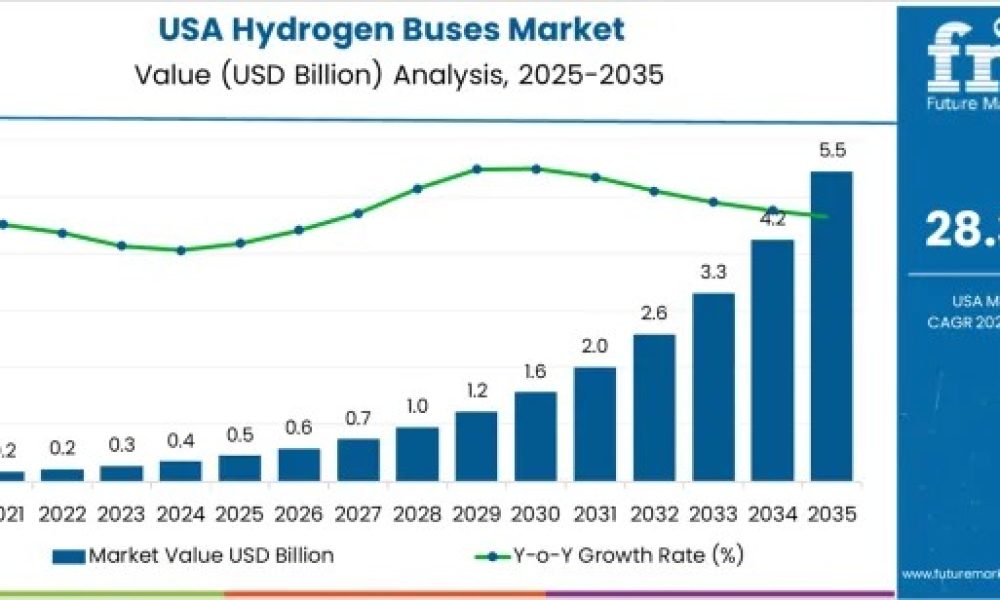
The demand for hydrogen buses in the United States is entering a decisive expansion phase, signaling a major shift in how public transit systems approach decarbonization, operational efficiency, and long-term fleet resilience. Valued at USD 0.5 billion in 2025, the U.S. hydrogen bus market is projected to surge to USD 5.5 billion by 2035, registering a robust compound annual growth rate (CAGR) of 28.3% over the forecast period. This rapid escalation reflects increasing confidence in hydrogen fuel-cell technology as a viable, scalable solution for zero-emission public transportation.
Momentum is being shaped by the convergence of regulatory mandates, fleet modernization programs, and the operational advantages of hydrogen buses—most notably long driving range, fast refuelling times, and consistent performance across diverse climates. Transit agencies across the country are evaluating hydrogen buses as a strategic complement to battery-electric fleets, particularly for high-utilization routes where downtime and range limitations can disrupt service reliability.
Get access to comprehensive data tables and detailed market insights – request your sample report today!
Market Evolution and Growth Trajectory
The U.S. hydrogen bus market has evolved from early pilot deployments into a scaling growth opportunity. From a modest valuation of approximately USD 0.1 billion in 2020, demand increased steadily to reach USD 0.5 billion by 2025, supported by demonstration projects and initial infrastructure investments. Beyond 2025, the growth curve steepens sharply. Market value is expected to rise to USD 1.6 billion by 2031, expand to USD 3.3 billion by 2033, and ultimately reach USD 5.5 billion by 2035.
This trajectory reflects a transition from niche adoption to broader fleet integration. Early-stage growth is characterized by smaller procurement volumes and infrastructure learning curves, while later-stage expansion is driven by declining system costs, improved fuel-cell durability, and increasing standardization across hydrogen supply chains. The resulting USD 5.0 billion absolute market expansion between 2025 and 2035 underscores the scale of opportunity emerging within the U.S. clean transit ecosystem.
Policy Support and Infrastructure Development Fuel Demand
Federal and state-level initiatives aimed at reducing transportation emissions are central to hydrogen bus adoption. Several states have introduced timelines requiring public transit fleets to transition to zero-emission vehicles, creating sustained demand for alternatives to diesel propulsion. Hydrogen buses are gaining attention within this framework due to their ability to deliver diesel-like operational flexibility without tailpipe emissions.
Public funding programs supporting fleet modernization, clean transportation grants, and hydrogen infrastructure development are reinforcing long-term demand visibility. As hydrogen refuelling networks expand—particularly in regions with strong clean-energy policy alignment—transit agencies are increasingly confident in committing to multi-year hydrogen bus procurement strategies. This policy-infrastructure alignment is a critical factor underpinning the market’s accelerated growth outlook.
Technology Leadership: Proton Exchange Membrane Fuel Cells
From a technology standpoint, proton exchange membrane (PEM) fuel cells represent the leading solution in the U.S. hydrogen bus market, accounting for approximately 42% of total demand. PEM fuel cells are favored for their quick start-up capability, high power density, and efficient performance under frequent stop-and-go conditions, making them well suited for urban transit routes.
Their relatively compact design and strong energy-to-weight ratio enable long driving ranges without compromising passenger capacity. Transit operators also value PEM systems for their compatibility with existing bus platforms and their ability to support rapid refuelling, which maximizes vehicle utilization. As hydrogen supply infrastructure matures, PEM fuel cells are expected to remain the dominant technology choice for U.S. hydrogen bus deployments.
Municipal Transit Anchors Market Adoption
By application, municipal transit accounts for approximately 37.2% of hydrogen bus demand in the United States, making it the single largest deployment segment. Urban transit agencies are under increasing pressure to reduce local air pollution while maintaining high service frequency and reliability. Hydrogen buses address these priorities by offering quiet operation, zero tailpipe emissions, and extended range, enabling full-day operation with minimal refuelling interruptions.
Federal and state grant programs further strengthen municipal adoption by offsetting upfront costs and supporting infrastructure build-out. Hydrogen buses are particularly attractive in large metropolitan systems where high passenger loads, long routes, and climate variability can challenge battery-electric alternatives. As cities pursue long-term sustainability goals, municipal transit remains the primary anchor for hydrogen bus demand growth.
Tailor Your Solution: Request Customization for Your Unique Needs!
Regional Growth Patterns Highlight Nationwide Momentum
Regionally, hydrogen bus adoption is expanding across all major U.S. markets, led by the West, which is projected to grow at a 32.6% CAGR through 2035. Strong environmental regulations, early hydrogen infrastructure investments, and active deployment programs in states such as California position the region as a national leader. The South follows with a 29.2% CAGR, driven by urban fleet modernization and growing interest in diversified clean-fuel strategies. The Northeast, at 26.0% CAGR, benefits from dense urban transit networks and emissions-reduction initiatives, while the Midwest, growing at 22.6%, reflects steady adoption supported by manufacturing activity and early-stage fleet trials.
Competitive Landscape and Industry Direction
The U.S. hydrogen bus market is shaped by a mix of global vehicle manufacturers and fuel-cell technology providers. Companies such as Tata Motors Limited, Thor Industries, Hyundai, Ballard Power Systems, NovaBus Corporation, and New Flyer Industries Ltd play critical roles across bus manufacturing, fuel-cell integration, and system deployment. Competition increasingly centers on vehicle range, fuel-cell efficiency, lifecycle cost optimization, and the ability to deliver integrated bus-and-infrastructure solutions.
As transit agencies move from pilot programs to scaled procurement, suppliers with proven performance data, strong service support, and infrastructure partnerships are positioned to capture expanding demand.
Outlook
With regulatory alignment, improving technology economics, and expanding hydrogen infrastructure, the U.S. hydrogen bus market is positioned for structural, long-term growth through 2035. The sector’s rapid value expansion highlights hydrogen buses as a critical pillar of the nation’s zero-emission transit transition, offering a compelling blend of environmental performance and operational reliability that continues to attract sustained interest across public transportation networks.
Why Choose FMI: Empowering Decisions that Drive Real-World Outcomes: https://www.futuremarketinsights.com/why-fmi
About Future Market Insights (FMI)
Future Market Insights, Inc. (FMI) is an ESOMAR-certified, ISO 9001:2015 market research and consulting organization, trusted by Fortune 500 clients and global enterprises. With operations in the U.S., UK, India, and Dubai, FMI provides data-backed insights and strategic intelligence across 30+ industries and 1200 markets worldwide.



