
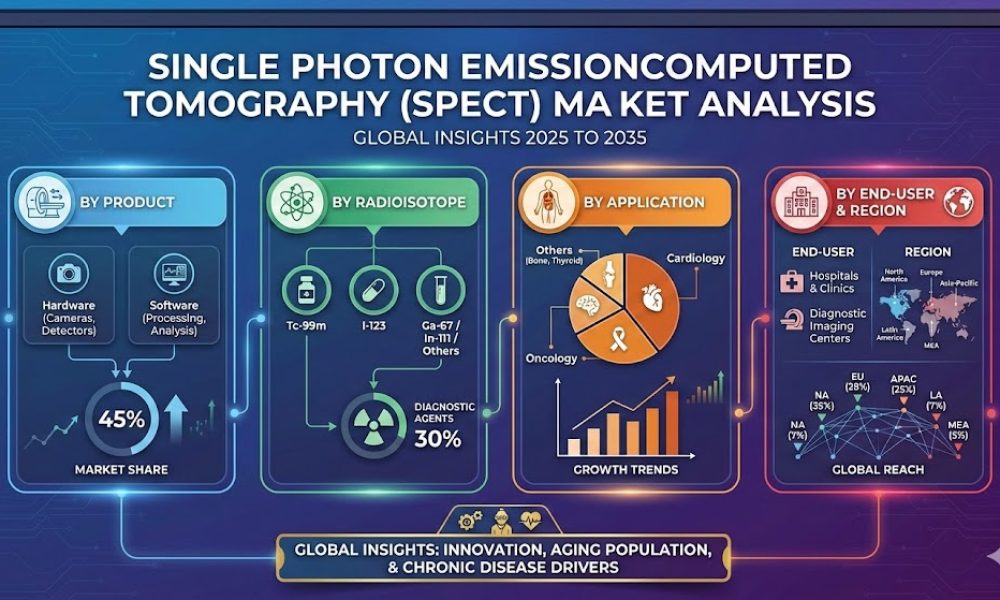
The Single Photon Emission Computed Tomography (SPECT) market is projected to demonstrate robust growth over the next decade, driven by ongoing technological innovation and rising clinical demand for advanced functional imaging. The global SPECT market is poised to expand from an estimated USD 2.45 billion in 2025 to approximately USD 4.74 billion by 2035, registering a compound annual growth rate (CAGR) of around 6.8 % over the forecast period.
This substantial growth trajectory reflects wider adoption of SPECT imaging across cardiology, oncology, and neurology, where non‑invasive functional diagnostic tools are increasingly valued for early disease detection and therapy monitoring. The emphasis on hybrid imaging systems, improved radiotracers, and AI‑enhanced image reconstruction is a key catalyst in this expansion.
To access the complete data tables and in-depth insights, request a Discount On The Report here: https://www.factmr.com/connectus/sample?flag=S&rep_id=7596
Evolution of SPECT Technology
1. Hybrid Imaging Platforms:
One of the dominant technological trends shaping the SPECT landscape is the integration of SPECT with computed tomography (CT), forming hybrid SPECT‑CT systems. These platforms combine high‑resolution anatomical imaging with precise functional data, significantly improving diagnostic confidence in complex cases, especially in oncology staging and cardiology perfusion studies. Hybrid systems are expected to grow at a higher CAGR (~7.6 %) compared to conventional SPECT modalities, reflecting strong clinical preference for multimodal imaging.
2. AI & Software Integration:
Artificial intelligence (AI) and advanced reconstruction algorithms are rapidly transforming workflow and image quality. AI‑based solutions can enhance image clarity, reduce scan times, and standardize quantitative assessments across centers. A majority of stakeholders prioritize image precision, radiotracer availability, and digital interoperability, underscoring the strategic imperative for manufacturers to invest in software‑driven capabilities.
3. Radiotracer Innovation:
Technetium‑99m (Tc‑99m) remains the cornerstone radioisotope for SPECT imaging due to its optimal emission profile, short half‑life, and wide clinical acceptance. Tc‑99m is expected to remain the most profitable radioisotope segment through 2035, with a CAGR of 7.2 %, outpacing the overall market growth. Investments in reliable Mo‑99 production are also enhancing supply stability, which is vital for consistent clinical utilization.
Regional Demand & Market Dynamics
1. North America:
North America holds a leading share of the SPECT market due to advanced healthcare infrastructure, substantial R&D investment, and strong clinical adoption. Mature healthcare ecosystems in the U.S. and Canada support widespread uptake of high‑end hybrid platforms, particularly in cardiology and oncology. Policy incentives and fast‑track regulatory frameworks contribute to radiopharmaceutical pipeline growth and expanded procedural volumes.
2. Asia Pacific:
Emerging Asia Pacific markets, including China and India, are among the fastest-growing globally. These regions are experiencing robust demand expansion, propelled by rising healthcare expenditure, expanding hospital networks, and increasing awareness of early disease detection benefits. China’s centralized healthcare investments and India’s public‑private healthcare expansions are significant drivers. SPECT adoption in these markets benefits from improving reimbursement structures and rising incidence of chronic diseases.
3. Europe:
Europe continues to represent a critical market with sustained growth supported by well-established nuclear medicine protocols and strong regulatory support. Countries like Germany, the UK, and France are increasing investments in imaging infrastructure. Cross‑border collaborations in clinical research and initiatives to standardize advanced imaging further bolster adoption.
4. Other Regions:
Regions such as Australia‑New Zealand demonstrate noteworthy expansion, driven by public‑private healthcare collaboration and mobile imaging deployment in remote areas. Latin America and the Middle East & Africa exhibit steady growth, albeit from a smaller base, reflecting broader healthcare modernization and foreign capital inflows in diagnostic imaging.
Application & End‑User Trends
Cardiology:
SPECT remains pivotal in cardiology, especially for myocardial perfusion imaging (MPI), a key diagnostic tool for ischemia detection and infarct sizing. This segment is projected to grow faster than others, reflecting heightened demand for precise cardiac diagnostics.
Hospital Adoption:
Hospitals dominate end‑user demand due to higher patient throughput and greater capital capacity for advanced imaging technologies. Both public and private healthcare networks are increasing investments in SPECT systems to streamline comprehensive diagnostic workflows.
Market Challenges & Strategic Considerations
Despite strong growth, the SPECT market faces potential hurdles, including supply chain disruptions for isotopes and device components, and infrastructure disparities in middle‑ and low‑income countries that can constrain adoption. Regulatory lags in radiopharmaceutical approval also pose risks to timely technology deployment.
To navigate these challenges, stakeholders are focusing on enhancing global distribution networks, forming strategic radiotracer partnerships, and accelerating AI integration to maintain competitive advantage.
Conclusion:
The Single Photon Emission Computed Tomography market is set for significant future expansion, supported by hybrid imaging innovation, regional healthcare growth, and strong clinical demand across multiple therapeutic areas. As technology and access evolve, the market will continue transforming nuclear diagnostic imaging, driving better clinical outcomes and broader global adoption through 2036.
Have a specific Requirements and Need Assistant on Report Pricing or Limited Budget please contact us – [email protected]
To View Related Report :
Single Use Assemblies Market https://www.factmr.com/report/single-use-assemblies-market
Single-Lead ECG Monitor Market https://www.factmr.com/report/single-lead-ecg-monitor-market
Single Domain Antibody Platform Market https://www.factmr.com/report/single-domain-antibody-platform-market
Single Dose Radiotherapy Market https://www.factmr.com/report/5282/single-dose-radiotherapy-market



