
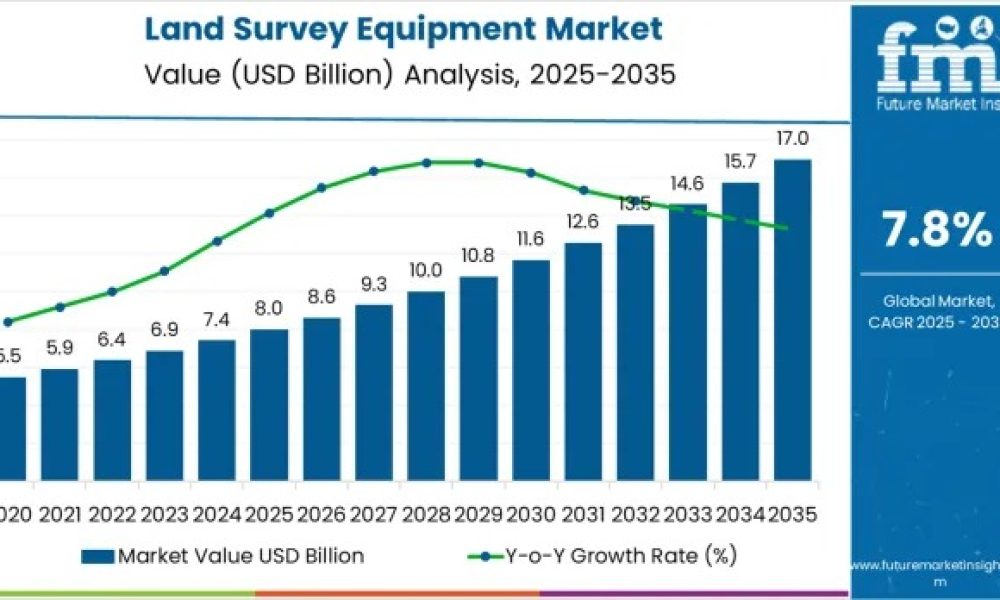
The Land Survey Equipment Market is set for sustained expansion over the next decade, driven by accelerating infrastructure development, construction digitization, and growing reliance on precision measurement technologies. The market is projected to grow from USD 8 billion in 2025 to USD 17 billion by 2035, registering a 7.8% CAGR during the forecast period.
This growth reflects a structural shift in construction, mining, and industrial projects, where accuracy, automation, and data integration are no longer optional but essential. Land survey equipment is increasingly embedded in planning, execution, and monitoring workflows across global infrastructure ecosystems.
Stay ahead with quarterly and annual data updates:
https://www.futuremarketinsights.com/reports/sample/rep-gb-6805
Market Growth Phases: A Decade of Technology Adoption
Phase 1: 2025–2030 – GNSS-Led Acceleration
- Market value rises from USD 8 billion to USD 11.6 billion
- Contributes 40% of total decade growth
- Rapid adoption of GNSS systems for high-accuracy positioning
- Automated measurement and digital compatibility become industry standards
This phase is characterized by widespread modernization of surveying practices, particularly in construction-heavy regions.
Phase 2: 2030–2035 – UAV and Platform Integration
- Market expands from USD 11.6 billion to USD 17 billion
- Accounts for 60% of total forecast growth
- UAVs, 3D laser scanners, and GIS platforms gain mass adoption
- Seamless integration with BIM and cloud-based construction systems
Surveying evolves into a real-time, data-driven function supporting continuous project optimization.
Key Drivers Powering Market Expansion
- Global Infrastructure Boom
- Heavy investments in transportation, smart cities, energy, and industrial facilities
- Survey equipment ensures accurate land measurement, layout control, and compliance
- Construction Industry Digitization
- Shift toward precision-led project execution
- Demand for real-time data, reduced rework, and faster timelines
- Technological Advancements
- GNSS, UAVs, and 3D laser scanning enable faster, more accurate data capture
- Cloud-based processing improves scalability and decision-making
Product Insights: GNSS Systems Lead the Market
Dominant Segment: GNSS Systems
- Accounts for ~31% market share
- Key advantages:
- Superior positioning accuracy
- High operational reliability
- Compatibility with automated construction platforms
GNSS systems are increasingly preferred as core surveying tools across large-scale infrastructure projects.
Other High-Growth Equipment Categories
- Total stations and theodolites
- UAV and drone-based surveying solutions
- 3D laser scanners for complex modeling
Collectively, these segments represent 69% of total market demand, serving specialized and high-precision applications.
Industry Analysis: Construction Remains the Primary Demand Engine
Construction Sector Leadership
- Contributes ~36% of total market demand
- Driven by:
- Infrastructure modernization
- Precision compliance requirements
- Integration with project management systems
Other Key Industries
- Mining
- Oil & gas
- Agriculture
- Disaster management
These sectors demand durable, high-performance surveying equipment capable of operating in challenging environments.
Regional Growth Highlights
Asia Pacific: Fastest-Growing Region
- India: 11.6% growth rate driven by infrastructure megaprojects
- China: 8.7% growth supported by urban expansion and industrial construction
North America & Europe: Technology-Driven Stability
- United States maintains 4.4% growth through premium system adoption
- Europe grows from USD 2.2B (2025) to USD 4.7B (2035)
- Germany leads European adoption with advanced construction ecosystems
Competitive Landscape: Innovation Over Price
The market remains moderately consolidated, with leading players controlling 65–70% of global share.
Key Market Players
- Trimble Inc.
- Hexagon AB
- Topcon Corporation
- Autodesk, Inc.
- FARO Technologies, Inc.
- Nikon Corporation
- CHC Navigation
Competition centers on precision, software integration, automation, and reliability, rather than pricing alone.
Market Challenges and Risk Factors
- High upfront costs for advanced surveying equipment
- Performance limitations in extreme terrain and weather
- Fragmented standards across regions and construction specifications
However, falling component costs and localized manufacturing are gradually improving accessibility.
Strategic Market Outlook
The land survey equipment market is transitioning from a support function to a strategic infrastructure enabler. As digital construction, smart cities, and automation gain momentum, demand for advanced surveying solutions will remain resilient and investment-worthy through 2035.
Get data that aligns with your strategic priorities — ask for report customization today:
https://www.futuremarketinsights.com/customization-available/rep-gb-6805
Have a specific Requirements and Need Assistant on Report Pricing or Limited Budget please contact us – [email protected]
About Future Market Insights (FMI)
Future Market Insights, Inc. (FMI) is an ESOMAR-certified, ISO 9001:2015 market research and consulting organization, trusted by Fortune 500 clients and global enterprises. With operations in the U.S., UK, India, and Dubai, FMI provides data-backed insights and strategic intelligence across 30+ industries and 1200 markets worldwide.
Contact Us:
Future Market Insights Inc.
Christiana Corporate, 200 Continental Drive,
Suite 401, Newark, Delaware – 19713, USA
T: +1-347-918-3531



