
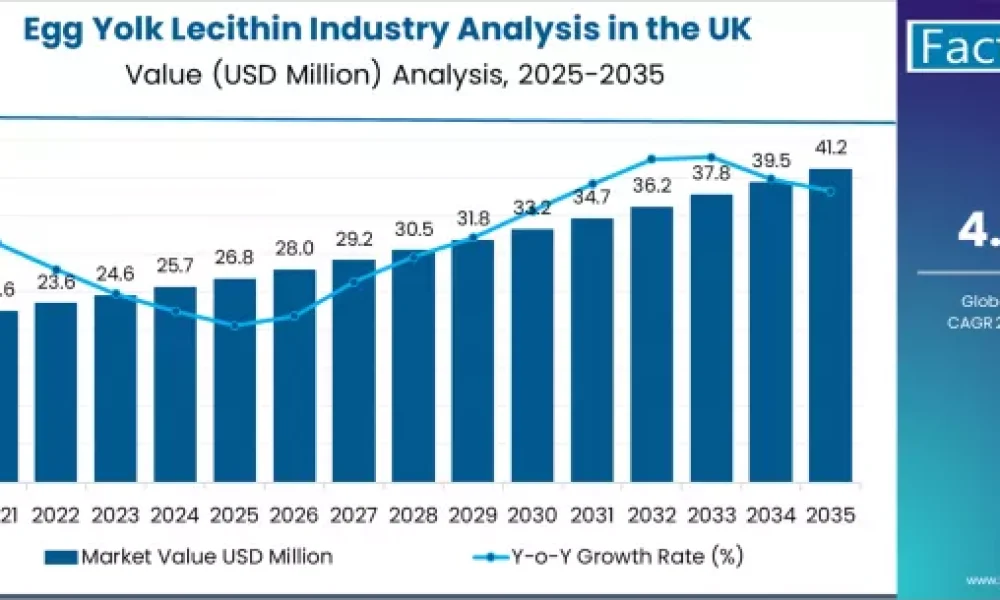
The United Kingdom’s egg yolk lecithin industry is set for steady expansion over the next decade, driven by rising adoption of natural emulsifiers, growth in functional foods, and increasing applications across pharmaceuticals and cosmetics. According to a new analysis, the demand for egg yolk lecithin in the UK is projected to rise from USD 26.8 million in 2025 to approximately USD 40.3 million by 2035, marking an absolute growth of USD 13.5 million. This represents total growth of 50.4% and a CAGR of 4.4% between 2025 and 2035.
Growing preference for clean-label ingredients, advanced formulation requirements, and expanding nutraceutical consumption are major contributors to rising demand across the UK market.
Strategic Market Drivers
Clean-Label & Natural Ingredient Demand Surges
Consumers and manufacturers across the UK are increasingly shifting toward natural, minimally processed, and clean-label ingredients. Egg yolk lecithin—valued for its natural origin, superior emulsification properties, and nutritional profile—is gaining significant traction across:
- Functional food & beverages
- Dietary supplements
- Infant nutrition
- Clean-label bakery and confectionery
This shift is strongly aligned with evolving consumer preferences for transparency and natural formulations.
To access the complete data tables and in-depth insights, request a Discount On The Report here: https://www.factmr.com/connectus/sample?flag=S&rep_id=12059
Pharmaceutical & Nutraceutical Expansion Boosts Utilization
Egg yolk lecithin plays a crucial role in drug delivery systems, lipid-based formulations, and solubilization technologies. The UK’s expanding nutraceutical and pharmaceutical manufacturing ecosystem is accelerating demand due to:
- Growth of lipid emulsions
- Increased use in brain and cognitive health supplements
- Rising demand for liposomal delivery technologies
Cosmetics & Personal Care Industry Drives Adoption
With its excellent skin-conditioning and stabilizing properties, egg yolk lecithin is increasingly used in:
- Anti-aging formulations
- Moisturizers
- Serums
- Dermatological products
The UK’s strong beauty and personal care market is reinforcing growth, especially as consumers gravitate toward bio-derived ingredients.
Food Processing Advancements and R&D
Innovations in food technology, texture enhancement, and product stability are creating new opportunities for lecithin-based formulations. Manufacturers are adopting egg yolk lecithin for:
- Improved texture in low-fat foods
- Enhanced shelf stability
- Superior emulsification in bakery and processed foods
Regional Growth Highlights
United Kingdom: A Growing Clean-Label Ingredient Hub
The UK remains a key European market for egg yolk lecithin due to:
- Strong functional food demand
- Growing pharmaceutical and nutraceutical production
- Dynamic cosmetic manufacturing ecosystem
- Consumer shift toward natural and organic ingredients
Government regulations supporting safer and more transparent labeling are further boosting adoption.
Market Segmentation Insights
By Form
- Liquid Lecithin – Widely used in food products and emulsification systems.
- Powdered Lecithin – Preferred in nutraceuticals, tablets, and cosmetics.
- Granulated Lecithin – Emerging in bakery applications and supplements.
By Application
- Food & Beverage – Largest segment driven by clean-label demand.
- Pharmaceuticals & Nutraceuticals – Fast-growing due to liposomal and cognitive-health formulations.
- Cosmetics & Personal Care – Increasingly adopted in natural skincare.
- Animal Nutrition – Used for digestion support and feed efficiency.
Challenges Impacting Market Growth
High Production Costs
Extraction and refinement processes for egg yolk lecithin remain more expensive than soy-based alternatives, posing challenges for price-sensitive segments.
Supply Chain Concerns
Fluctuations in egg production, avian influenza outbreaks, and rising raw material costs influence overall supply stability.
Competition from Plant-Based Lecithin
Soy and sunflower lecithin remain strong alternatives, particularly for vegan and allergen-friendly products.
Competitive Landscape
The UK egg yolk lecithin industry is moderately competitive, with companies focusing on high-purity formulations, enhanced functional properties, and expanded application development.
Key Players Profiled
- FSL (Food Specialities Limited)
- Lipoid GmbH
- Lecico GmbH
- Novastell Ingredients
- Kewpie Corporation
- Soya International
- American Lecithin Company
Players are investing in R&D, advanced extraction techniques, clean-label innovation, and product traceability systems.
Recent Developments
- 2024: Growth in liposomal supplement manufacturing increases use of high-purity egg yolk lecithin.
- 2023: Cosmetic brands expand utilization of egg-derived phospholipids in anti-aging formulations.
- 2022: Food manufacturers enhance adoption to meet demand for natural emulsifiers in bakery and processed foods.
Future Outlook: A Decade of Natural Ingredient Innovation
The coming decade will bring significant advancements driven by:
- Rising consumer demand for natural and clean-label ingredients
- Expanded use in pharmaceutical and nutraceutical technologies
- Growth of functional foods and fortified nutrition
- Increased R&D into phospholipid-based delivery systems
- Strong momentum in natural cosmetics
As UK industries prioritize purity, natural origin, and functional performance, the egg yolk lecithin market is positioned for strong and sustainable growth through 2035.
Have a specific Requirements and Need Assistant on Report Pricing or Limited Budget please contact us – [email protected]
About Fact.MR
Fact.MR is a global market research and consulting firm, trusted by Fortune 500 companies and emerging businesses for reliable insights and strategic intelligence. With a presence across the U.S., UK, India, and Dubai, we deliver data-driven research and tailored consulting solutions across 30+ industries and 1,000+ markets. Backed by deep expertise and advanced analytics, Fact.MR helps organizations uncover opportunities, reduce risks, and make informed decisions for sustainable growth.



