
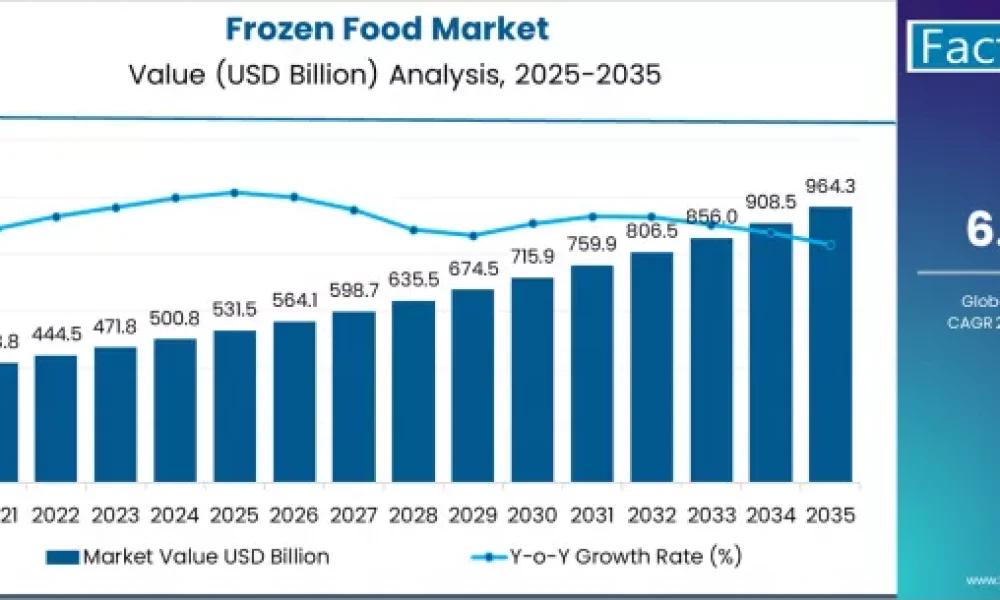
The global frozen food market continues to expand as changing consumer lifestyles, urbanization, rising disposable incomes, and demand for convenient, longer-shelf-life options drive consistent uptake. Frozen foods — spanning ready meals, vegetables, fruits, seafood, meat, bakery items, and desserts — offer food security, reduced waste, and year-round access to seasonal ingredients. Advances in freezing technology, cold-chain logistics, and consumer trust in quality have elevated frozen products from commodity staples to premium, value-added offerings across retail and foodservice channels.
Quick Stats (2025–2035)
Market Value 2025 (global, approx.): USD 280 billion
Forecast Market Value 2035 (global, approx.): USD 430 billion
Absolute Growth (2025–2035): ~USD 150 billion
Forecast CAGR (2025–2035): ~4.0%
Leading Category (2025): Frozen ready meals & prepared foods (~28% share)
Fastest-Growing Category: Premium frozen seafood & plant-based frozen items
To access the complete data tables and in-depth insights, request a Discount On The Report here: https://www.factmr.com/connectus/sample?flag=S&rep_id=12333
Key Market Drivers
1. Convenience & Time-Saved Eating
Consumers prioritize ready-to-heat and single-serve frozen meals due to busy lifestyles and multi-tasking routines.
Single-household living and remote working increase demand for convenient portioned frozen options.
2. Improved Freezing & Quality Retention Technologies
Shock freezing, cryogenic freezing, and IQF (individual quick freeze) maintain texture, flavor and nutrients.
Quality improvements increase consumer perception and willingness to pay for premium frozen offerings.
3. Year-Round Access to Seasonal & Specialty Items
Frozen categories enable year-round supply of seasonal fruits, vegetables, and seafood, stabilizing pricing and availability for retailers and manufacturers.
4. Reducing Food Waste & Extending Shelf Life
Frozen products lower spoilage across supply chains and promote sustainable inventory management for retailers and foodservice operators.
5. Rising Demand for Healthier & Specialty Options
Growth in organic frozen lines, clean-label ingredients, plant-based frozen meals, and low-sodium or low-sugar options responds to health-conscious consumers.
Market Structure & Segment Insights
By Product Category
Ready Meals & Prepared Foods: Largest segment; includes single-serve and family meals, ethnic cuisines, and premium chef-style offerings.
Frozen Vegetables & Fruits: High volume due to affordability and nutritional retention.
Frozen Seafood & Meat: Premiumization and traceability are driving growth in high-value species and sustainably sourced lines.
Bakery & Desserts: Growing impulse and convenience purchases (croissants, pastries, frozen cakes).
Plant-Based & Alternative Proteins: Rapidly expanding niche as vegan and flexitarian diets rise.
By Distribution Channel
Supermarkets & Hypermarkets: Primary sales channel for mainstream frozen products; focus on private-label and premium SKUs.
E-commerce & Online Grocery: Fastest-growing channel supported by cold-chain home delivery and click-and-collect services.
Foodservice & QSRs: Institutional demand for frozen intermediates and ready meals supports B2B volumes.
Convenience Stores & C-Stores: Growth in on-the-go frozen snacks and microwavable options.
By Region
North America & Europe: Mature markets with high per-capita frozen consumption and premiumization trends.
Asia-Pacific: Fastest growth driven by urbanization, rising incomes, and expanding modern retail and e-grocery.
Latin America & Africa: Emerging demand; opportunities tied to cold-chain investment and retail modernization.
Challenges & Restraints
Cold-Chain Infrastructure Gaps: In emerging markets, limited cold storage and transport capacity restrict market penetration.
Energy Costs & Sustainability Concerns: Freezing, storage and transport are energy-intensive; rising energy prices and emissions pressure require efficiency investments.
Consumer Perception & Freshness Bias: Some consumers still perceive fresh as superior — education and premium frozen positioning are needed.
Logistics & Last-Mile Delivery Complexity: Scaling e-grocery for frozen foods requires specialized packaging and reliable, low-temperature delivery solutions.
Opportunities & Strategic Directions
1. Premiumization & Product Innovation
Launch chef-style, ethnic, organic, and gourmet frozen lines to capture higher margins and differentiate from private-label commoditized SKUs.
2. Plant-Based & Functional Frozen Foods
Invest in plant-based ready meals, fortified frozen foods, and functional ingredients (protein-rich, fiber, probiotics) to meet health trends.
3. Cold-Chain Modernization & Localized Freezing Hubs
Build distributed freezing centers and micro-fulfillment sites close to urban demand centers to enable same-day frozen e-grocery delivery.
4. Sustainable Packaging & Energy Efficiency
Adopt recyclable, insulated packaging and invest in renewable energy for cold storage to reduce lifecycle emissions and meet sustainability commitments.
5. Enhanced Traceability & Transparency
Use QR codes and supply-chain storytelling for seafood and specialty products to increase trust and willingness to pay.
Outlook
The frozen food market is poised for durable growth to 2035, transitioning from a value-oriented staple category to one characterized by premium innovation, health functionality, and e-commerce penetration. Companies that combine superior freezing technologies, supply-chain resilience, product differentiation (including plant-based and premium seafood), and sustainable cold-chain practices will capture the largest share of the growing market. Demand will be strongest where modern retail, efficient logistics, and consumer convenience converge — making the frozen category a strategic growth area for food manufacturers and retailers alike.
Have specific requirements or need assistance on report pricing or have a limited budget? Please contact [email protected]
About Fact.MR:
Fact.MR is a global market research and consulting firm, trusted by Fortune 500 companies and emerging businesses for reliable insights and strategic intelligence. With a presence across the U.S., UK, India, and Dubai, we deliver data-driven research and tailored consulting solutions across 30+ industries and 1,000+ markets. Backed by deep expertise and advanced analytics, Fact.MR helps organizations uncover opportunities, reduce risks, and make informed decisions for sustainable growth.



