
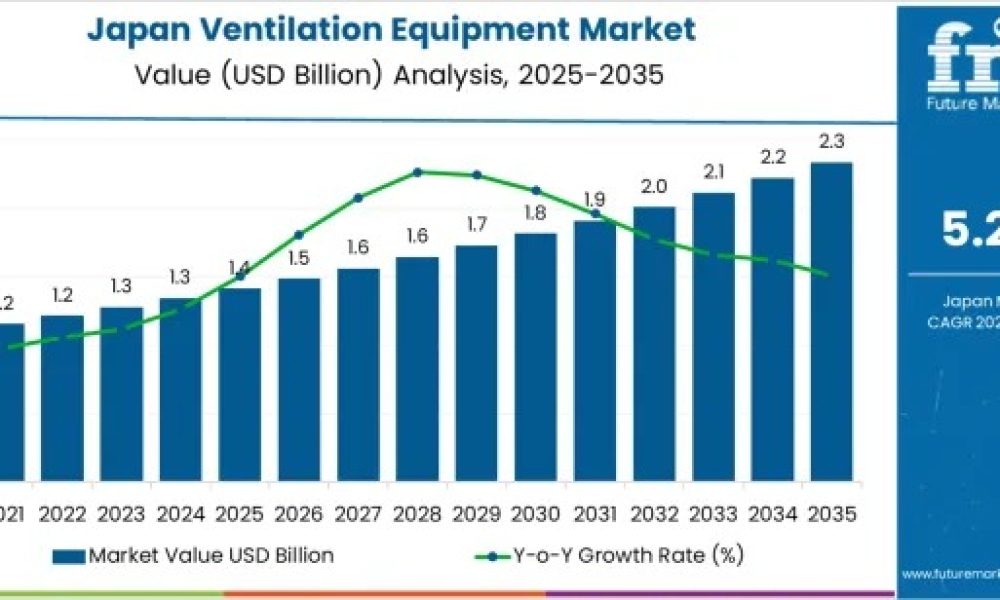
Japan’s building and industrial landscape is entering a decisive modernization phase, with the Demand for Ventilation Equipment in Japan projected to increase from USD 1.4 billion in 2025 to USD 2.3 billion by 2035, registering a 5.2% CAGR. This growth reflects the country’s heightened focus on sustainability, stringent environmental regulations, and increasing emphasis on healthy indoor environments. As residential, commercial, and industrial structures adopt advanced ventilation technologies for energy savings and air-quality improvement, manufacturers are unlocking significant long-term opportunities.
Subscribe for Year-Round Insights → Stay ahead with quarterly and annual data updates:
https://www.futuremarketinsights.com/reports/sample/rep-gb-28981
Japan’s push toward cleaner and more efficient buildings—supported by national carbon-neutrality targets for 2050—is reshaping ventilation system demand across new developments and retrofit projects. Between 2025 and 2030, market value will rise from USD 1.4 billion to USD 1.8 billion as smart ventilation, heat-recovery systems, and IoT-enabled monitoring shift from premium options to mainstream infrastructure. This period marks accelerated adoption of air-quality solutions amid rising respiratory health concerns, urban crowding, and extreme weather patterns.
By 2030–2035, growth will stabilize as the market matures, rising from USD 1.8 billion to USD 2.3 billion. Although installation saturation will begin in major urban regions, replacement cycles, retrofit upgrades, and efficiency-driven improvements will maintain consistent demand. The shift toward hybrid natural-mechanical ventilation and advanced particulate filtration will further influence buyer priorities, especially in corporate offices, healthcare facilities, and semiconductor manufacturing units.
Key Growth Drivers Creating Momentum
Japan’s ventilation industry is benefiting from three major forces shaping infrastructure development:
- Environmental and regulatory pressure:
Stricter building performance laws, energy-efficiency mandates, and indoor air-quality standards are pushing facility managers to invest in advanced ventilation systems. Factory ventilation alone—valued at USD 337.2 million in 2024—is projected to reach nearly USD 970.3 million by 2033 at a formidable 12.5% CAGR. - Surge in smart buildings and Industry 4.0 installations:
Commercial complexes, data centers, and electronics manufacturing lines are increasingly adopting demand-controlled ventilation, variable-speed fans, and IoT control modules for real-time performance monitoring. - Increased consumer and corporate preference for energy-saving solutions:
High electricity costs, labor shortages, and decarbonization goals have made heat-recovery units and hybrid systems a priority in both new construction and modernization projects.
Market Dynamics: Product Type & Application Shifts
Axial fans dominate Japan’s product mix, accounting for 35% of total demand due to their affordability, efficiency in moving large air volumes, and ready compatibility with both commercial and industrial ventilation systems. Their versatility across HVAC systems, industrial exhausts, and large public spaces ensures steady demand through 2035.
Non-residential buildings hold a commanding 65% share of the national market. Office complexes, factories, hospitality facilities, healthcare institutions, and logistics hubs are intensifying investments in energy-efficient and digitally managed ventilation. As businesses place greater emphasis on indoor environmental quality and operational efficiency, non-residential demand is expected to sustain its leadership.
Regional Outlook: Kyushu & Okinawa Lead Growth
Regional dynamics reveal notable differences in adoption pace:
- Kyushu & Okinawa (6.5% CAGR): Fastest-growing region, driven by tourism-centric infrastructure, humid climate challenges, and strong adoption in hotels and public buildings.
- Kanto (6.0% CAGR): Japan’s economic core, with high commercial density and strict indoor air-quality compliance requirements.
- Kinki (5.2% CAGR): Demand supported by heavy industries and modernization of office complexes.
- Chubu (4.6% CAGR): Strong manufacturing base driving consistent upgrades in ventilation systems.
- Tohoku (4.0%) & Rest of Japan (3.8%): Slower adoption but growing steadily due to improvements in construction activity and rising awareness of energy-efficient systems.
Competitive Landscape
Japan’s ventilation equipment market is shaped by global and regional leaders including VENTS, Centrotec Sustainable AG, Twin City Fan Companies Ltd., Nortek Incorporated, Soler & Palau Group, and Zibo Lihua Co. Ltd. Competition centers on advancements such as electronically commutated motors, IoT-enabled sensors, modular systems, performance efficiency, and ease of installation. Alignment with Japanese building standards and long-term maintenance support remain key differentiators.
Get data that aligns with your strategic priorities — ask for report customization today:
https://www.futuremarketinsights.com/customization-available/rep-gb-28981
Have a specific Requirements and Need Assistant on Report Pricing or Limited Budget please contact us – [email protected]
About Future Market Insights (FMI)
Future Market Insights, Inc. (FMI) is an ESOMAR-certified, ISO 9001:2015 market research and consulting organization, trusted by Fortune 500 clients and global enterprises. With operations in the U.S., UK, India, and Dubai, FMI provides data-backed insights and strategic intelligence across 30+ industries and 1200 markets worldwide.
Contact Us:
Future Market Insights Inc.
Christiana Corporate, 200 Continental Drive,
Suite 401, Newark, Delaware – 19713, USA
T: +1-347-918-3531



