
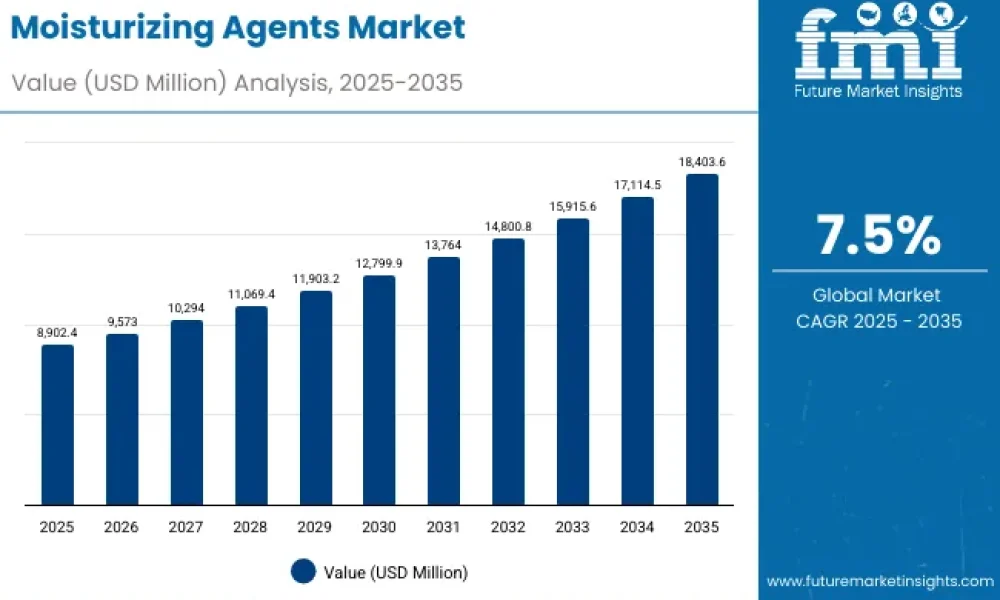
The global Moisturizing Agents Market, valued at USD 8,902.4 million in 2025, is projected to reach USD 18,403.6 million by 2035, reflecting an impressive 7.5% CAGR throughout the forecast period. This growth equals an additional USD 9,501.2 million in market value and highlights the rising global demand for hydration-focused ingredients across skincare, personal care, and dermocosmetic formulations.
Market Overview and Growth Momentum
Growing consumer awareness of skin-barrier repair, long-lasting moisturization, and the benefits of clean-label ingredients continues to fuel market expansion. Between 2025 and 2030, the market is expected to add USD 3,897.5 million, while the period 2030 to 2035 is forecasted to generate an even stronger USD 5,603.7 million. This acceleration reflects the shift toward premium formulations, encapsulated systems, and plant-based moisturizing technologies.
Subscribe for Year-Round Insights → Stay ahead with quarterly and annual data updates : https://www.futuremarketinsights.com/reports/sample/rep-gb-26720
Key Market Statistics (2025)
- Market Value: USD 8,902.4 million
- 2035 Forecast Value: USD 18,403.6 million
- CAGR (2025–2035): 7.5%
- Leading Functional Segment: Plant-based (55.7%)
- Top Regions: Asia-Pacific, Europe, North America
- Key Players: BASF, Croda, Evonik, Ashland, DSM-Firmenich, Givaudan, Lubrizol, Clariant, Seppic, Roquette
Key Market Drivers
- Rising Demand for Hydration-Focused Skincare
Consumers worldwide are prioritizing skin hydration, barrier repair, and long-term moisturization. This is increasing the use of high-performance humectants, emollients, and botanical moisturizing complexes in creams, serums, and dermocosmetic treatments.
- Rapid Growth in Premium and Plant-Based Beauty
With 55.7% share held by plant-based ingredients, sustainability has become central to procurement decisions. Brands, retailers, and R&D teams are seeking renewable, traceable, and clean-label sources for moisturizing agents.
- Expansion of the Asia-Pacific Market
Countries like India (12.7% CAGR) and China (11.3% CAGR) are leading global demand, influenced by middle-class expansion, premium skincare adoption, and increased consumption of dermocosmetic products.
- Technological Innovation in Delivery Systems
Encapsulated hydration systems, time-release moisturizers, and fermentation-derived actives are enabling brands to differentiate with enhanced efficacy and consumer-perceivable results.
Segmental Highlights
Chemistry Segment – Polyols & Humectants Lead with 44.3% Share
Polyols remain the backbone of moisturizing formulations due to:
- Strong hydration performance
- Broad regulatory acceptance
- Compatibility with both mass and premium skincare
- Cost-effective inclusion levels
Future growth is expected from higher-purity grades and smart blends combining humectants with barrier-repair actives.
Function Segment – Plant-Based Systems Dominate Named Categories
Plant-derived moisturizing agents hold 38.2% share, driven by:
- Clean-label expectations
- Rising demand for bio-aligned ingredients
- Traceability and safety compliance standards
- Consumer preference for botanical narratives
Fermentation-based and clinically backed plant extracts are expected to strengthen this segment.
Physical Form Segment – Liquids Hold 55% Market Share
Liquid moisturizing agents dominate owing to:
- Ease of formulation and dosing
- Faster batch processing
- High compatibility with emulsions and serums
- Stable performance in various temperatures
Their role is expected to expand as manufacturers target low-energy, efficient production processes.
Country-Level Growth Outlook
United States – Moderate, Stable Growth (4.7% CAGR)
- Market to reach USD 3,396.36 million by 2035
- Growth driven by clean-label moisturizers and dermatologist-endorsed formulations
- Mass market relies on polyols, while premium brands shift to plant-derived systems
United Kingdom – Strong 7.4% CAGR
- Driven by strict sustainability norms, microplastic-safe formulations, and clinical claims
- Retailers favor suppliers with transparent documentation and eco-friendly manufacturing
India – Fastest Growing Market (12.7% CAGR)
- High demand in facial care and dermocosmetics
- Plant-based, vegan, and climate-resistant ingredients gaining traction
- Rising manufacturing localization enhances supply agility
China – 11.3% CAGR with High Premium Adoption
- Rapid movement toward barrier repair, fast hydration, and evidence-backed actives
- Cross-border beauty commerce boosts demand for natural and high-performance moisturizers
Competitive Landscape
The market is moderately consolidated. BASF leads with 8.1% global share, supported by innovations in biodegradable, plant-derived cosmetic ingredients. Companies like Croda, Evonik, Ashland, DSM-Firmenich, Givaudan, and Lubrizol are investing heavily in:
- Bio-fermented actives
- Encapsulated moisturizing systems
- High-efficacy botanical moisturizers
Regional players such as Clariant, Seppic, and Roquette are gaining traction through specialization in plant-based and clean-label moisturizing technologies.
Conclusion
The Moisturizing Agents Market is set for a transformative decade driven by sustainability, innovation, and global shifts toward premium skincare. With demand nearly doubling by 2035, suppliers offering plant-based, traceable, high-performance, and clinically substantiated moisturizing systems are expected to capture the strongest growth opportunities.
Have a specific Requirements and Need Assistant on Report Pricing or Limited Budget please contact us – [email protected]
About Future Market Insights (FMI)
Future Market Insights, Inc. (FMI) is an ESOMAR-certified, ISO 9001:2015 market research and consulting organization, trusted by Fortune 500 clients and global enterprises. With operations in the U.S., UK, India, and Dubai, FMI provides data-backed insights and strategic intelligence across 30+ industries and 1200 markets worldwide.



