
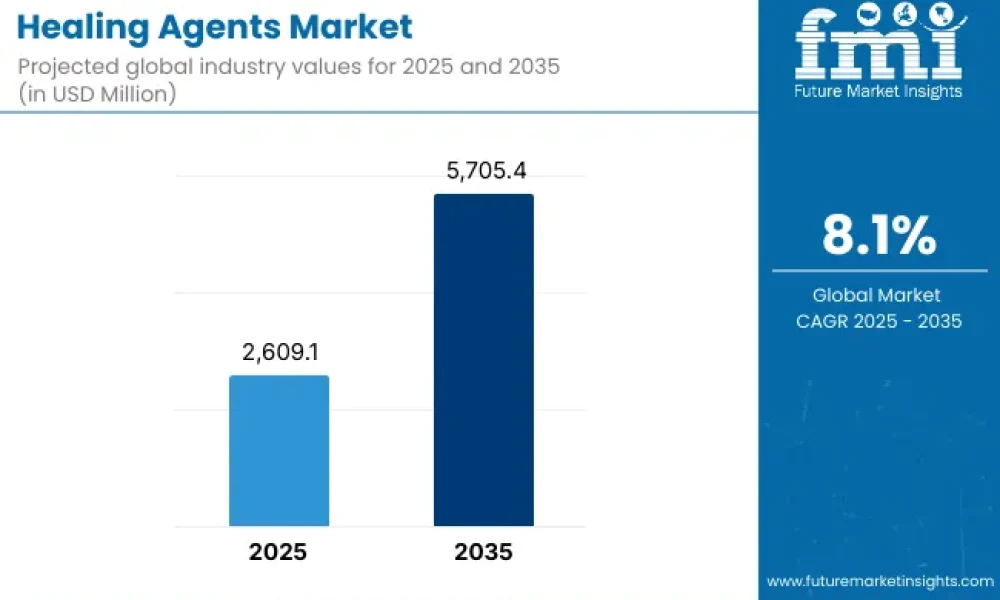
The Healing Agents Market (Skin Repair & Soothing Actives) is set for strong, sustained expansion over the next decade, rising from USD 2,609.1 Million in 2025 to USD 5,705.4 Million by 2035. This growth—representing an increase of USD 3,096.3 Million—reflects rising consumer preference for clinically validated ingredients that target barrier repair, irritation reduction, and recovery support in both dermocosmetic and OTC formulations.
Subscribe for Year-Round Insights → Stay ahead with quarterly and annual data updates: https://www.futuremarketinsights.com/reports/sample/rep-gb-26703
Market Overview
The market is projected to grow at a CAGR of 8.1% (2025–2035), driven by the demand for:
- Sensitive-skin solutions
- Post-procedure recovery actives
- Encapsulated delivery technologies
- Biotechnology-derived ingredients with high reproducibility
By 2025, biotechnology-derived actives hold 33.5% market share, highlighting a significant shift toward clean, traceable, and regulated ingredient sourcing.
Key Market Highlights
- Market Value 2025: USD 2,609.1 Million
- Market Forecast 2035: USD 5,705.4 Million
- CAGR (2025–2035): 8.1%
- Top Players: DSM-Firmenich, Givaudan, Symrise, Croda, BASF, Seppic, Ashland, Clariant, Lubrizol, Greentech
- Leading Regions: China, India, Japan, Europe, USA
- Dominant Category 2025: Biotechnology-derived actives (33.5% share)
Why the Healing Agents Market Is Growing
Several transformative drivers are shaping demand:
- Rising Sensitive-Skin Incidences
Pollution, active-ingredient-heavy routines, and lifestyle stressors are increasing cases of redness, dryness, and irritation.
- Boom in Post-Procedure Recovery
Growth in cosmetic dermatology procedures—laser, chemical peels, microneedling—has created strong need for high-efficacy repair and soothing actives.
- Shift Toward Biotechnology-Derived Actives
These ingredients offer:
- Controlled quality
- Batch consistency
- Sustainability advantages
- Regulatory compliance
- Encapsulation Technology Becoming Mainstream
Encapsulated formats improve:
- Stability
- Bioavailability
- Irritation control
- Targeted release
- Expansion of Premium Skincare in Asia
China and India are emerging as the fastest adopters of clinical-grade skincare, driving demand for advanced actives.
Segmental Insights
- Active Class – Barrier Lipids & Ceramides Lead
- 33.5% share in 2025 (USD 874.05 Million)
- Preferred for restoring barrier function, reducing TEWL, and improving resilience
- High adoption in dermocosmetic and recovery formulations
- Source – Biotechnology-Derived Actives Dominate
- 35.9% share in 2025 (USD 936.67 Million)
- Valued for traceability, clean-label compliance, and reproducibility
- Delivery System – Encapsulation Drives Innovation
- 47.4% share in 2025 (USD 1,236.71 Million)
- Enhances efficacy while minimizing irritation
- Increasingly used in premium and OTC products
Geographical Outlook
India – Fastest Growing Market
- 14.5% CAGR
- Driven by rising middle-class spending and strong OTC penetration
China – Strong Premiumization Momentum
- 12.9% CAGR
- Government support for domestic biotech production
Japan – High Clinical Preference
- 10.5% CAGR
- Strong demand for encapsulated and biotech-derived actives
Europe – Compliance-Driven Growth
- 7.8% CAGR
- UK and Germany prioritize irritation-free formulations
USA – Mature But Expanding Premium Segment
- 5.4% CAGR
- Growth supported by sensitive-skin and baby-care categories
Competitive Landscape
The market is moderately fragmented, with global leaders expanding through innovation and clinical validation.
- Givaudan leads with 8.1% global share, supported by strong biotech and encapsulation technologies.
- DSM-Firmenich, BASF, Croda, Symrise, Lubrizol, and Seppic continue to invest in microbiome, postbiotic, and ceramide systems.
- Niche players emphasize botanical and marine-derived actives with natural-origin positioning.
Competitive differentiation is shifting toward:
- Clinical claims
- Evidence-backed efficacy
- Encapsulation technologies
- Regulatory compliance
- Sustainability and traceability
Recent Industry Developments
- January 2025: La Roche-Posay introduced a new ceramide-rich, encapsulation-enhanced Toleriane Ultra formula targeting chronic sensitivity.
- September 2025: Galderma launched a biotechnology-peptide-based post-procedure soothing concentrate showing rapid redness reduction within 12 hours.
Outlook to 2035
The next decade will see:
- Wider adoption of biotechnology-derived inputs
- Stronger demand for encapsulated systems
- Increased premium skincare penetration in Asia
- More stringent regulatory frameworks
- Greater emphasis on clinical claims and irritation-free performance
By 2035, the market will be defined by advanced bio-active technologies, sustainable sourcing, and clinical-grade formulation strategies, positioning healing agents as a core pillar of the global skincare industry.
Have a specific Requirements and Need Assistant on Report Pricing or Limited Budget please contact us – [email protected]
About Future Market Insights (FMI)
Future Market Insights, Inc. (FMI) is an ESOMAR-certified, ISO 9001:2015 market research and consulting organization, trusted by Fortune 500 clients and global enterprises. With operations in the U.S., UK, India, and Dubai, FMI provides data-backed insights and strategic intelligence across 30+ industries and 1200 markets worldwide.



