
The U.S. Bone Morphogenetic Protein (BMP) market is entering a decade of steady, data-supported growth driven by rising procedural volumes in spinal fusion, expanding applications in orthopedic reconstruction, continued clinical confidence in BMP-2 technology, and incremental innovation in scaffolds, carriers, and regenerative platforms. From a 2024 revenue baseline slightly above USD 130 million, the U.S. market is projected to advance at a 4–5% compound annual growth rate (CAGR) from 2025 to 2035, placing it among the most stable segments within the orthopedic biologics landscape.
As the nation faces a growing aging population and rising incidence of degenerative spine conditions, the need for strong, predictable bone regeneration technologies is accelerating. Bone Morphogenetic Proteins—especially rhBMP-2—remain at the forefront due to their well-characterized mechanism of action, clinical outcomes in complex cases, and ability to reduce the need for autograft harvesting.
To access the complete data tables and in-depth insights, request a Discount On The Report here: https://www.factmr.com/connectus/sample?flag=S&rep_id=11920
Market Outlook: 2025–2035
Between 2025 and 2035, the U.S. BMP market is expected to experience consistent growth shaped by procedural demand, reimbursement patterns, and technology evolution. Forecasts indicate that by 2035, the market value could approach or exceed USD 200–220 million, depending on adoption rates and the regulatory landscape.
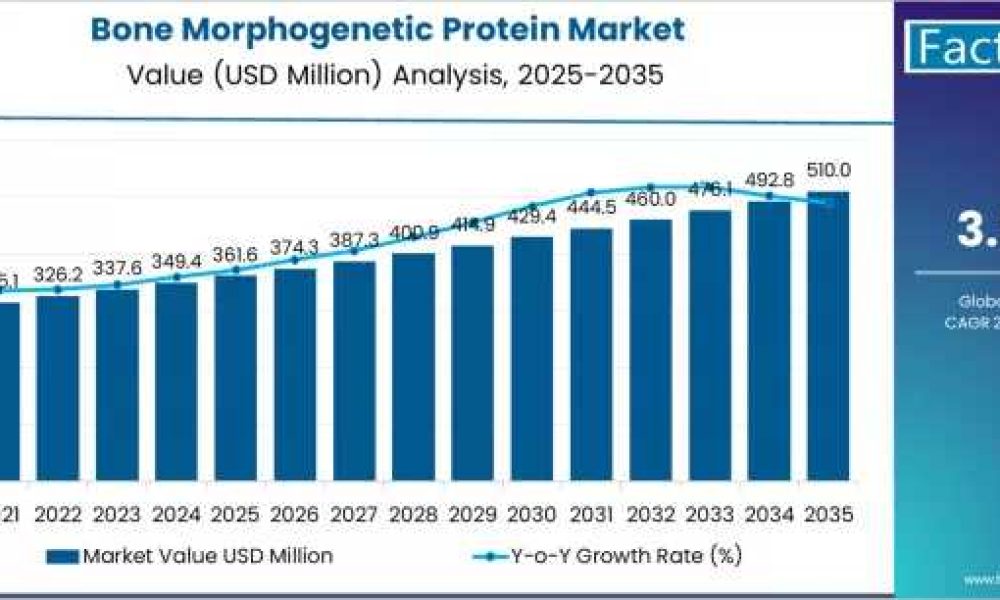
This growth trajectory aligns with global BMP projections, which anticipate the worldwide market to increase from roughly USD 358 million in 2025 to over USD 575 million by 2035. The U.S. is projected to retain one of the largest national market shares thanks to its high surgery volume, well-established orthopedic infrastructure, and early adoption of advanced regenerative products.
Key Growth Drivers
1. Rising Spinal Fusion Volume
Spinal fusion remains the single largest clinical application for BMPs. In the U.S., spinal fusion procedure volumes have grown steadily due to:
increased diagnosis of degenerative disc disease,
higher prevalence of chronic back pain,
expanding use of minimally invasive surgical techniques,
improved perioperative recovery protocols.
BMPs are especially valuable in multilevel fusions, revision surgeries, and cases where autograft quantity or quality is limited.
2. Clinical Benefits Over Autograft
Bone autograft harvesting—traditionally the gold standard—carries risks such as donor site pain, longer operative time, and potential complications. BMPs reduce these burdens, making them highly attractive for:
elderly patients,
high-risk patients with reduced bone quality,
surgeons seeking more predictable fusion rates.
The reduction in operative time and postoperative complications remains a key cost and clinical advantage.
3. Dominance of rhBMP-2
Recombinant human BMP-2 continues to represent the majority of BMP revenue due to:
strong clinical evidence,
long-standing surgeon familiarity,
proven outcomes in spinal fusion and select off-label settings.
Although debates about dosage have persisted historically, improved patient selection and modern carrier technologies have increased confidence in safety profiles.
4. Innovation in Carriers and Delivery Systems
Next-generation BMP technologies are being developed to:
improve controlled release,
reduce postoperative inflammation,
minimize ectopic bone growth,
enhance handling properties in minimally invasive approaches.
These innovations are expected to support broader adoption and open new clinical indications throughout the forecast period.
Ongoing Challenges
1. Reimbursement Pressures
Despite their clinical benefits, BMPs remain costly relative to traditional bone graft substitutes. Hospitals operating under value-based care and bundled payment models often restrict BMP usage to the most appropriate, high-value cases.
2. Competition from Alternatives
The BMP market competes with:
synthetic bone graft substitutes,
demineralized bone matrices (DBMs),
cellular bone matrices (CBMs),
autologous stem cell–based therapies.
Many of these alternatives offer lower prices and fewer regulatory restrictions, challenging BMP growth outside high-complexity procedures.
3. Legacy Safety Concerns
Earlier scrutiny related to off-label use and high-dose formulations has led to conservative adoption policies at some institutions. Improved clinical guidelines and reduced dosing strategies continue to rebuild confidence, but the effects are still felt in certain regions and payer groups.
Segment Forecasts
By Product Type
rhBMP-2: Maintains the dominant share through 2035 with steady volume growth.
Next-generation BMP variants: Expected to expand gradually as innovations receive regulatory clearance.
Combination products (BMP + scaffold or BMP + synthetic graft): Forecasted to grow faster than standalone BMPs due to enhanced control and improved outcomes.
By Application
Spinal Fusion: Likely to remain the largest segment and primary revenue driver.
Orthopedic Trauma & Reconstruction: Increasing interest in segmental defect repair and nonunions supports additional growth.
Dental and Maxillofacial Surgery: A smaller but expanding niche with rising cosmetic and reconstructive procedure volumes.
Strategic Opportunities for Stakeholders
For Manufacturers
Invest in dose-optimized, next-gen BMP formulations to improve safety and reduce cost per case.
Develop advanced carriers and delivery devices compatible with minimally invasive approaches.
Strengthen clinical evidence in revision and multilevel fusion markets.
Pursue partnerships with digital surgical planning and navigation companies for integrated procedural solutions.
For Healthcare Providers
Implement BMP stewardship programs to align product use with evidence-based criteria.
Track real-world outcomes to support payer negotiations and internal value analyses.
Educate surgical teams on optimized dosing and patient selection.
For Investors
Expect stable, moderate returns rather than disruptive hypergrowth.
Watch for entrants developing novel delivery systems or BMP-mimetic peptides.
Consider long-term potential in trauma, oncology reconstruction, and dental markets.
Market Scenarios (2025–2035)
Base Case
CAGR: 4–5%
Steady spinal volume growth
Incremental adoption of next-gen BMP carriers
Upside Scenario
Broader reimbursement support
Regulatory approval of safer, lower-dose BMPs
CAGR could rise to 6–7%
Downside Scenario
Increased competition from lower-cost graft substitutes
Stricter payer restrictions
CAGR falls to 2–3%
Conclusion
The U.S. Bone Morphogenetic Protein market is poised for reliable, data-supported expansion through 2035. While not a hypergrowth sector, BMPs remain indispensable in complex spinal and orthopedic cases where predictability and biological potency matter most. With a projected CAGR of 4–5% and continued innovation on the horizon, the BMP landscape will evolve steadily, driven by clinical need, technological refinement, and a focus on evidence-based value.
Have a specific Requirements and Need Assistant on Report Pricing or Limited Budget please contact us – [email protected]
To View Related Report :
Bone Marrow Transplantation Market https://www.factmr.com/report/bone-marrow-transplantation-market
Bone Growth Stimulator Market https://www.factmr.com/report/54/bone-growth-stimulator-market
“



