
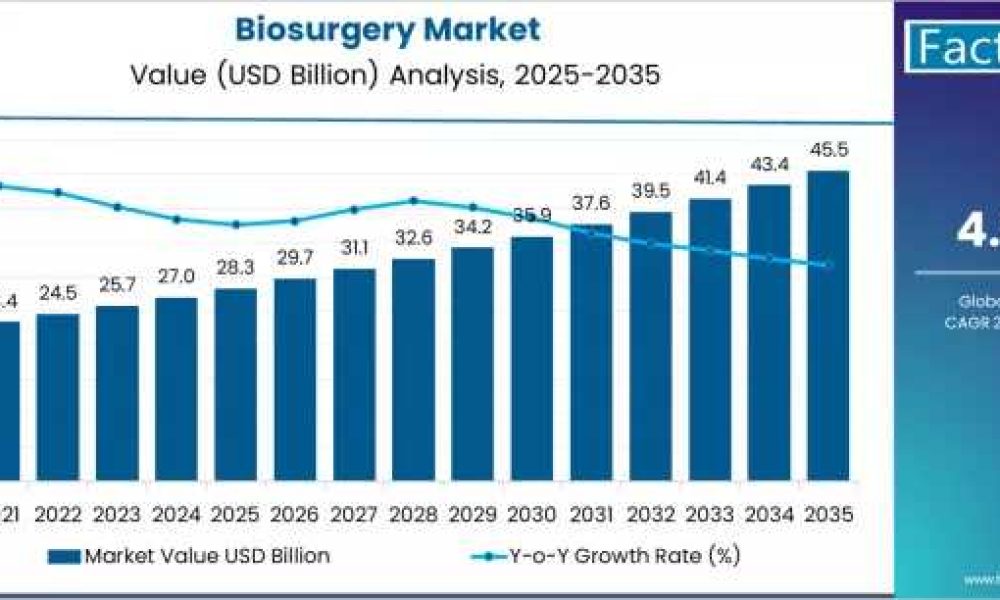
The U.S. biosurgery market—encompassing hemostats, sealants, adhesion barriers, soft-tissue repair adjuncts, bone graft substitutes, and biologically active surgical materials—is entering a decade of steady, innovation-driven expansion. In 2025, the market is widely estimated to stand in the $5.8–6.0 billion range. Over the next ten years, structural shifts in surgery, technological advancements, and broader adoption across high-volume specialties are set to fuel growth. Depending on industry assumptions, the market is projected to reach $9.5–13.3 billion by 2035, reflecting conservative to high-growth scenarios.
1. Market Overview: A Strong Base Entering 2025
Biosurgery products have become essential tools for reducing intraoperative bleeding, minimizing postoperative complications, and improving recovery times. Hospitals and ambulatory surgical centers have integrated these solutions into standard protocols across cardiovascular, orthopedic, neuro, general, and reconstructive surgeries. The U.S. remains the largest biosurgery market globally due to its high surgical volumes, strong reimbursement environment for advanced devices, and rapid adoption of new biomaterials.
To access the complete data tables and in-depth insights, request a Discount On The Report here: https://www.factmr.com/connectus/sample?flag=S&rep_id=11906
In 2025, several product categories dominate revenue:
Hemostatic agents and sealants remain the largest contributors due to broad usage across nearly every surgical specialty.
Bone graft substitutes and biologics command strong demand in orthopedics and spine care.
Adhesion barriers and anti-leak sealants continue to expand as minimally invasive surgeries grow.
Regenerative and bioactive materials represent a smaller portion but have some of the highest growth potential.
2. Growth Forecast 2025–2035: Market Outlook by Scenario
Forecasting growth through 2035 requires analyzing three types of scenarios—conservative, central, and optimistic—based on different assumptions about procedure volumes, pricing, innovation, and regulatory dynamics.
Conservative case (≈4.8–5.0% CAGR)
This scenario assumes moderate surgical volume growth, stable pricing, and incremental—not breakthrough—innovation. Under these conditions, the market grows from approximately $5.86B in 2025 to around $9.4–9.6B by 2035.
Central case (≈5.5–6.0% CAGR)
This is the most realistic trajectory for the sector. It incorporates ongoing expansion in robotic and minimally invasive surgeries, regular product upgrades, broader hospital adoption, and manageable pricing pressure. Under this model, the market achieves $10.0–10.4B by 2035.
Optimistic case (≈8.0–8.6% CAGR)
The high-growth scenario assumes accelerated innovation, faster uptake of novel biologic scaffolds, and wider adoption of outpatient surgical centers performing complex procedures. Under these conditions, the market could climb toward $13B+ by 2035.
Across all scenarios, the U.S. biosurgery market remains a stable, upward-trending segment with strong demand support from clinical and economic value drivers.
3. Key Market Drivers Through 2035
1. Rising Surgical Volumes
The aging U.S. population, combined with increased incidence of chronic diseases, is projected to raise demand for orthopedic, cardiovascular, oncology, and general surgeries. Elective surgery volumes, which have recovered from pandemic disruptions, are expected to grow steadily through 2035. More surgeries translate directly into higher usage of biosurgical adjuncts.
2. Expansion of Minimally Invasive and Robotic Procedures
Robotic systems and advanced laparoscopic platforms enable more precise and complex procedures. These approaches rely heavily on high-performance hemostats and sealants that function effectively in confined spaces. The trend toward same-day surgery centers further reinforces the need for products that reduce bleeding, leaks, and complications.
3. Technology Innovation and Product Pipeline Growth
Manufacturers are investing in next-generation biologic matrices, advanced synthetic sealants, sprayable hemostats, bioresorbable scaffolds, and combination products designed to deliver both mechanical and biological benefits. Improvements in ease of use, activation time, storage conditions, and application mechanisms are increasing adoption across specialties.
4. Economic Pressures Favoring High-Value Solutions
Hospitals continue to prioritize products that shorten operating room times, reduce transfusion rates, and decrease readmission risks. Biosurgery products that demonstrably reduce total episode-of-care costs—even if their unit price is higher—are gaining preference on value-based purchasing lists.
4. Segment-Level Insights
Hemostats and Tissue Sealants
This segment will remain the largest revenue contributor. Innovations such as faster-acting flowable hemostats, dual-polymer sealants, and bioactive materials are helping clinicians reduce bleeding more reliably and quickly. Adoption is especially strong in cardiac, thoracic, liver, and reconstructive surgeries.
Bone Graft Substitutes and Biologic Materials
Driven by an aging population and rising joint replacement and spine surgery volumes, this category is expected to grow above the market average. Synthetic ceramics, demineralized bone matrices, and stem-cell-enhanced biologics represent areas of strategic focus.
Adhesion Barriers and Soft-Tissue Repair Adjuncts
As procedural complexity rises, so does the demand for barriers that reduce adhesions and fibrosis. Growth will be supported by expanding indications in gynecologic, colorectal, and general surgery.
5. Competitive Landscape and Strategic Dynamics
The competitive environment is led by major medtech companies with broad surgical portfolios, strong distribution networks, and robust clinical education platforms. However, smaller biotechnology and biomaterials companies are increasingly contributing breakthrough innovations that reshuffle competitive positioning.
Key strategic themes shaping competition include:
Acquisition of niche biosurgery innovators by large device manufacturers
Integration of biosurgery products into robotic-assisted surgical platforms
Expansion of single-use and easy-application solutions to reduce OR complexity
Greater emphasis on evidence-based marketing tied to cost and outcome improvements
Over the next decade, companies able to bundle biosurgical tools with instruments, robotics, and digital surgery solutions will gain competitive advantage.
6. Risks and Constraints
While growth fundamentals are strong, the market faces several constraints:
Pricing pressure as hospitals aim to reduce supply-chain costs
Regulatory scrutiny for complex biologics and regenerative materials
Slower adoption in procedures with well-established surgical protocols
Variability in reimbursement for novel biosurgical technologies
Competition from alternative techniques such as advanced suturing devices or energy-based hemostatic tools
These factors may temper growth in specific subsegments but are unlikely to derail the overall expansion trajectory.
7. Conclusion: Outlook for 2035
Between 2025 and 2035, the U.S. biosurgery market is positioned for durable, moderate-to-strong growth. Under central expectations, the market will expand from roughly $6B to just over $10B, driven by rising surgical volumes, biomaterial innovation, and the growing importance of technologies that support safer, faster, and minimally invasive procedures.
The next decade will reward companies delivering clinically proven, easy-to-use, and cost-efficient solutions that integrate seamlessly into modern surgical workflows. As biosurgery evolves from a set of supplemental products to a critical component of procedural success, its strategic importance across the U.S. healthcare system will only continue to rise.
Have a specific Requirements and Need Assistant on Report Pricing or Limited Budget please contact us – [email protected]
To View Related Report :
Endoscope Washer Disinfector Market https://www.factmr.com/report/endoscope-washer-disinfector-market
Endoluminal Suturing Devices Market https://www.factmr.com/report/endoluminal-suturing-devices-market
Electronic Drug Delivery Systems Market https://www.factmr.com/report/electronic-drug-delivery-systems-market
Breast Cancer Drugs Market https://www.factmr.com/report/breast-cancer-drugs-market
“



