
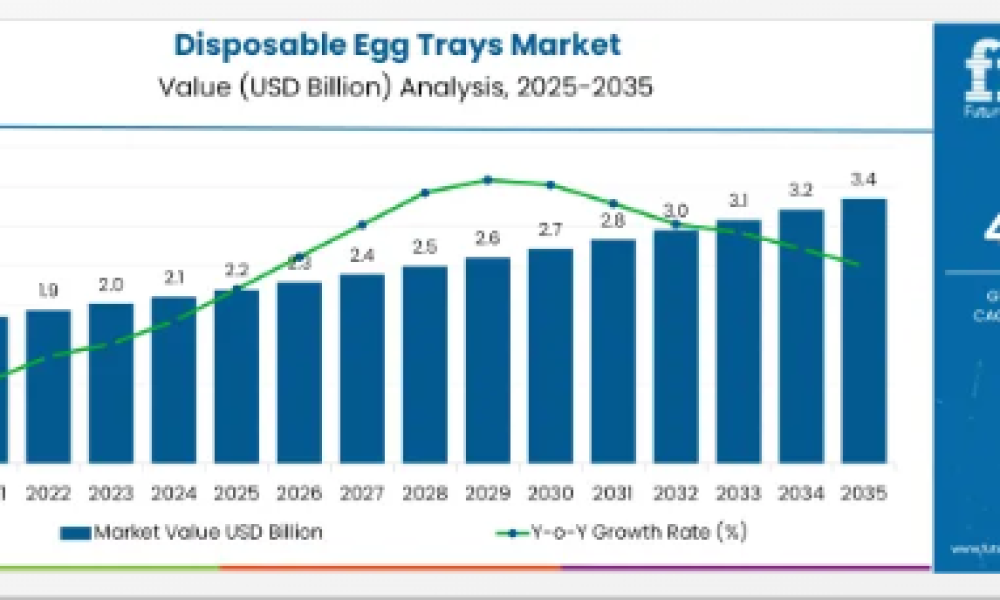
The global disposable egg trays industry is entering a high-growth phase, underpinned by the poultry sector’s surging demand for sustainable, protective packaging. Fueled by rising concerns around food safety, biosecurity, and environmental impact, the market is expected to expand from an estimated US$ 2.2 billion in 2025 to approximately US$ 3.4 billion by 2035, representing a compound annual growth rate (CAGR) of 4.3 percent.
Key Market Insights at a Glance
A steady shift toward recyclable and compostable materials is a dominant driver. As retailers and regulators push for greener packaging, manufacturers are embracing molded-pulp and recycled-paper egg trays that balance structural strength with environmental stewardship. The forecasted rise in global egg production and consumption further underpins demand, especially in regions where robust logistics and shelf-life requirements necessitate dependable packaging. Notably, the growing prevalence of online ordering in agriculture has boosted the adoption of disposable trays via digital channels, enabling faster restocking and wider reach.
Segment Overview
In terms of cavity type, trays holding 2 to 6 eggs command the highest market share in 2025, accounting for about 38.2 percent of global revenue. These smaller-format trays remain popular due to their efficiency in transportation and handling. When it comes to material type, paper egg cartons dominate, especially recycled paper and molded pulp variants that combine sustainability and cushioning performance, representing approximately 34.6 percent of the market. On the sales-channel front, the online segment is emerging as a key revenue source, capturing over 28 percent of sales by giving smaller poultry farms and retailers access to a broad range of packaging options with flexible procurement
Regional Overview
Geographically, Asia-Pacific, North America, and Europe are poised to lead growth. In Asia-Pacific, rapid urbanization, digitization of supply chains, and booming poultry production are elevating demand for disposable trays. Meanwhile, sustainability regulations and eco-conscious consumer bases in North America and Europe are accelerating the transition to molded-pulp trays. Together, these regions are shaping global innovation trajectories, from biodegradable designs to smart packaging that leverages lightweight materials without compromising strength.
Competitive Landscape
The competitive landscape is dynamic but moderately consolidated. Tier-1 companies such as Huhtamaki, Hartmann, and CDL Omnipac dominate roughly 29 percent of the market with their investments in advanced molding technologies and sustainable materials. Tier-2 players—including Pactiv Evergreen and Tekni-Plex—hold about 38 percent, focusing on cost-efficient, lightweight, and digitally printed solutions. Meanwhile, regional and niche manufacturers comprise Tier-3, exploring compostable, high-barrier trays suited to local or specialized markets.
Market Outlook: Powering the Next Decade
Over the coming ten years, growth will be propelled by three intertwined trends: sustainability, e-commerce penetration, and packaging innovation. Regulatory pressure and consumer demand are expected to drive further adoption of molded-pulp and recycled-paper trays. E-commerce platforms—especially in emerging markets—will continue to disrupt traditional procurement by enabling small farms and retailers to access sustainable packaging at scale. At the same time, technological advancements in pulp molding, automation, and even smart packaging (e.g., moisture-resistant or traceable trays) will enhance cost efficiency and egg protection across the value chain.
Key Players of the Sustainable Tray Industry
Prominent market players shaping this transformation include Pacific Pulp Molding LLC, KSP Fibre Products, Cosmoplast Ind. Co., Cascades Inc., Hartmann, and Huhtamaki Brazil. These companies are leveraging their production scale, innovative mold design, and sustainability commitments to maintain leadership while expanding into high-growth geographies such as South Asia and Latin America.
Recent Strategic Developments
Recent strategic moves underscore the industry’s pivot to sustainability. For instance, Hartmann’s acquisition of an Indian fiber-tray manufacturer has strengthened its foothold in South Asia, while Huhtamaki’s R&D efforts have focused on fully recyclable molded-fiber trays that reduce breakage and waste. On the innovation front, many producers are investing in automated molding lines and exploring barrier enhancements and traceability features to meet retailer and regulatory demands for quality and transparency.
Subscribe for Year-Round Insights → Stay ahead with quarterly and annual data updates: https://www.futuremarketinsights.com/reports/sample/rep-gb-13658
Have a specific Requirements and Need Assistant on Report Pricing or Limited Budget please contact us – [email protected]
About Future Market Insights (FMI)
Future Market Insights, Inc. (FMI) is an ESOMAR-certified, ISO 9001:2015 market research and consulting organization, trusted by Fortune 500 clients and global enterprises. With operations in the U.S., UK, India, and Dubai, FMI provides data-backed insights and strategic intelligence across 30+ industries and 1200 markets worldwide.



