
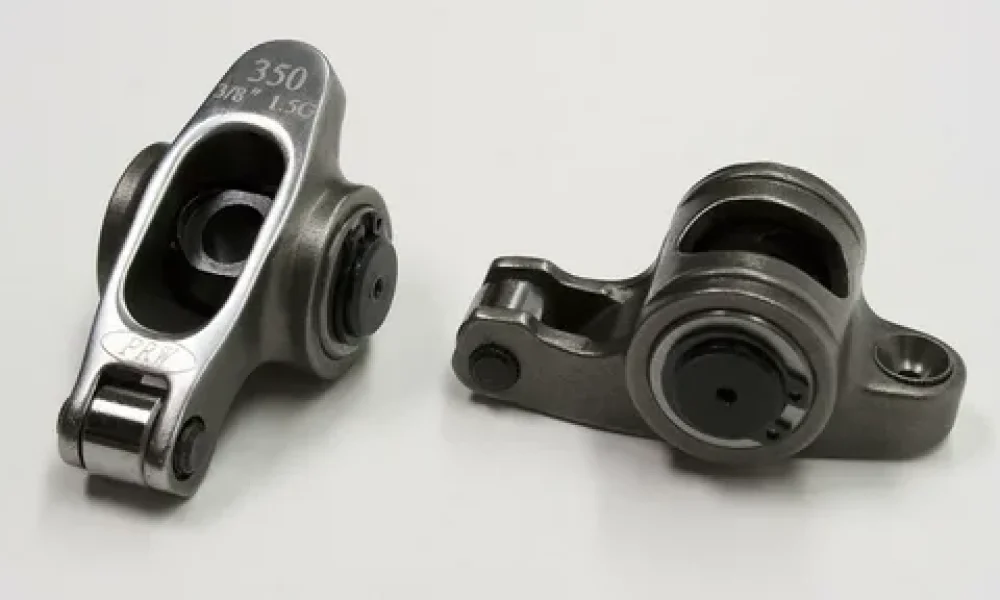
The global automotive rocker arm market is projected to grow from USD 11,693.8 million in 2025 to USD 20,233.2 million by 2035, reflecting a CAGR of 5.6% over the forecast period. Market expansion is primarily supported by rising vehicle production, increasing focus on fuel-efficient valvetrain systems, and the adoption of high-performance engine architectures across passenger and commercial vehicles.
Key Market Developments and Technological Innovations
In early 2024, Rheinmetall confirmed a low double-digit million-euro order for rocker arm bushings from a globally active automaker. These components, designed for heavy-duty engine variants, are engineered to reduce friction losses, improve cylinder fill, and enhance thermal efficiency under high-RPM operation.
Throughout 2024, innovations in material science and geometry have continued to advance rocker arm performance. Roller rocker arms with hardened contact areas and integrated bearings have emerged, reducing wear and sustaining high-speed valve operation. Notably, patent CN201802814U introduced a roller-follower rocker arm with reduced mass and enhanced load-bearing properties, targeted at racing and high-output vehicles.
The market has also benefited from hybrid and turbocharged engine platforms, where steel alloy rocker arms are reinforced to handle frequent ignition cycling and elevated valvetrain pressures. Lightweight aluminum and high-strength alloy rocker arms are increasingly deployed in motorsport, adventure, and performance applications, with anti-corrosion finishes and sealed bearings extending service life in humid or salt-prone environments.
Subscribe for Year-Round Insights → Stay ahead with quarterly and annual data updates
https://www.futuremarketinsights.com/reports/sample/rep-gb-3388
Market Segmentation and Investment Insights
By Design: Full Roller Rocker Arms Lead
Full roller rocker arms are estimated to account for 36% of the global market in 2025, with a projected CAGR of 6.3% through 2035. Their low-friction design reduces wear and parasitic losses, supporting engine efficiency, durability, and precise valve actuation. Full roller designs are preferred in high-performance and turbocharged powertrains, particularly in North America and Europe, where fuel economy standards drive the adoption of lightweight, high-strength materials and advanced heat-treated alloys.
By Engine: Overhead Cam (OHC) Dominates
OHC engines are projected to represent 61% of global rocker arm demand in 2025, growing at a CAGR of 6.2% through 2035. These engines support higher RPMs, improved airflow, and compact designs, making them ideal for passenger vehicles and light commercial vehicles. Rocker arms in OHC engines are increasingly designed for precision motion control and reduced mass, enabling compatibility with variable valve timing (VVT) and hybrid powertrain configurations.
Challenges and Market Dynamics
Challenges
- Electric Vehicle (EV) Adoption: EVs do not require conventional valvetrain components, including rocker arms. Accelerated EV production may gradually reduce demand for traditional rocker arms, particularly in mature markets. Manufacturers are responding by targeting hybrid and ICE-reduction technologies, ensuring relevance in high-performance and fuel-efficient engines.
- Raw Material and Manufacturing Costs: The volatility of aluminum, steel, and composite prices affects manufacturing costs, while precision engineering, automation, and quality control contribute to high investment requirements. Manufacturers are exploring molecular composites, advanced coatings, and lightweight alloys to balance performance and cost-efficiency.
Opportunities
- Lightweight, High-Strength Materials: Advanced materials, including aluminum, titanium, and carbon-fiber composites, offer reduced engine weight, improved fuel efficiency, and extended service life. These materials are increasingly applied in motorsport, adventure, and hybrid engines.
- Aftermarket Performance Upgrades: Enthusiast and professional markets drive demand for roller rocker arms, hydraulic lifters, and VVT-compatible components. Motorsport events, engine tuning, and aftermarket customization continue to create growth opportunities.
Country-Wise Insights
- United States (CAGR 5.8%): Growth driven by fuel-efficient engines, hybrid adoption, and high-performance aftermarket components. Manufacturers increasingly utilize aluminum and composite alloys to meet EPA emission standards while supporting performance vehicle upgrades.
- United Kingdom (CAGR 5.3%): Steady growth fueled by emissions regulations, hybrid engine adoption, and motorsport demand, encouraging lightweight, high-strength rocker arms for high-performance applications.
- European Union (CAGR 5.6%): Euro 7 regulations and a shift toward hybrid and TGDI engines drive demand for low-friction, durable rocker arms. Germany, France, and Italy lead in implementing advanced materials and manufacturing techniques.
- Japan (CAGR 5.2%): Sustained demand due to hybrid production, precision engineering, and high-performance vehicle trends. Automotive R&D focuses on digital valve-train control and lightweight rocker arms.
- South Korea (CAGR 5.9%): Growth driven by hybrid and electric-assisted engines, lightweight material adoption, and smart manufacturing. Companies like Hyundai and Kia are leveraging roller rocker arms and robotic production to optimize efficiency.
Competitive Landscape
The market remains competitive and innovation-driven, with key players focusing on precision engineering, lightweight materials, and performance optimization. Leading companies include:
- Jesel Valvetrain Innovation
- Harland Sharp
- PRW Industries Inc.
- Yella Terra
- Smith Brothers Pushrods
- Manton Pushrods
- Rocker Arm Specialist
- Elgin Industries
- Autowin Rocker Arm Co.
- Melling Engine Parts
Material and design innovations, such as aluminum roller rockers, high-strength alloy aluminum, and chrome-moly steel, continue to support growth, particularly in performance and hybrid engine segments.
Personalize Your Experience: Ask for Customization to Meet Your Requirements
https://www.futuremarketinsights.com/customization-available/rep-gb-3388
Competitive Landscape
With projected growth to USD 20.2 billion by 2035, the automotive rocker arm market is poised for sustained expansion. Key drivers include fuel efficiency regulations, hybrid powertrain adoption, lightweight material utilization, and aftermarket performance upgrades. Manufacturers investing in roller and low-friction rocker arm technologies, advanced alloys, and precision engineering are well-positioned to capitalize on evolving engine architectures globally.
Key Segments: By Design – Stamped Steel, Roller-tipped, Full Roller, Shaft, Centre Pivot, End Pivot; By Engine – Push Rod, OHC, Other; By Material – Steel, Aluminum, Alloy, Chrome-moly Steel; By Vehicle – Passenger, SUV, Luxury, Commercial; By Fuel – Petrol, Diesel; By Region – North America, Latin America, Western Europe, South Asia, East Asia, Eastern Europe, Middle East & Africa
Why Choose FMI: Empowering Decisions that Drive Real-World Outcomes: https://www.futuremarketinsights.com/why-fmi
About Future Market Insights (FMI)
Future Market Insights, Inc. (FMI) is an ESOMAR-certified, ISO 9001:2015 market research and consulting organization, trusted by Fortune 500 clients and global enterprises. With operations in the U.S., UK, India, and Dubai, FMI provides data-backed insights and strategic intelligence across 30+ industries and 1200 markets worldwide.



