
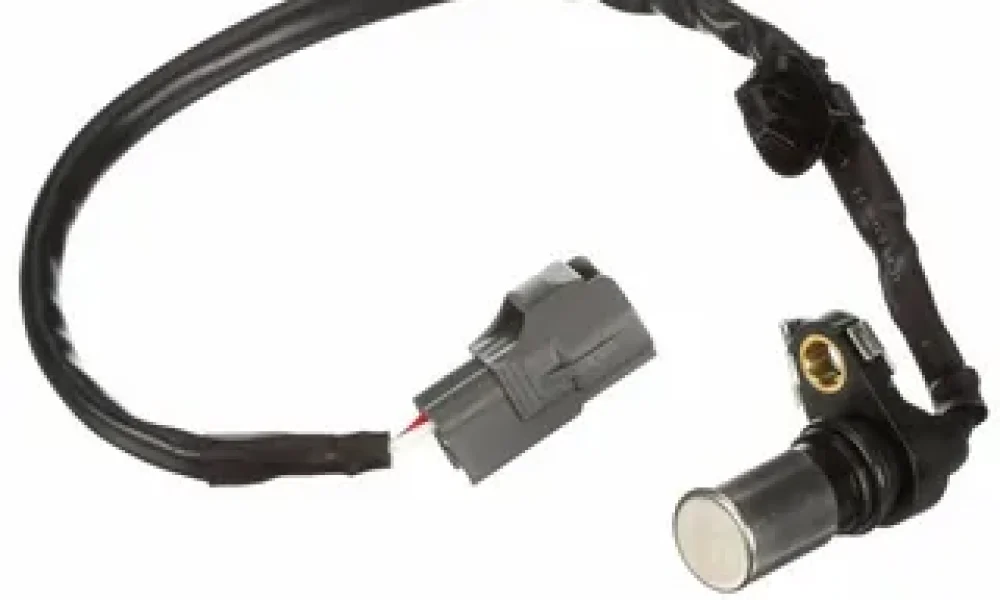
The global crankshaft position sensor market is poised for robust growth, projected to increase from USD 594 million in 2025 to USD 1,380 million by 2035, reflecting a CAGR of 8.8% during the forecast period. The market expansion is being driven by tightening emission regulations, increased integration of electronic engine control units (ECUs), and ongoing advancements in powertrain sensing technologies across both internal combustion engine (ICE) and hybrid/electric platforms.
Innovations in Sensor Technology Driving Market Expansion
In 2024, Standard Motor Products significantly expanded its portfolio by launching over 150 new crankshaft and camshaft sensor SKUs for ICE and hybrid vehicles in North America and Europe. These sensors, validated against OBD-II diagnostic benchmarks, are designed to meet precision requirements in emission-critical systems, supporting applications such as ignition timing, fuel injection synchronization, and variable valve timing (VVT).
Similarly, Allegro MicroSystems unveiled inductive position sensors engineered for high-temperature and high-RPM environments. Featuring solid-state magnetic detection, wide air-gap tolerance, and compliance with ASIL-B safety protocols, these sensors are optimized for integration into crankshaft sensing rings and hybrid starter-generator modules.
Modern vehicle architectures, including V6 and turbocharged I4 engines, increasingly rely on crankshaft sensors for monitoring misfires and crankshaft acceleration. Belt starter-generator (BSG) modules and mild hybrid systems have also adopted these sensors, reflecting the critical role of rotational position sensing in contemporary powertrains.
Subscribe for Year-Round Insights → Stay ahead with quarterly and annual data updates
https://www.futuremarketinsights.com/reports/sample/rep-gb-13697
Key Sensor Types and Applications
Hall-effect sensors continue to dominate the market, accounting for approximately 49% of total sensor share in 2025 and projected to grow at a CAGR of 8.9% through 2035. Their cost efficiency, compact form factor, and high reliability make them ideal for detecting position, speed, and rotation in ICE and electric vehicles (EVs). Hall-effect sensors are widely used in wheel speed sensors, electric power steering, battery management systems, throttle-by-wire modules, and regenerative braking applications.
Magneto-resistive, inductive, and optical sensors are also gaining traction, particularly for high-resolution applications, torque request monitoring, and integration with advanced driver-assistance systems (ADAS). Dual-output sensors are increasingly specified by OEMs to enhance redundancy and functional safety in critical engine and brake-by-wire systems.
Passenger Vehicles Lead Demand Growth
Passenger vehicles account for the largest market share in 2025 and are projected to grow at a CAGR of 9.0% through 2035. Growth is supported by increased adoption of electrified platforms, enhanced powertrain control, and expanding use of ADAS-related sensors. Mid-size SUVs, sedans, and electric passenger cars are seeing rising sensor intensity due to regulatory requirements for emissions, safety, and performance.
In EVs and hybrid vehicles, Hall-effect and magneto-resistive sensors play crucial roles in rotor position sensing, accelerator pedal modules, thermal management, and motor control. OEMs are scaling sensor deployment to support real-time engine monitoring, energy efficiency, and integration of auxiliary electrified systems.
Market Challenges
The crankshaft position sensor market faces several challenges:
- High manufacturing costs due to precision materials, thermal resilience, and EMI-resistant designs.
- Complex integration with ECUs, ADAS, and hybrid powertrains.
- Supply chain disruptions and semiconductor shortages, causing price volatility and production delays.
- Calibration and durability requirements for extreme temperature and high-RPM conditions.
Manufacturers are addressing these challenges through modular designs, automated manufacturing, multi-sourcing strategies, and investment in local production capabilities.
Emerging Opportunities
The market offers significant opportunities:
- Electrification of vehicles: EVs and HEVs require precise rotational monitoring for seamless powertrain switching and regenerative braking.
- Smart sensor integration: IoT-enabled, AI-powered sensors allow predictive maintenance, real-time diagnostics, and remote performance monitoring.
- Low-power, high-precision sensors: Innovations in solid-state and contactless sensor technologies improve efficiency and reliability while lowering maintenance costs.
By 2030, with EVs expected to comprise 50% of new vehicle sales, manufacturers offering advanced, energy-efficient sensors will gain a competitive edge.
Regional Market Outlook
- United States (CAGR 9.0%): Market growth is driven by rising adoption of advanced engine management systems, AI-based diagnostics, and increased EV penetration.
- United Kingdom (CAGR 8.6%): Expansion fueled by hybrid adoption, government fuel efficiency policies, and increasing demand for high-performance vehicles.
- European Union (CAGR 8.7%): Growth supported by Germany, France, and Italy through strict emission standards, AI-enhanced engine monitoring, and hybrid powertrain integration.
- Japan (CAGR 8.9%): Accelerated by hybrid/electric vehicle penetration, AI-based calibration, and precision sensor engineering.
- South Korea (CAGR 8.8%): Driven by EV adoption, smart vehicle technologies, and government-backed efficiency initiatives.
Personalize Your Experience: Ask for Customization to Meet Your Requirements
https://www.futuremarketinsights.com/customization-available/rep-gb-13697
Competitive Landscape
The market is moderately consolidated with global and regional players focusing on precision, durability, and smart sensing capabilities. Key players include:
- Mitsubishi Electric Corporation – High-efficiency sensors for ignition timing and fuel economy.
- Valeo S.A. – Contactless sensors with high durability and accuracy.
- Standard Motor Products, Inc. – Aftermarket sensors for hybrid and ICE vehicles.
- Hella GmbH & Co. KGaA – Precision sensors with integrated diagnostics.
- BorgWarner Inc. – Intelligent crankshaft sensors for advanced engine management.
Other emerging innovators are leveraging AI, IoT, and predictive maintenance technologies to differentiate product offerings and expand market reach.
Market Segmentation
By Sensor Type: Hall-effect, Magneto-resistive, Inductive, Optical
By Vehicle Type: Passenger Vehicles, Light Commercial Vehicles, Heavy Commercial Vehicles
By Sales Channel: OEM, Aftermarket
By Region: North America, Latin America, Europe, South Asia & Pacific, East Asia, Middle East & Africa
Why Choose FMI: Empowering Decisions that Drive Real-World Outcomes: https://www.futuremarketinsights.com/why-fmi
About Future Market Insights (FMI)
Future Market Insights, Inc. (FMI) is an ESOMAR-certified, ISO 9001:2015 market research and consulting organization, trusted by Fortune 500 clients and global enterprises. With operations in the U.S., UK, India, and Dubai, FMI provides data-backed insights and strategic intelligence across 30+ industries and 1200 markets worldwide.



