
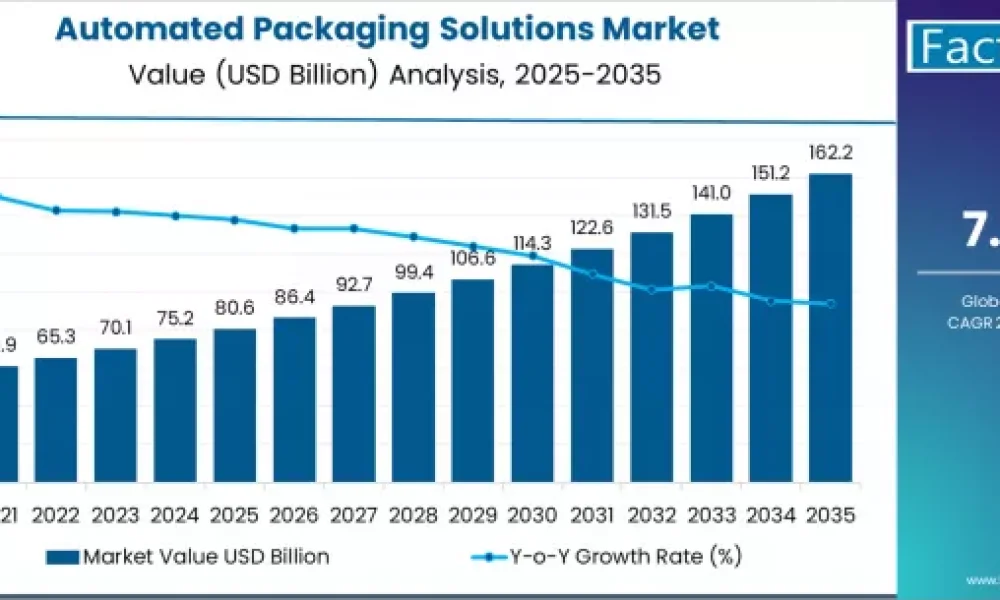
The U.S. automated packaging solutions market is set for steady growth from 2025 to 2035, driven by increasing demand for operational efficiency, labor cost reduction, and enhanced productivity across industries. Automated packaging solutions—including robotic case packers, palletizers, pick-and-place systems, conveyor-based solutions, and integrated software platforms—play a critical role in streamlining packaging operations in food and beverages, pharmaceuticals, e-commerce, and consumer goods sectors. This report provides insights on market size, growth drivers, U.S. regional dynamics, technological trends, and strategic implications for stakeholders.
Market Size and Growth
The U.S. automated packaging solutions market is projected to expand from approximately USD 2.4 billion in 2025 to around USD 4.1 billion by 2035, reflecting a compound annual growth rate (CAGR) of about 5.4%. The moderate yet sustained growth is indicative of increasing adoption of automated systems to address labor shortages, enhance packaging speed, and meet evolving consumer expectations for efficiency and quality.
To access the complete data tables and in-depth insights, request a Discount On The Report here: https://www.factmr.com/connectus/sample?flag=S&rep_id=11691
Key Growth Drivers
- Labor Cost Optimization and Efficiency: Rising labor costs and workforce challenges are encouraging manufacturers to adopt automated packaging systems that reduce dependency on manual labor while improving operational throughput.
- Technological Innovation: Advanced robotics, AI-enabled vision systems, and IoT-integrated automation platforms are improving accuracy, flexibility, and real-time monitoring in packaging processes. These innovations allow manufacturers to adapt quickly to changing product lines and packaging formats.
- E-commerce and Omnichannel Distribution Growth: The rapid expansion of e-commerce and direct-to-consumer sales channels is driving demand for flexible and high-speed automated packaging solutions capable of handling diverse product sizes and SKUs.
- Regulatory Compliance and Quality Assurance: Automated systems help maintain consistency in packaging quality, adhere to food safety and pharmaceutical regulations, and reduce errors and product recalls.
U.S. Market Insights
The United States represents a major market for automated packaging solutions, accounting for a substantial share of North American adoption. Industrial hubs in California, Texas, and the Midwest drive growth due to high manufacturing activity and the presence of leading food, beverage, and pharmaceutical companies. The market is witnessing increased deployment of modular and scalable solutions that can accommodate future growth while minimizing upfront investment.
Technology Trends and Competition
The U.S. market is highly competitive, with a combination of global automation solution providers and specialized domestic players. Key trends include:
- AI-driven robotic systemsfor faster and more precise packaging operations.
- Flexible conveyors and modular packaging linesto handle multiple product sizes and formats efficiently.
- Smart monitoring and predictive maintenanceto reduce downtime and improve overall equipment effectiveness (OEE).
These technological advancements enable manufacturers to improve throughput, reduce waste, and enhance operational resilience.
Challenges
Despite promising growth, the market faces certain constraints:
- High capital investment requirements for advanced automation solutions may deter small and medium enterprises.
- Integration complexity with existing production lines can slow adoption.
- Rapid technological advancements necessitate continuous staff training and software updates, which may increase operational costs.
Strategic Implications
For manufacturers and solution providers: Focus on developing flexible, scalable, and cost-effective solutions that cater to both large-scale operations and smaller facilities. Emphasize connectivity, predictive maintenance, and AI integration to provide competitive differentiation.
For industrial operators: Adopting automated packaging systems can reduce labor dependency, improve throughput, and maintain consistent quality while preparing for future scalability.
For investors: The U.S. automated packaging solutions market presents steady and resilient growth, supported by increasing e-commerce demand, industrial automation adoption, and technological innovation.
Outlook Summary
From 2025 to 2035, the U.S. automated packaging solutions market is expected to grow steadily, driven by labor cost pressures, technological advancements, and increasing consumer demand for faster and more efficient packaging operations. Adoption of AI, robotics, and IoT-enabled platforms will enhance operational efficiency and flexibility, while challenges related to high capital costs and integration complexity remain. Overall, the market offers strong opportunities for manufacturers, industrial operators, and investors focused on innovation, efficiency, and quality in packaging processes.
Have a specific Requirements and Need Assistant on Report Pricing or Limited Budget please contact us – [email protected]
About Fact.MR
Fact.MR is a global market research and consulting firm, trusted by Fortune 500 companies and emerging businesses for reliable insights and strategic intelligence. With a presence across the U.S., UK, India, and Dubai, we deliver data-driven research and tailored consulting solutions across 30+ industries and 1,000+ markets. Backed by deep expertise and advanced analytics, Fact.MR helps organizations uncover opportunities, reduce risks, and make informed decisions for sustainable growth.



