
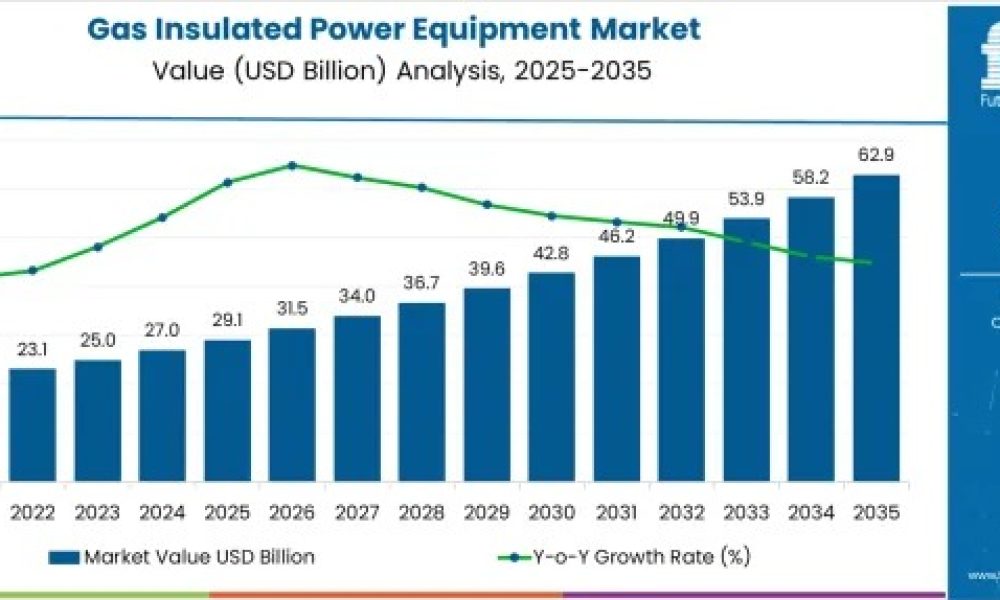
The global Gas Insulated Power Equipment Market is entering a decade of robust expansion, with new projections revealing the market will surge from USD 29.1 billion in 2025 to USD 62.9 billion by 2035. With an 8.0% CAGR, this growth rate outperforms many traditional electrical infrastructure categories, supported by rising demand for compact, high-reliability equipment across urban substations, renewable energy corridors, and high-voltage transmission networks.
Subscribe for Year-Round Insights → Stay ahead with quarterly and annual data updates
https://www.futuremarketinsights.com/reports/sample/rep-gb-22529
This accelerating momentum reflects a structural shift toward modernizing grid assets, reducing spatial footprints, and deploying equipment capable of sustaining long-term operational reliability. From 2026 to 2033, market value jumps from USD 31.5 billion to USD 53.9 billion, marking nearly 70% value addition in seven years—a signal of strong procurement pipelines. Although the post-2033 period indicates a mild deceleration as annual growth drops from USD 4.3 billion to roughly USD 3 billion, this tapering aligns with the natural maturity cycle of high-capital grid assets.
Technology Momentum Favors GIS Dominance
Gas Insulated Switchgear (GIS) emerges as the leading segment with 34.7% share in 2025, driven by compact form factors, high dielectric strength, and suitability for restricted installation environments. GIS systems offer up to 70% space savings versus air-insulated alternatives and exhibit high immunity to moisture, pollution, and particulate interference—making them indispensable in underground substations, metro cities, and offshore transmission hubs.
Asia-Pacific leads global adoption, propelled by aggressive grid expansion in China and India. North America and Europe follow closely as aging substations are replaced with next-generation insulated equipment featuring digital monitoring systems and advanced environmental sealing.
Key Market Drivers Supporting Demand Growth
The market’s long-term expansion is underpinned by three structural forces:
- Urbanization and space constraints: Compact GIS installations are enabling utility operators to modernize nodes in dense commercial centers and underground networks.
- Renewable energy integration: Wind, solar, and hybrid grids require stable, high-efficiency switchgear and substations capable of handling fluctuating loads.
- Grid reliability and modernization programs: Governments globally are prioritizing substation automation, blackout risk mitigation, and replacement of legacy assets.
Utilities remain the top adopters, representing 38.4% of revenue share in 2025, driven by mission-critical reliability needs and modernization mandates.
Regional Growth Patterns Signal Strong BRICS Momentum
China (10.8% CAGR) and India (10.0% CAGR) are projected to outperform the global average, reflecting large-scale transmission corridor expansion, rapid metro electrification, and domestic manufacturing investments.
- China Highlights:
Over 1,700 GIS units (220kV+) installed between 2022–2024; SF₆-alternative gas output exceeded 14,000 metric tons annually by 2024. - India Highlights:
More than 290 substations integrated GIS racks between 2021–2024; domestic production of 132kV GIS rose 31% YoY in 2024.
In Europe, Germany (9.2% CAGR) exhibits strong adoption of hybrid GIS technology for offshore wind and commercial electrification, while the UK maintains moderate growth (7.6% CAGR) driven by data center power nodes and national rail infrastructure.
Market Challenges: Cost Sensitivity & Installation Complexity
Despite its strong advantages, gas insulated equipment carries 35–45% higher initial cost than air-insulated systems. Installation requires skilled technicians due to gas handling protocols and sealed compartment designs. Lead times in emerging markets often exceed 12 weeks for accessories and service kits, slowing adoption across smaller utilities.
Competitive Landscape
The market is shaped by global leaders including ABB, Siemens AG, General Electric, Toshiba, Mitsubishi Electric, Schneider Electric, and Hitachi Energy. Asian firms such as Hyundai Electric, Fuji Electric, Iljin Electric, and Xi’an XD Switchgear are expanding aggressively across emerging markets. Indian players BHEL, CG Power, and Larsen & Toubro support domestic grid upgrades aligned with renewable energy expansion. High capital intensity and strict compliance standards continue to reinforce high entry barriers for new challengers.
Strategic Outlook Through 2035
As the market approaches maturity toward 2034–2035, strategic focus will shift to predictive maintenance, eco-efficient gas alternatives, and lifecycle cost optimization. Digitalized GIS platforms, hybrid dielectric systems, and AI-based monitoring will play a central role in sustaining competitiveness.
Get data that aligns with your strategic priorities — ask for report customization today:
https://www.futuremarketinsights.com/customization-available/rep-gb-22529
Have a specific Requirements and Need Assistant on Report Pricing or Limited Budget please contact us – [email protected]
About Future Market Insights (FMI)
Future Market Insights, Inc. (FMI) is an ESOMAR-certified, ISO 9001:2015 market research and consulting organization, trusted by Fortune 500 clients and global enterprises. With operations in the U.S., UK, India, and Dubai, FMI provides data-backed insights and strategic intelligence across 30+ industries and 1200 markets worldwide.
Contact Us:
Future Market Insights Inc.
Christiana Corporate, 200 Continental Drive,
Suite 401, Newark, Delaware – 19713, USA
T: +1-347-918-3531



