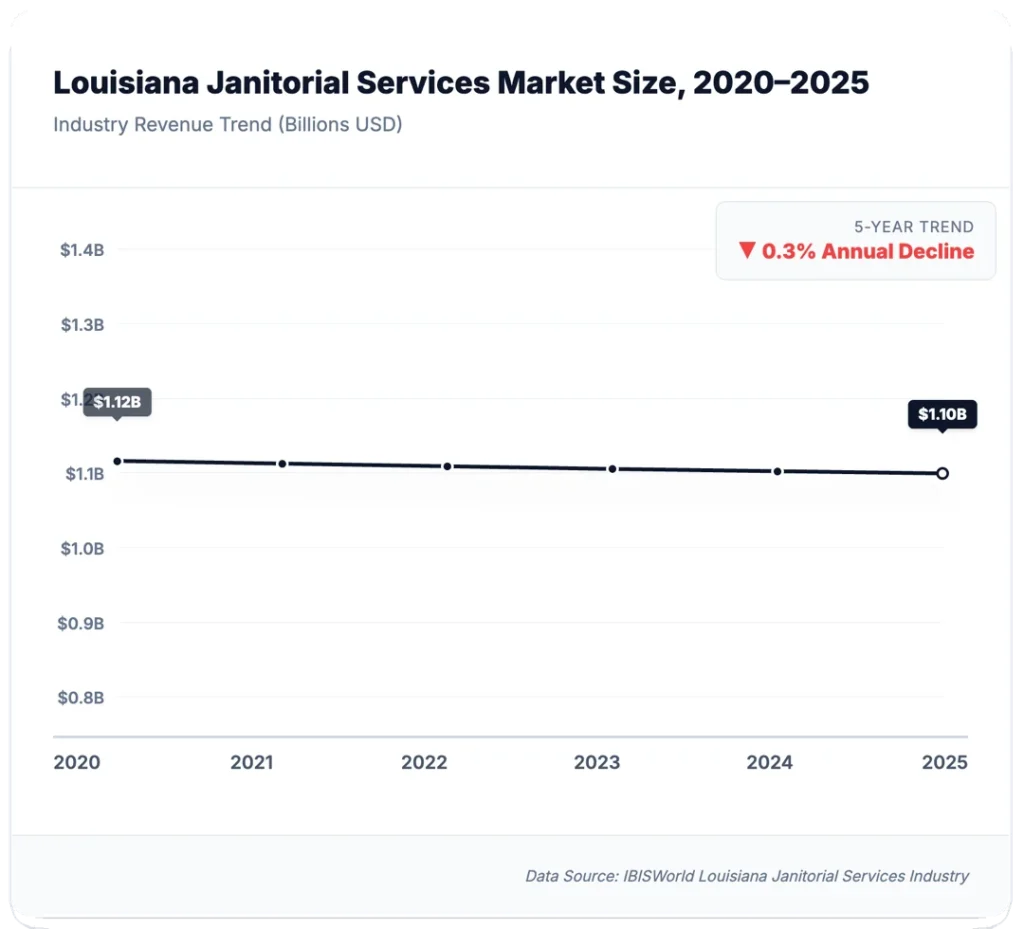
Across Louisiana, commercial facilities are navigating a year of transition as the statewide janitorial services market reaches a critical inflection point. In 2025, the janitorial sector is valued at approximately $ 1.1 billion, according to IBISWorld’s 2025 analysis of Louisiana’s janitorial services industry. While the statewide market size has declined by an annual rate of 0.3 percent from 2020 to 2025, the number of businesses and employees in the sector continues to rise. This unusual combination of contraction and expansion is reshaping expectations for facility maintenance throughout Baton Rouge, where commercial offices, industrial operations, schools, and healthcare centers depend on reliable cleaning support.
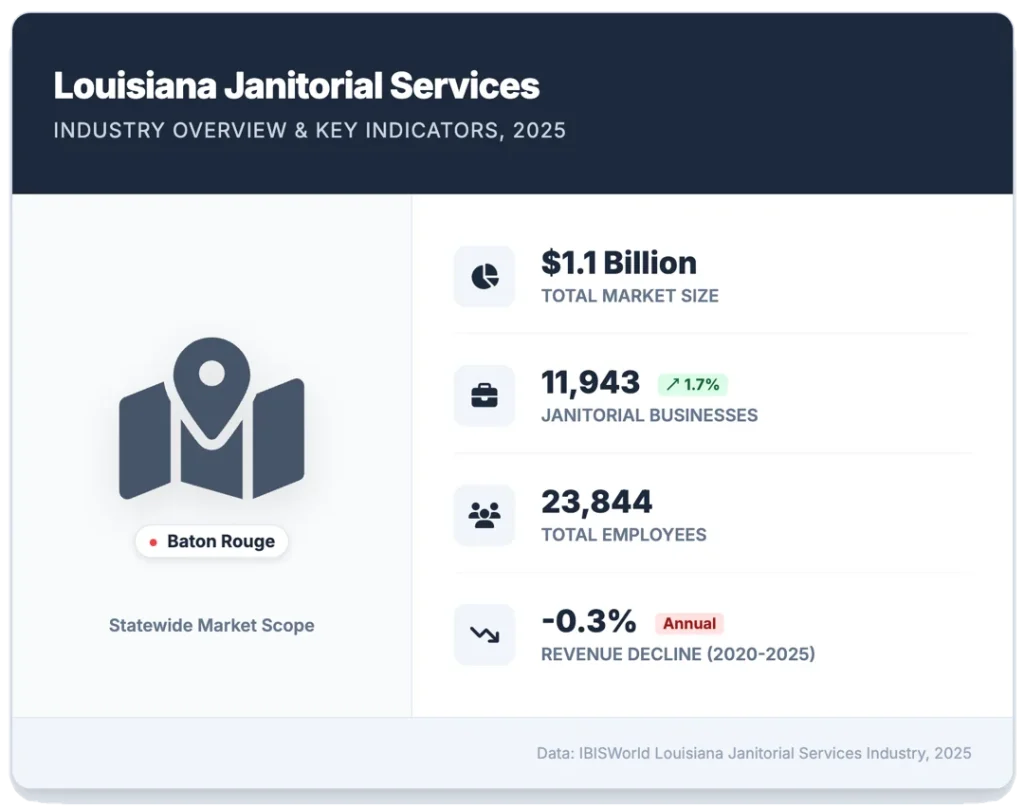
The same market analysis reports that Louisiana is home to an estimated 11,943 janitorial businesses in 2025, reflecting average annual business count growth of 1.7 percent over the past five years. Employment has also increased, with approximately 23,844 workers statewide and year-to-year labor growth averaging 1.0 percent. This growth in the number of providers and workers stands in contrast to the slight revenue decline, indicating that competition is rising even as facility needs continue to evolve.
Within Baton Rouge, these statewide trends are particularly evident. The city’s office corridors, medical environments, logistics hubs, and educational institutions require consistent and specialized cleaning schedules. Local providers that have adapted to changing expectations report that organizations are now seeking more structured maintenance plans, greater transparency, and more comprehensive service capabilities.
Several Baton Rouge cleaning providers have adapted their service models to meet stronger facility hygiene expectations across office, medical, and industrial spaces. Advanced Office Care is among the firms participating in this shift, and its commercial cleaning services in Baton Rouge reflect the broader move toward structured maintenance programs.
A Market Balancing Expansion and Contraction
The contrast between declining statewide revenue and growing business presence reflects a market that is adjusting to new operational pressures. While IBISWorld data shows that industry value has contracted slightly, more service providers continue to enter the market. This type of market activity often appears in sectors where demand remains stable but competitive pricing and increased specialization place pressure on revenue margins. In Louisiana, new companies are expanding their offerings to include specialized cleaning for healthcare, industrial facilities, and high-traffic public environments, in addition to routine office cleaning.
At the same time, Baton Rouge businesses have elevated their baseline expectations for facility hygiene. Many organizations note that post-2024 workplace standards have permanently shifted, with cleanliness now serving as a core component of employee confidence and client perception. Facility managers in the region increasingly request measurable cleaning protocols, predictable scheduling, and service models that support daily operations.
Baton Rouge as a Regional Center for Professional Cleaning Services
Baton Rouge has emerged as one of Louisiana’s most consistent hubs for commercial cleaning demand. Its mix of office towers, state agency buildings, university facilities, medical centers, and industrial operations creates a continuous need for dependable janitorial services. Service providers report that recurring cleaning contracts have increased as regional businesses place greater emphasis on long-term facility hygiene.
This diversity of facility types also drives specialization within the cleaning sector. Healthcare environments require adherence to detailed sanitation guidelines, while hospitality venues rely on fast and precise turnover cleaning. Industrial locations often require advanced floor care, equipment-safe cleaning methods, and scheduled maintenance programs. These conditions encourage Baton Rouge providers to maintain broad capabilities and invest in training to meet varied operational requirements.
Workplace Expectations and the Rising Importance of Cleanliness
Facility managers across Baton Rouge note that workplace expectations surrounding cleanliness have strengthened significantly in recent years. This mirrors national research linking cleaner indoor environments to improved productivity, reduced absenteeism, and higher employee satisfaction. Studies such as Harvard Public Health research examining how office cleanliness and indoor air quality influence worker productivity reinforce the growing emphasis that organizations place on hygienic environments. These insights apply broadly across commercial offices, healthcare facilities, educational institutions, and industrial workplaces in Baton Rouge.
Businesses that depend on public engagement, such as hospitality and customer service operations, are particularly affected by this shift. Cleanliness directly affects customer impressions and influences repeat visits, making facility hygiene an operational and economic priority. As a result, commercial cleaning providers are tailoring programs to align with new expectations and measurable performance standards.
Labor Dynamics and Operational Pressure
Louisiana’s janitorial workforce continues to expand gradually, even as statewide revenue contracts. With nearly 24,000 workers in 2025, employment stability has been a key component in supporting day-to-day cleaning requirements. Providers in Baton Rouge, however, often face more dynamic labor needs due to fluctuating commercial activity, facility expansions, and seasonal demand patterns. Organizations with established training programs and diversified cleaning capabilities are often better positioned to navigate these challenges.
Local providers note that labor reliability, safety training, and process consistency are increasingly viewed as differentiators in a competitive market. With more businesses entering the industry and client expectations rising, operational discipline has become essential in maintaining service quality.
Adapting to Long-Term Structural Change
Industry observers expect continued adjustment in Louisiana’s janitorial sector through 2025 and beyond. While market value has declined slightly, the continued expansion of businesses and the number of employees reflects sustained demand for commercial cleaning. Economic activity in Baton Rouge, particularly in professional, industrial, and healthcare environments, supports the city’s position as a regional center for facility maintenance.
Companies that invest in service quality, transparency, and adaptable maintenance programs are likely to be most resilient in a shifting market. As organizations across Baton Rouge reexamine their long-term expectations for cleanliness and operational readiness, commercial cleaning providers will play a central role in shaping facility standards for years to come.