
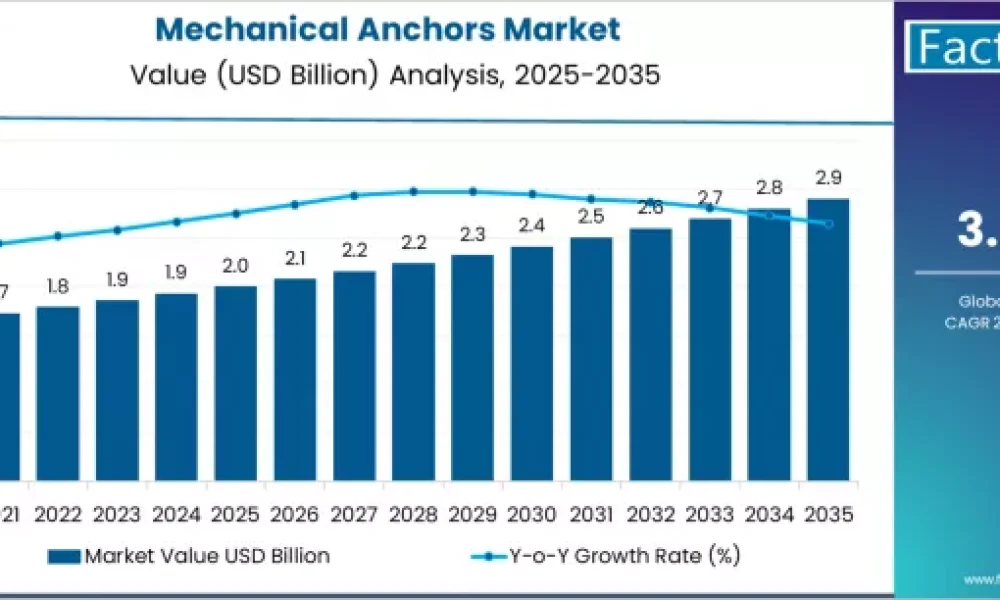
The U.S. mechanical anchors market is poised for a strong long-term growth trajectory through 2035, according to a comprehensive market analysis report. Anchoring systems play a critical role in construction, infrastructure, and renovation projects, and rising demand across commercial construction and public infrastructure is expected to fuel sustained expansion.
Market Outlook & Forecast
The U.S. mechanical anchors market is forecast to grow at a compound annual growth rate (CAGR) of approximately 3.8% from 2025 to 2035.
By 2035, the market is projected to reach USD 2.9 billion, reflecting substantial value creation and demand momentum over the decade.
This growth is driven by accelerating construction activity, infrastructure modernization, and stricter building codes emphasizing structural safety and load-bearing integrity.
To access the complete data tables and in-depth insights, request a Discount On The Report here: https://www.factmr.com/connectus/sample?flag=S&rep_id=11647
Key Growth Drivers
Infrastructure Modernization & Urban Development
Continued investment in urban infrastructure — including bridges, transit systems, and public buildings — is fueling demand for high-performance fastening systems. Mechanical anchors are being used more widely in retrofits, seismic upgrades, and large-scale construction projects where reliable anchoring is essential.Robust Commercial Construction Activity
The commercial construction segment is expected to dominate anchor usage, accounting for a major share of demand. Logistics hubs, office complexes, and high-rise commercial spaces rely heavily on mechanical anchors for structural stability and long-term safety.Material Innovation
Innovation in anchor materials, particularly stainless steel, is creating durable and high-corrosion-resistance products that appeal to engineers and architects. These anchors meet stringent performance standards while delivering longevity and low maintenance.Regulatory Compliance & Safety Requirements
Building codes and structural regulations are becoming more stringent, particularly for seismic-prone regions and high-density urban areas. Mechanical anchor systems that offer predictable performance under load are increasingly specified by engineers and regulators.Enhanced Installation & Quality Assurance
Advances in installation tools, testing methods, and quality control are reducing installation risk. These improvements are helping contractors adopt mechanical anchors more confidently, even in challenging substrate environments.
Market Segmentation & Trends
By Material
Stainless Steel Anchors: Expected to capture more than half of the market due to their superior corrosion resistance and durability.
Carbon Steel & Other Alloys: These remain important, especially in cost-sensitive applications, but may face competition from premium materials as performance requirements rise.
By Application
Commercial Construction: The largest application segment. Its dominance stems from high structural demands and scale.
Residential Construction: While smaller, this segment remains steady and supports demand for both standard and customized anchor solutions.
Competitive Landscape
The U.S. market features a diverse set of players, ranging from global anchoring system manufacturers to niche fastening component specialists. Key trends in the competitive space include:
Product innovation focusing on load-bearing design and corrosion resistance.
Strategic partnerships with construction and engineering firms to integrate anchor solutions into broader structural systems.
Investments in distribution and technical training to improve adoption in complex projects.
Leading companies are increasingly differentiating themselves not just on product strength but also on service support, installation guidance, and quality certification.
Challenges & Risks
Raw Material Price Volatility: Fluctuations in steel and alloy prices can squeeze manufacturer margins and affect end-product pricing.
Installation Complexity: Certain anchor types demand specialized labor and rigorous quality testing, which can slow project adoption.
Competition from Alternative Fastening Solutions: Methods such as chemical anchors or welded connections may compete in some use-cases.
Regulatory Hurdles: As codes evolve, anchor manufacturers must continuously meet evolving certification and compliance standards.
Strategic Opportunities
Several promising opportunities are emerging in the U.S. mechanical anchors space:
Retrofit & Seismic Upgrades: Anchor solutions tailored for seismic reinforcement and retrofitting aging infrastructure could capture a growing share of public-sector construction.
Green Building Initiatives: As sustainability becomes central to construction, anchors with long life, low maintenance, and eco-friendly materials can become more attractive.
Smart Installation Technologies: Integrating digital tools for quality verification, torque monitoring, and real-time installation feedback can drive efficiency.
Customized Anchors for Specialty Projects: Demand for anchors designed for façade systems, heavy machinery mounts, and industrial platforms is rising; niche, high-performance products can command premium pricing.
Outlook for 2025–2035
The U.S. mechanical anchors market is forecast to remain a key pillar in construction and infrastructure strategy through 2035. Given its steady, predictable growth and strong alignment with long-term public infrastructure investment, this sector offers a compelling proposition for manufacturers, suppliers, and investors.
Short-Term (2025–2030): Growth will be anchored by commercial construction, logistics facilities, and increased code-driven demand for reliable anchoring systems.
Long-Term (2030–2035): Expansion into public infrastructure, seismic retrofit projects, and advanced anchor technologies is expected to drive the next phase of growth.
By 2035, mechanical anchors will not just be components but critical enablers of structural safety, regulatory compliance, and design innovation.
Have a specific Requirements and Need Assistant on Report Pricing or Limited Budget please contact us – [email protected]
To View Related Report :



