
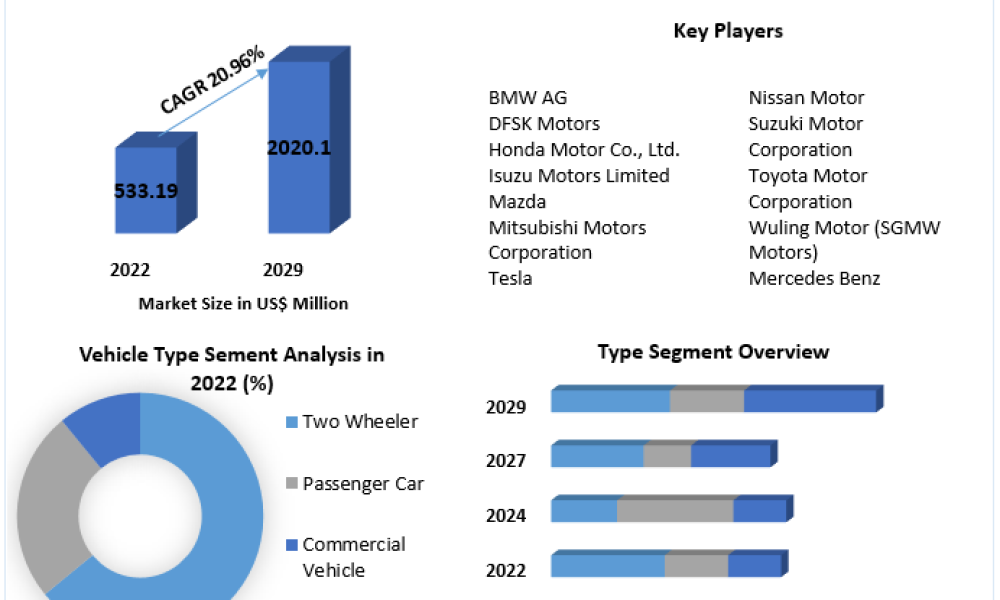
Indonesia Electric Vehicle Market Market Overview:
Indonesia Electric Vehicle Market is undergoing robust growth, driven by strong government incentives, rising domestic demand, and strategic industry investments. In 2024, battery electric vehicle (BEV) sales surged 151% year-over-year, with 43,188 BEV cars sold, marking Indonesia’s EV penetration at approximately 5% of total vehicle sales. The government has set ambitious targets to deploy 2 million electric cars and 12.9 million electric two-wheelers by 2030, positioning Indonesia as a key player in Southeast Asia’s EV ecosystem.
Key Highlights & Insights
Market Size & Growth: In 2024, Indonesia’s EV market saw 43,188 BEV cars sold, a 151% increase from the previous year. The EV share of new passenger vehicle sales grew from 9% in 2023 to roughly 15% in 2024, with projections reaching 29% by 2030.
Dominating Region: Java and Bali regions lead in adoption due to higher income levels, dense urban populations, and better-developed charging infrastructure.
Leading Segment: Two-wheelers dominate the market by volume, with Indonesia projected to become the world’s third-largest electric two-wheeler market by 2030 with approximately 2 million annual units.
Key Driver: Government subsidies, complete luxury sales tax waivers for EVs in 2025, and Indonesia’s vast nickel reserves underpinning local battery production drive the market forward.
► Get a sample of the report:https://www.maximizemarketresearch.com/request-sample/65817/
Recent Developments
2024-2025: BYD announced a $1 billion investment in a new EV factory in Indonesia scheduled to produce 150,000 EVs annually by 2026.
Toyota plans to invest approximately $1.8 billion to locally produce EVs by 2027, initially focusing on hybrids as a bridge to full battery EVs.
Indonesian electric ride-hailing operators like Grab and Blue Bird are rapidly electrifying their vehicle fleets, with Grab deploying over 10,000 electric two-wheelers and Blue Bird targeting 10% EV taxis by 2030.
Expansion of charging infrastructure is ongoing, including subsidies for battery swapping stations and public chargers to improve EV usability and adoption.
Market Dynamics
Growth Drivers:
Government incentives such as tax exemptions and subsidies spurring consumer demand and local manufacturing.
Strategic investments by global automotive OEMs and battery producers linking Indonesia’s mineral wealth with full EV supply chains.
Urbanization and environmental policies supporting the electrification of mobility to reduce pollution.
Increasing consumer acceptance of EVs fueled by growing awareness of operational cost savings and sustainability.
Challenges:
Limited charging infrastructure outside urban centers hinders adoption in rural areas.
Higher upfront costs of EVs compared to internal combustion engine vehicles.
Domestic production capacity is still scaling, creating supply-demand gaps.
Consumer education and infrastructure reliability remain key focus areas.
Regional Analysis
Java and Bali: Highest EV penetration, supported by government programs and commercial infrastructure.
Sumatra and Kalimantan: Emerging markets with improving incentives and industrial investments.
Eastern Indonesia: Lower adoption currently due to infrastructural challenges but targeted for growth initiatives.
Product Segmentation
By Vehicle Type: Battery electric vehicles (BEVs) including cars and two/three-wheelers dominate, with hybrids playing a transitional role.
By End User: Personal vehicles, ride-hailing fleets, commercial delivery services, and public transportation initiatives.
By Charging Infrastructure: Public charging stations, battery swapping networks, and home charging solutions.
Key Trends
Rapid electrification of commercial fleets, particularly ride-hailing and delivery vehicles.
Expansion of local EV manufacturing hubs leveraging Indonesia’s nickel and battery supply chain.
Integrated government and private sector efforts toward nationwide EV infrastructure deployment.
Growing collaborations among international EV OEMs and local assemblers to customize vehicles for the Indonesian market.
Frequently Asked Questions (FAQs)
Q1: What is the Indonesian government’s target for EV adoption?
A: The government plans for 2 million electric cars and 12.9 million electric two-wheelers by 2030.
Q2: Which vehicle category leads in Indonesia’s EV market?
A: Electric two-wheelers dominate due to their affordability, urban suitability, and booming ride-hailing fleet electrification.
Q3: What incentives promote EV adoption in Indonesia?
A: Incentives include a 100% luxury sales tax exemption on EVs, VAT reductions, subsidies for charging infrastructure, and investment in local battery production.
Q4: Who are the key players in the Indonesian EV market?
A: Major players include BYD, Toyota, Hyundai, Wuling Motors, and local manufacturers such as Gesits, supported by strong presence from ride-hailing companies like Grab and Blue Bird.
Conclusion
Indonesia’s electric vehicle market is experiencing rapid expansion supported by favorable policies, progressive industry investments, and strong consumer interest. While challenges in infrastructure and production capacity remain, the country’s strategic push to integrate resource-rich battery manufacturing with growing EV demand positions it as a key leader in Asia’s transition to sustainable transportation. By 2030, Indonesia aims to substantially transform its mobility landscape, contributing significantly to regional and global clean energy goals.
◉ Get Market Research Latest Trends
♦ Global Heterogeneous Network Market
♦ Maximize Market Research is launching a subscription model for data and analysis in the MMR Statistics
Contact Maximize Market Research:
3rd Floor, Navale IT Park, Phase 2
Pune Bangalore Highway, Narhe,
Pune, Maharashtra 411041, India
[email protected]
+91 96071 95908, +91 9607365656
About Maximize Market Research:
Maximize Market Research is a multifaceted market research and consulting company with professionals from several industries. Some of the industries we cover include medical devices, pharmaceutical manufacturers, science and engineering, electronic components, industrial equipment, technology and communication, cars and automobiles, chemical products and substances, general merchandise, beverages, personal care, and automated systems. To mention a few, we provide market-verified industry estimations, technical trend analysis, crucial market research, strategic advice, competition analysis, production and demand analysis, and client impact studies.




