
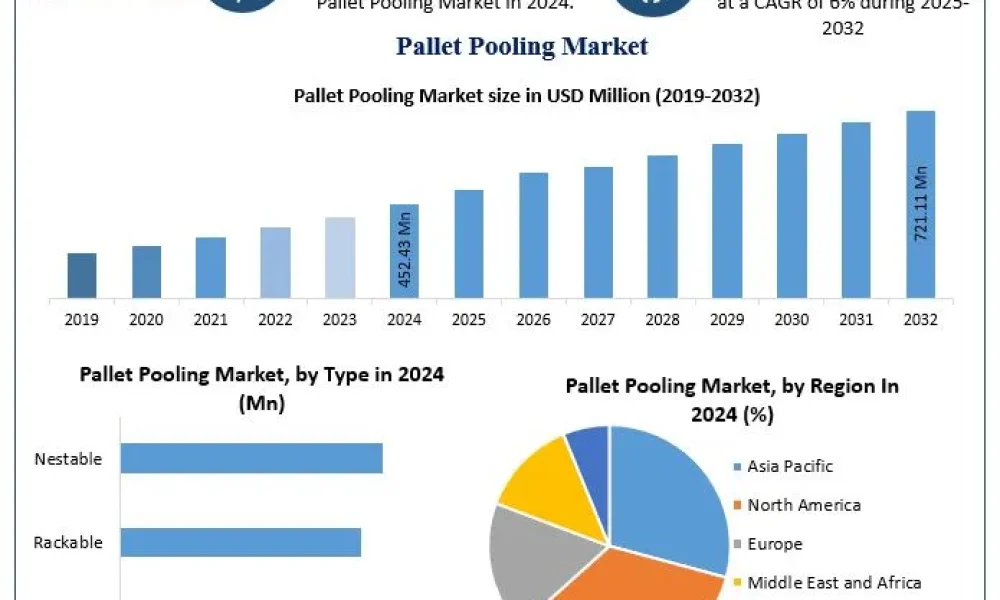
Pallet Pooling Market Overview:
Pallet Pooling Market is forecasted to expand from an estimated USD 8.5 billion in 2025 to USD 15.4 billion by 2035, growing at a compound annual growth rate (CAGR) of 6.1%. The increasing adoption of reusable pallets for logistics and supply chain efficiency, rising e-commerce penetration, and emphasis on sustainability are driving the market growth. Asia Pacific and North America emerge as dominant regions, supported by expanding industrial bases, strong retail sectors, and government policies promoting circular economy solutions.
Key Highlights & Insights
Market Size & Growth: Projected to grow from USD 8.5 billion in 2025 to USD 15.4 billion by 2035 with a CAGR of 6.1%.
Dominating Regions:
Asia Pacific leads with rapid industrialization, expanding e-commerce, and growing awareness of sustainable supply chain solutions.
North America holds significant market share due to its mature logistics infrastructure, extensive use in food & beverage and pharmaceutical sectors, and innovation in pooled logistics.
Leading Segment: Plastic pallet pooling dominates product type, primarily driven by durability, weight advantages, and increasing use in FMCG, pharmaceutical, and retail supply chains.
Key Driver: The shift towards cost-efficient, sustainable, and traceable pallet solutions amid growing global trade and the surge in e-commerce logistics demands.
► Get a sample of the report:https://www.maximizemarketresearch.com/request-sample/117367/
Recent Developments
2024-2025: Major market players like Brambles Limited (CHEP), iGPS Logistics, Loscam Australia, and Euro Pool Group expanded their pallet pooling services in Asia Pacific and North America, establishing new logistics hubs.
Increased integration of RFID, GPS tracking, and IoT solutions in pallet pooling to enhance supply chain visibility and asset management.
Strategic collaborations between pallet pooling service providers and major e-commerce companies to support last-mile delivery efficiency.
Sustainability pledges by global corporations have accelerated investments in reusable pallet systems and recycling programs.
Market Dynamics
Growth Drivers:
Rising e-commerce and retail sector growth requiring flexible and efficient supply chain logistics.
Heightened focus on reducing carbon footprint encouraging reusable pallet adoption.
Cost savings in transportation, reduced waste, and improved inventory management through pallet pooling.
Technological advancements in tracking and asset management improving operational efficiency.
Challenges:
Initial high costs associated with establishing pooling networks and technology adoption.
Supply chain complexities and logistical barriers in emerging economies.
Varying regional regulations and standards can pose operational difficulties.
Regional Analysis
Asia Pacific: Fastest-growing region with expanding manufacturing hubs, retail, and e-commerce sectors in China, Japan, India, and Southeast Asia.
North America: Mature market driven by large-scale industrial operations, pharmaceuticals, and FMCG sectors adopting advanced pallet pooling systems.
Europe: Steady growth with stringent environmental regulations incentivizing pallet reuse.
Latin America & Middle East/Africa: Emerging adoption linked to increasing industrialization, retail growth, and infrastructure investments.
Product Segmentation
By Material: Plastic pallets (dominant), wooden pallets, metal pallets.
By Application: FMCG, pharmaceuticals, retail, automotive, chemicals, food & beverage.
By Service Model: Rental, pooling, leasing.
Key Trends
Growing use of smart pallets with embedded tracking for real-time location and condition monitoring.
Increasing customization of pallets to meet sector-specific logistics needs.
Expansion of circular supply chains leveraging reusable pallets to reduce waste and cost.
Collaboration between pooling companies and manufacturers for end-to-end supply chain optimization.
Frequently Asked Questions (FAQs)
What is pallet pooling?
Pallet pooling involves sharing and reusing pallets within a network to enhance supply chain efficiency and sustainability.Why is the pallet pooling market growing?
Growth is driven by rising e-commerce, need for sustainable packaging, and cost efficiency in logistics.Which regions dominate the market?
Asia Pacific and North America lead due to industrial growth, logistics infrastructure, and environmental policies.What materials are most preferred?
Plastic pallets dominate for their durability and reusability, followed by wooden pallets.Who are the major players?
Brambles Limited, iGPS Logistics, Loscam Australia, Euro Pool Group, and other regional operators.
Conclusion
The global pallet pooling market’s expansion is propelled by increasing demand for sustainable, cost-effective supply chain solutions, rapid e-commerce growth, and technological advancements. Asia Pacific and North America dominate, benefiting from mature logistics networks and favorable policies. Continued innovation in smart tracking and collaborative pooling models will further strengthen the market, ensuring efficient resource use and enhanced logistics performance worldwide through 2035.
◉ Get Market Research Latest Trends
♦ Maximize Market Research is launching a subscription model for data and analysis in the MMR Statistics
Contact Maximize Market Research:
3rd Floor, Navale IT Park, Phase 2
Pune Bangalore Highway, Narhe,
Pune, Maharashtra 411041, India
[email protected]
+91 96071 95908, +91 9607365656
About Maximize Market Research:
Maximize Market Research is a multifaceted market research and consulting company with professionals from several industries. Some of the industries we cover include medical devices, pharmaceutical manufacturers, science and engineering, electronic components, industrial equipment, technology and communication, cars and automobiles, chemical products and substances, general merchandise, beverages, personal care, and automated systems. To mention a few, we provide market-verified industry estimations, technical trend analysis, crucial market research, strategic advice, competition analysis, production and demand analysis, and client impact studies.




