
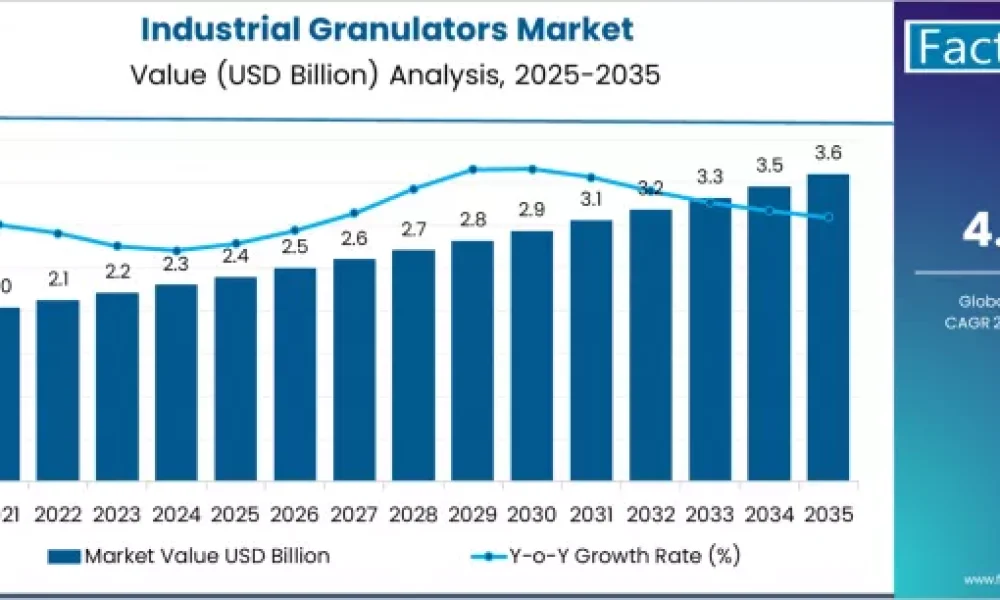
The global industrial granulators market is set for steady expansion from 2025 to 2035, supported by rising manufacturing output, rapid waste-recycling initiatives, and growing demand for efficient size-reduction equipment across plastics, chemicals, food processing, and industrial waste management.
Industrial granulators—ranging from heavy-duty central granulators and beside-the-press units to shredding-granulation hybrids—play a critical role in material standardization, reprocessing, and production efficiency. This report outlines market size, key demand drivers, regional dynamics, technology evolution, and strategic considerations for stakeholders.
Market Size and Growth
The global industrial granulators market is projected to grow from USD 2,400.0 million in 2025 to approximately USD 3,600.0 million by 2035, registering an absolute increase of USD 1,200.0 million. This reflects 50.0% total growth over the decade, with the market expected to advance at a CAGR of 4.1%. Growth is consistent across developed and emerging economies as industries prioritize recycling efficiency, consistent particle output, and production cost optimization.
To access the complete data tables and in-depth insights, request a Discount On The Report here: https://www.factmr.com/connectus/sample?flag=S&rep_id=8585
Key Growth Drivers
- Industrial expansion and material reprocessing
Growing demand for plastics, chemicals, rubber, and engineered materials is increasing the need for granulators to reduce waste, reclaim material, and improve process flow. - Rise of circular manufacturing and recycling
Global pressure to reduce industrial waste is driving adoption of granulators for recycling plastics, e-waste, packaging materials, and industrial scrap. - Automation and efficiency upgrades
Manufacturers are replacing outdated equipment with automated granulation systems offering improved throughput, noise reduction, and energy efficiency. - Growth in food and pharmaceutical processing
Granulators are becoming essential for uniform particle sizing, quality control, and improved mixing and compounding in hygienic industries.
Regional Insights
Industrial granulators see strong adoption across North America, Europe, and high-growth Asian markets.
• Europe shows stable demand from recycling, polymer processing, and regulated waste-management sectors.
• North America benefits from strong plastics reprocessing, packaging, and manufacturing activity.
• Asia Pacific is the fastest-growing region, driven by rapid industrialization, expansion of chemical processing, and government-backed recycling initiatives.
Cost sensitivity, environmental regulations, and the shift toward high-efficiency machines shape procurement patterns across regions.
Technology Trends and Competitive Dynamics
- Energy-efficient motors and low-noise systems
New granulators prioritize reduced operational cost and workplace safety.
• Integrated shredding-granulation platforms
Hybrid systems support high-volume recycling and complex material processing.
• Smart diagnostics and automation
Predictive maintenance, automated monitoring, and sensor-based performance control are becoming standard.
• Enhanced wear-resistant components
Improved rotor designs, hardened cutting chambers, and long-life blades reduce maintenance downtime.
Manufacturers compete on durability, throughput, ease of maintenance, and integration with automated production lines.
Challenges
- Moderate CAGR limits rapid expansion relative to high-growth industrial equipment categories.
• Capital cost sensitivity may delay replacement cycles in small and mid-scale facilities.
• Variability in recycling infrastructure across developing regions can restrict adoption.
• Maintenance intensity and operator training remain essential for optimum uptime.
Strategic Implications
For manufacturers: Prioritize energy-efficient designs, integrated recycling solutions, and modular platforms. Balance premium offerings for advanced industrial users with durable, cost-effective machines for emerging markets.
For industrial facilities: Invest in automated granulation equipment to improve material utilization, reduce scrap, and support circular economy targets.
For investors: The market presents stable, long-term growth supported by sustainability mandates, global manufacturing expansion, and rising recycling volumes.
Outlook Summary
From 2025 to 2035, the global industrial granulators market is positioned for controlled yet resilient growth. Expansion in plastics reprocessing, packaging, chemical manufacturing, and industrial waste reduction will drive consistent demand. While cost pressures and regional disparities persist, the shift toward automation, sustainability, and process efficiency reinforces the market’s long-term attractiveness.
Have a specific Requirements and Need Assistant on Report Pricing or Limited Budget please contact us – [email protected]
About Fact.MR
Fact.MR is a global market research and consulting firm, trusted by Fortune 500 companies and emerging businesses for reliable insights and strategic intelligence. With a presence across the U.S., UK, India, and Dubai, we deliver data-driven research and tailored consulting solutions across 30+ industries and 1,000+ markets. Backed by deep expertise and advanced analytics, Fact.MR helps organizations uncover opportunities, reduce risks, and make informed decisions for sustainable growth.



