
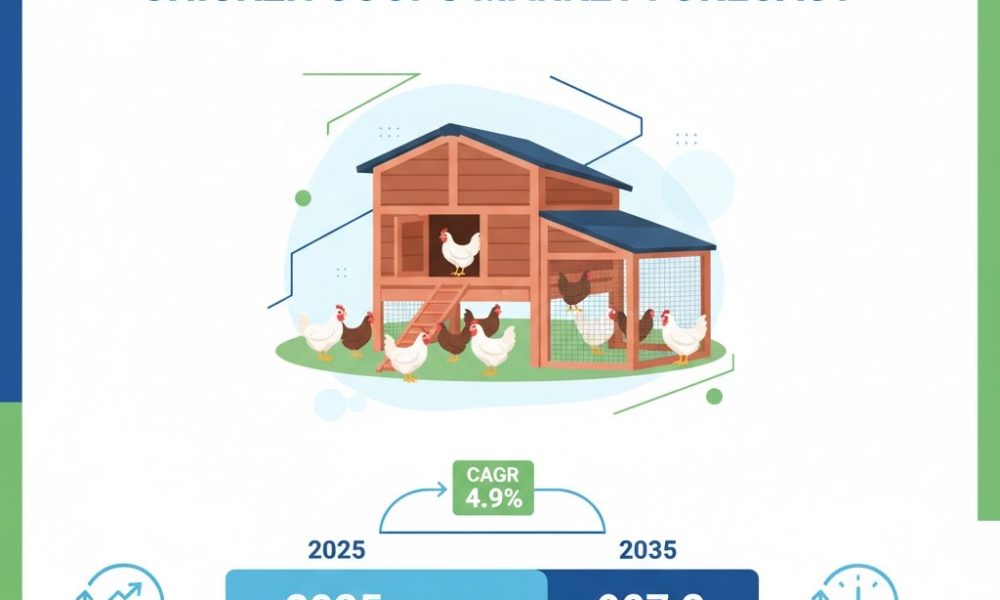
The Chicken Coops Market is poised for significant expansion from 2025 to 2035, supported by rising adoption of backyard poultry farming, surging consumer inclination toward organic egg production, and widespread interest in sustainable, self-sufficient living. According to new market assessments, the industry is projected to grow from USD 562.3 million in 2025 to USD 907.2 million by 2035, registering a steady CAGR of 4.9% over the forecast period.
Market Outlook 2025–2035
The expansion of the chicken coops market is driven by multiple dynamics, particularly the growing trend of urban homesteading, support for municipal zoning reforms, and heightened awareness of eco-friendly lifestyle habits. Chicken coops—ranging from compact portable shelters to advanced walk-in modular enclosures—play a crucial role in providing optimal shelter, predator protection, nesting space, and ventilation for poultry.
Key market drivers include:
- Rapid adoption of backyard poultry farming among suburban and semi-urban households
- Rising demand for organic, home-produced eggs
- Growth of sustainable living practices and DIY culture
- Innovations in smart, automated, and solar-powered coop systems
However, challenges such as zoning restrictions, maintenance costs, and predator risks continue to impact purchasing decisions.
Subscribe for Year-Round Insights → Stay ahead with quarterly and annual data updates : https://www.futuremarketinsights.com/reports/sample/rep-gb-12298
Regional Insights
- North America
North America remains a dominant regional market, buoyed by the ongoing DIY farming trend and heightened interest in homegrown food. In the U.S., relaxed zoning regulations and enthusiasm for farm-to-table lifestyles are fueling rapid adoption of coop installations. Canada shows increasing demand for insulated and winter-ready coop solutions suitable for colder climates.
- Europe
Sustainability-driven consumers in Germany, the UK, France, the Netherlands, and Sweden prefer eco-designed coops built with FSC-certified or upcycled materials. EU farming diversification incentives further propel the popularity of small-scale poultry setups and educational coops.
- Asia-Pacific
Asia-Pacific is projected as the fastest-growing regional market. Rising concerns surrounding food security, expanding urban farming, and small-scale poultry entrepreneurship drive growth in China, India, Japan, South Korea, and Australia. Demand for predator-proof and climate-resistant coops is sharply rising.
Challenges and Opportunities
Key Challenges
- Complex zoning rules limiting coop installations
- Climate durability concerns in regions with harsh weather
- High consumer expectations for animal welfare, hygiene, and proper ventilation
Major Opportunities
- Growing adoption of smart coop technologies (IoT, automated feeding, AI monitoring)
- Rising integration of coops in schools, parks, community gardens
- Surging demand for customizable, modular, and predator-proof designs
Market Transition: 2020–2024 vs. 2025–2035
From 2020 to 2024, backyard poultry keeping surged due to pandemic-driven self-sufficiency trends. Prefabricated wooden coops and mobile chicken tractors saw widespread adoption. From 2025 onward, the market will shift toward AI-enabled flock management, solar-powered ventilation, smart doors, and climate-resilient designs.
Forward-looking developments include:
- IoT-enabled flock health dashboards
- Automated waste management systems
- AR-based coop assembly guides
- Modular, multi-tier coop structures for urban spaces
Country-Level Forecast Highlights
- United States: CAGR 5.1% driven by sustainable food trends and rise in modular, prefabricated coops
- United Kingdom: CAGR 4.7%, demand rising for compact, aesthetic coops
- European Union: CAGR 4.8%, emphasis on welfare-oriented, insulated, natural-light housing
- Japan: CAGR 4.4%, preference for raised, compact, smart-equipped coops
- South Korea: CAGR 5.2%, growing rooftop/backyard poultry culture and smart coop adoption
Category Insights
Product Type: Wooden Coops Lead (62.8% Share)
Wood dominates the market with its durability, insulation strength, and customizability, making it the preferred choice among backyard poultry owners.
Sales Channel: Online Retailers Lead (47.5% Share)
E-commerce growth is accelerating adoption through ease of comparison, doorstep delivery, customer reviews, and access to a wider range of coop designs.
Competitive Landscape
Key players shaping the competitive ecosystem include Omlet Ltd., Tractor Supply Co., Petmate, SnapLock by Formex, and OverEZ Chicken Coops. Market participants are focusing on:
- Smart coop systems
- Reinforced predator-proof builds
- Prefabricated modular solutions
- Eco-friendly materials and energy-efficient designs
Emerging DTC brands and regional manufacturers are contributing through innovative, space-saving and customizable coop offerings.
Conclusion
The U.S. chicken coops market is entering a technologically advanced and sustainability-driven era. With rising consumer preference for organic living, growing urban agriculture initiatives, and accelerating adoption of smart farming solutions, the market is positioned for strong, steady growth through 2035.
Have a specific Requirements and Need Assistant on Report Pricing or Limited Budget please contact us – [email protected]
About Future Market Insights (FMI)
Future Market Insights, Inc. (FMI) is an ESOMAR-certified, ISO 9001:2015 market research and consulting organization, trusted by Fortune 500 clients and global enterprises. With operations in the U.S., UK, India, and Dubai, FMI provides data-backed insights and strategic intelligence across 30+ industries and 1200 markets worldwide.



