
Vacuum Insulated Glass Market Overview:
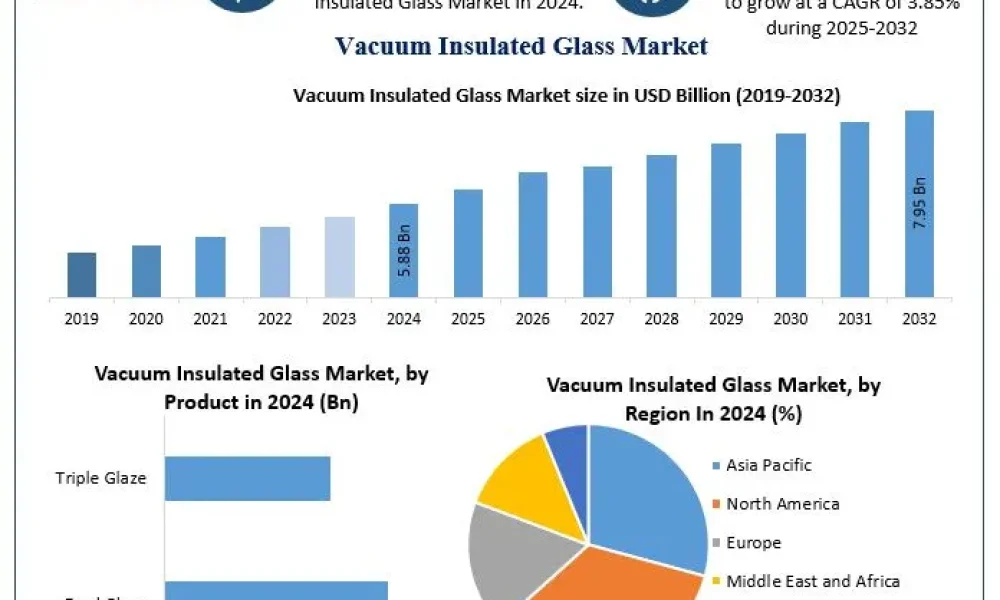
Vacuum Insulated Glass Market is experiencing robust growth, with market value estimated at USD 5.88 billion in 2024 and projected to reach nearly USD 7.95 billion by 2032, exhibiting a CAGR of about 3.85%. Vacuum insulated glass, noted for its superior thermal insulation performance, is increasingly adopted across residential, commercial, and industrial sectors to drive energy efficiency amid tightening building regulations. Asia Pacific dominates the market due to rapid urbanization, infrastructure development, and rising green building initiatives.
Key Highlights & Insights
Market Size & Forecast: Valued at USD 5.88 billion in 2024 and expected to grow to USD 7.95 billion by 2032, achieving a CAGR of approximately 3.85%.
Dominating Region: Asia Pacific leads due to accelerated construction activities, government support for energy-saving technologies, and expanding green building adoption.
Leading Segment: Dual-glaze vacuum insulated glass dominates with a 64.3% revenue share in 2024, favored for its cost-effectiveness and broad adoption in windows and façade applications.
Key Driver: Increasing demand for energy-efficient building materials, stringent energy code enforcement, and growing renovation and retrofit projects drive market growth.
► Get a sample of the report:https://www.maximizemarketresearch.com/request-sample/13272/
Recent Developments
In 2024-2025, manufacturers focused on product innovations including thinner glass designs with enhanced insulation properties and integration of smart coatings for solar control.
Collaborations with construction and architectural firms aim to expand VIG adoption in commercial and high-end residential buildings.
Key players such as Nippon Sheet Glass, Guardian Glass, and AGC are investing in capacity expansion and technological upgrades.
European markets, especially Germany, France, and the UK, actively deploy VIG in compliance with progressive energy-efficiency regulations.
Enhanced recycling and sustainable manufacturing practices are gaining attention to reduce environmental impacts associated with glass production.
Frequently Asked Questions (FAQs)
Q: What is vacuum insulated glass?
A: VIG consists of two or more glass panes separated by a narrow vacuum gap that significantly reduces heat transfer, enhancing insulation.
Q: Which region currently leads the VIG market?
A: Asia Pacific, propelled by urban development and demand for energy-saving materials.
Q: What are the primary applications for VIG?
A: Windows, doors, façades, roof lights, and commercial and residential construction.
Q: What types of VIG are commercially significant?
A: Dual-glaze VIG holds the largest market share, while triple-glaze is growing rapidly for higher insulation needs.
Q: How do energy regulations impact the market?
A: Stricter energy codes promote the adoption of VIG for new builds and retrofits to reduce heating and cooling energy consumption.
Market Dynamics
Growth Drivers:
Strong focus on reducing building energy consumption and carbon footprint globally.
Rising urbanization and growing commercial infrastructure development.
Increasing green building certifications promoting advanced insulating materials.
Technological advancements improving VIG durability and thermal performance.
Challenges:
High initial costs limit adoption in cost-sensitive markets.
Manufacturing complexities and raw material availability.
Competition from other insulating glass technologies and low-e coatings.
Opportunities:
Upgrading inefficient existing windows through retrofitting with VIG.
Growing adoption in automotive and electronics industries.
Integration with smart windows and energy management systems.
Regional Analysis
Asia Pacific: Largest and fastest growing, driven by China, India, and Southeast Asia’s construction boom.
Europe: Robust growth fueled by stringent energy efficiency regulations and renovations in commercial/residential sectors.
North America: Steady demand anchored by sustainability initiatives and advanced construction technologies.
Latin America and Middle East & Africa: Emerging growth prospects with expanding infrastructure and urbanization.
Product Segmentation
By Product Type: Dual-glaze VIG (dominant), Triple-glaze VIG (fastest growing).
By Application: Windows (largest share), Doors, Roof Lights, Glass Façade, Others.
By End-Use: Commercial, Residential, Industrial.
Key Trends
Increasing preference for green building materials aligned with sustainable construction standards.
Enhanced product features including thinner glass constructions and improved vacuum sealing techniques.
Growing retrofit activities targeting older buildings to improve energy performance.
Collaborative developments between glass manufacturers and smart home technology providers.
Expansion of automated manufacturing and quality control systems.
Conclusion
The vacuum insulated glass market is positioned for steady growth, largely propelled by environmental imperatives and expanding construction activities, particularly in Asia Pacific. Dual-glazed products dominate due to their balance of cost and performance, while triple-glaze variants gain momentum for premium applications. Market players are focusing on innovation, sustainability, and strategic collaborations to navigate challenges and tap emerging opportunities in both new construction and retrofit markets through 2032 and beyond.
◉ Get Market Research Latest Trends
♦ Global Threat Intelligence Security Market
♦ Maximize Market Research is launching a subscription model for data and analysis in the MMR Statistics
Contact Maximize Market Research:
3rd Floor, Navale IT Park, Phase 2
Pune Bangalore Highway, Narhe,
Pune, Maharashtra 411041, India
[email protected]
+91 96071 95908, +91 9607365656
About Maximize Market Research:
Maximize Market Research is a multifaceted market research and consulting company with professionals from several industries. Some of the industries we cover include medical devices, pharmaceutical manufacturers, science and engineering, electronic components, industrial equipment, technology and communication, cars and automobiles, chemical products and substances, general merchandise, beverages, personal care, and automated systems. To mention a few, we provide market-verified industry estimations, technical trend analysis, crucial market research, strategic advice, competition analysis, production and demand analysis, and client impact studies.




