
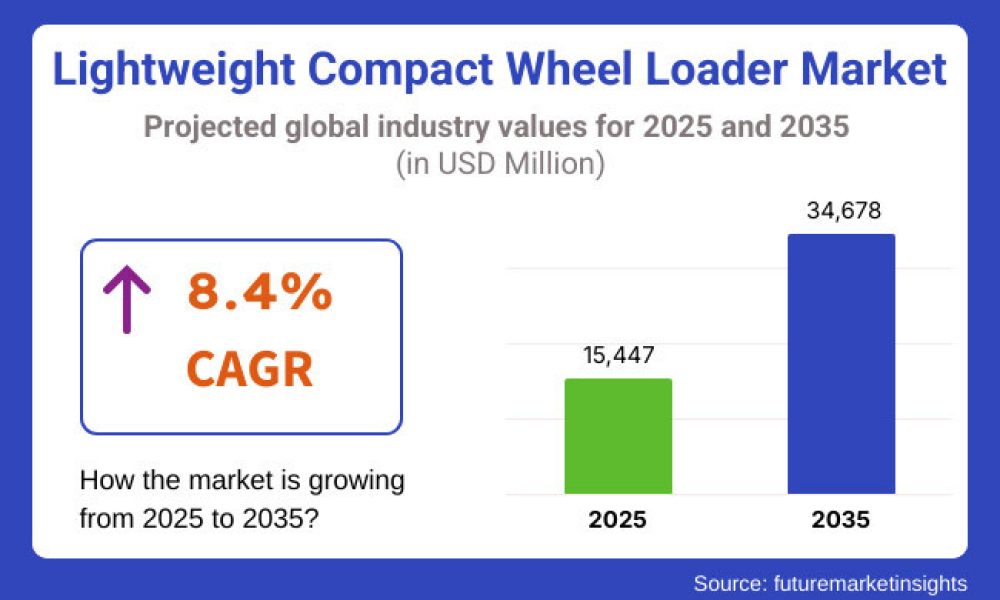
The global Lightweight Compact Wheel Loader Market is forecasted to grow from USD 15.45 billion in 2025 to USD 34.68 billion by 2035, advancing at a robust CAGR of 8.4%. This strong growth trajectory is powered by the rapid expansion of urban construction, mechanized agriculture, landscaping services, and municipal operations across APAC, Europe, the United States, and Saudi Arabia.
Compact wheel loaders—known for their versatility, mobility, and energy efficiency—are becoming indispensable in urban infrastructure, green building, and modern farming operations. As cities become denser and sustainability goals intensify, these lightweight machines are being increasingly adopted to perform complex tasks in confined spaces with lower emissions and higher precision.
Key Market Drivers: Electrification, Automation, and Urban Infrastructure Expansion
The shift toward electrified and hybrid loaders is accelerating due to stricter global emission regulations and increasing adoption of sustainable equipment. Electric compact wheel loaders are rapidly gaining traction in Europe and North America, where environmental standards such as the EU Green Deal and the EPA’s emission regulations are shaping procurement choices.
Subscribe for Year-Round Insights → Stay ahead with quarterly and annual data updates
https://www.futuremarketinsights.com/reports/sample/rep-gb-11429
In Asia-Pacific, nations like China, India, and Japan are fueling demand through urbanization programs, smart city projects, and agricultural mechanization. Meanwhile, Saudi Arabia’s Vision 2030 infrastructure push and diversification beyond oil are boosting demand for compact, energy-efficient loaders for construction and municipal maintenance.
Regional Growth Highlights
North America:
The U.S. and Canada are among the fastest-growing markets, with municipalities transitioning toward electric and hybrid compact loaders for urban maintenance and snow management. The EPA’s emission targets are motivating manufacturers to design zero-emission and hybrid equipment with advanced telematics. Compact loaders are also gaining popularity in the agricultural sector for material handling and precision farming.
Europe:
Europe dominates the market, driven by sustainable construction initiatives and government subsidies for zero-emission machinery. The UK, Germany, and France are key adopters, while the Netherlands and Spain show strong agricultural demand for compact farm loaders. Electrification, coupled with automation and remote-control features, is transforming the competitive landscape across the continent.
Asia-Pacific:
APAC is projected to be the fastest-growing regional market, powered by large-scale infrastructure investments and the modernization of agriculture. China, the world’s largest producer of construction equipment, leads both production and consumption. India and Japan are witnessing rising adoption of compact electric loaders in smart city projects and sustainable construction programs. Price-sensitive economies continue to prefer diesel variants, though battery-powered loaders are gaining ground as battery prices drop.
Middle East (Saudi Arabia):
Saudi Arabia is emerging as a promising market due to rapid urban expansion and Vision 2030 infrastructure goals. Lightweight loaders are increasingly used in construction, facility management, and industrial applications, as local authorities push for energy-efficient and dust-tolerant machinery adapted to harsh environments.
Market Segmentation Insights
- By Product Type:
Compact Track Loaders dominate the market due to their superior traction and versatility across rough terrains. Skid Steer Loaders are gaining demand in industrial and urban applications, while Backhoe Loaders remain essential for multipurpose infrastructure projects in developing economies.
Wheeled Loaders, known for their speed and stability, are increasingly deployed in industrial facilities and property management sectors. - By Application:
The construction industry remains the largest segment, driven by residential and commercial urbanization. Agriculture and forestry follow closely, with demand surging from mechanized farming and sustainable forestry operations. Industrial, utilities, and facility management sectors are also seeing rising usage due to automation and smart city maintenance requirements.
Challenges and Opportunities
The high initial investment cost of electric loaders remains a key challenge, particularly in small municipalities and low-budget contractors. However, technological breakthroughs in battery design, including solid-state batteries and hydrogen fuel cells, are reducing costs and improving operational range.
Opportunities abound in automation and telematics, with AI-driven predictive maintenance, fleet management, and semi-autonomous operation systems revolutionizing the equipment’s productivity and lifespan.
Tailor Your Solution: Request Customization for Your Unique Needs!
https://www.futuremarketinsights.com/customization-available/rep-gb-11429
Competitive Landscape
The market is moderately consolidated, with top players including:
- Caterpillar Inc. (14–18%) – Focused on hybrid-powered loaders and telematics integration.
- Volvo Construction Equipment (11–15%) – Leading provider of zero-emission electric loaders.
- Deere & Company (9–13%) – Specializing in smart attachments and agriculture-focused automation.
- Komatsu Ltd. (7–11%) – Renowned for fuel-saving hydraulics and intelligent load systems.
- Wacker Neuson SE (4–8%) – Known for lightweight, all-wheel-steering compact loaders suited for urban contractors.
Other prominent players include Hitachi Construction Machinery, JCB, Yanmar, Doosan, Liebherr, Kubota, and Takeuchi, all advancing their portfolios toward smart, sustainable machinery.
Future Outlook (2025–2035)
Between 2025 and 2035, the Lightweight Compact Wheel Loader Market will be shaped by sustainability mandates, digital automation, and localized supply chains. The integration of Industry 4.0 technologies and smart fleet analytics will redefine operational efficiency, while electrification continues to dominate the product roadmap.
As construction, agriculture, and municipal sectors converge on energy-efficient machinery, compact loaders will remain at the core of green infrastructure development worldwide—from urban centers in the U.S. and Europe to smart cities in APAC and sustainable projects in Saudi Arabia.
Have a specific Requirements and Need Assistant on Report Pricing or Limited Budget please contact us – [email protected]
About Future Market Insights (FMI)
Future Market Insights, Inc. (FMI) is an ESOMAR-certified, ISO 9001:2015 market research and consulting organization, trusted by Fortune 500 clients and global enterprises. With operations in the U.S., UK, India, and Dubai, FMI provides data-backed insights and strategic intelligence across 30+ industries and 1200 markets worldwide.



