
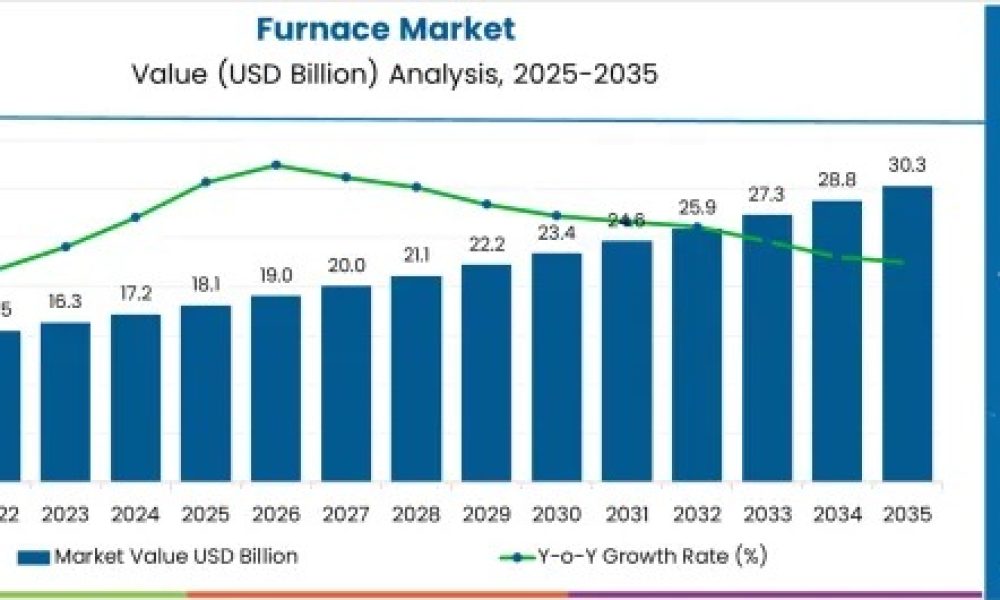
The global furnace market is set for sustained expansion through 2035, fueled by rising energy efficiency mandates, residential retrofitting, and industrial heat treatment demands. According to Future Market Insights (FMI), the market is valued at USD 18.1 billion in 2025 and is projected to reach USD 30.3 billion by 2035, expanding at a compound annual growth rate (CAGR) of 5.3%.
The FMI report, “Furnace Market Size, Share, and Forecast 2025–2035,” indicates global revenues will grow by USD 12.2 billion over the decade, driven by the surge in demand for electric, smart-enabled, and low-emission heating systems across residential, commercial, and industrial applications.
A Decade of Growth Anchored by Electric Adoption and Sustainability:
The shift toward electric furnaces, integrated with renewable energy and advanced controls, is reshaping market dynamics. Between 2025 and 2030, the furnace market will expand significantly, led by replacement cycles in aging infrastructure and stricter carbon regulations.
Between 2030 and 2035, FMI forecasts continued momentum, reflecting broader adoption of variable-speed motors, heat exchangers, and IoT-enabled monitoring for optimized performance and reduced energy consumption.
“Electric systems are dominating new installations due to safety, compatibility with solar integration, and lower maintenance,” said an FMI research analyst. “Regulatory pressures and cost savings are accelerating the transition from gas and oil-based units.”
Furnace Key Market Insights at a Glance:
Global Estimate Market Value (2025)- USD 18.1 billion
Forecast Value (2035)- USD 30.3 billion
CAGR- 5.3%
Leading Segment- Residential (47.3% share) Dominant Fuel- Electric (51.6% share) Fastest-Growing Capacity- Small (42.9% share)
China: The Fastest-Growing Furnace Market:
FMI’s analysis highlights China’s leadership in global furnace demand. The market is projected to grow at a CAGR of 7.2% through 2035, driven by steel production, cement manufacturing, and energy generation sectors. Investments in high-capacity, emission-compliant systems are boosting adoption, with electric furnaces gaining traction amid decarbonization goals.
India follows closely at 6.6% CAGR, supported by infrastructure projects, manufacturing expansion, and energy efficiency standards in steel and chemicals.
Furnace Five Forces Driving Market Expansion:
Energy Efficiency Regulations: Governmental directives for lower carbon footprints propel high-efficiency models. Residential Retrofitting: Aging housing stock and urbanization drive upgrades in colder regions. Electric Furnace Shift: Compatibility with renewables and stable grids reduces fossil fuel dependency. Industrial Output Growth: Rising demand in metalworking, ceramics, and power generation sustains high-temperature needs. Technological Advancements: Smart thermostats, variable-speed motors, and advanced heat exchangers cut operational costs.
Furnace Market Segment Overview:
By Application: Residential leads with 47.3% of global revenue in 2025, fueled by household comfort, indoor air quality, and renovation trends. By Fuel: Electric commands 51.6% share, favored for safety and solar integration; gas and oil follow in legacy systems. By Capacity: Small-capacity units dominate at 42.9%, ideal for urban homes and compact commercial spaces. By Temperature: Medium and high-temperature segments support industrial processes like forging and heat treating.
Furnace Market Regional Overview:
Asia-Pacific: Fastest growth globally — led by China (7.2% CAGR), India (6.6% CAGR), and Japan. North America: Steady at 4.5% CAGR in the USA, driven by energy and automotive sectors. Europe: From Germany (6.1% CAGR) to France (5.6% CAGR) and UK (5.0% CAGR), supported by sustainable manufacturing. Middle East & Africa: Infrastructure in Saudi Arabia and South Africa boosts specialized furnace demand.
Furnace Market Competitive Landscape:
- Andritz AG
- Carrier
- Daikin
- Emerson
- Goodman Manufacturing Company
- IHI Machinery and Furnace Co., Ltd.
- Inductotherm
- Ipsen
- Lennox
- Rheem Manufacturing
- Trane Technologies
Top players like Carrier, Daikin, and Trane hold significant shares through energy-efficient HVAC integrations and smart controls. Strategies focus on automation, custom solutions, and regional hubs to meet emission standards and local demands.
Furnace Market Outlook: Heating the Sustainable Future:
Over the next decade, the furnace market will prioritize cleaner technologies, precise controls, and hybrid systems. Induction and electric innovations in additive manufacturing and waste-to-energy will open new segments.
“Furnaces are evolving into efficient, data-driven assets for net-zero goals,” the FMI analyst added. “Manufacturers investing in versatile, low-emission designs will capture growth in industrial modernization and green retrofitting.”
Explore the full market insights and future trends—read the complete Market Report today! : https://www.futuremarketinsights.com/reports/sample/rep-gb-23983
Buy Now Report Here: https://www.futuremarketinsights.com/checkout/23983
Have a specific Requirements and Need Assistant on Report Pricing or Limited Budget please contact us – [email protected]
About Future Market Insights (FMI)
Future Market Insights, Inc. (FMI) is an ESOMAR-certified, ISO 9001:2015 market research and consulting organization, trusted by Fortune 500 clients and global enterprises. With operations in the U.S., UK, India, and Dubai, FMI provides data-backed insights and strategic intelligence across 30+ industries and 1200 markets worldwide.
Contact Us:
Future Market Insights Inc.
Christiana Corporate, 200 Continental Drive,
Suite 401, Newark, Delaware – 19713, USA
T: +1-347-918-3531



