
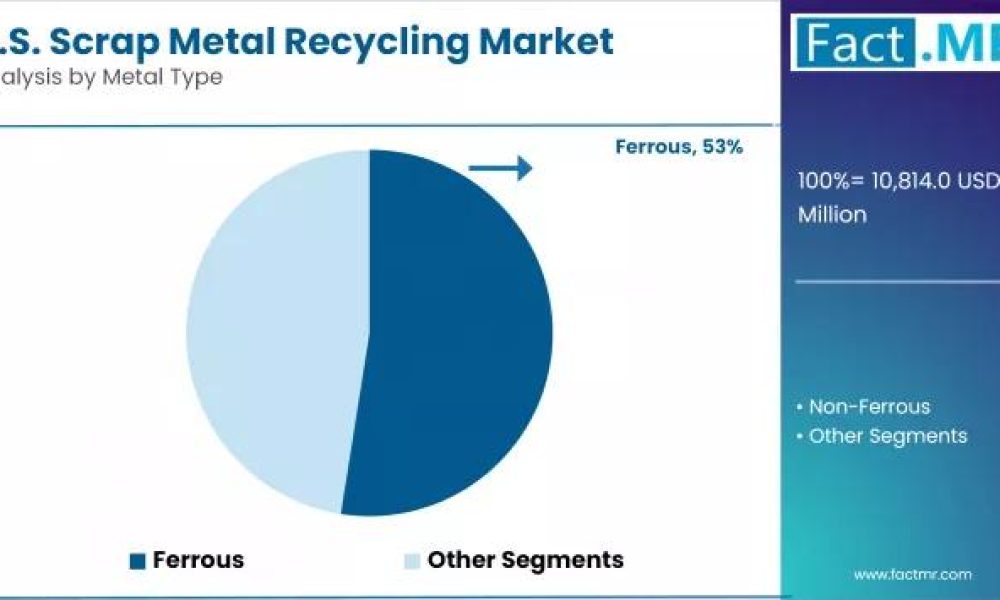
The U.S. scrap metal recycling market is projected to grow from approximately USD 10.8 billion in 2025 to about USD 18.47 billion by 2035, registering a compound annual growth rate (CAGR) of around 5.5% over the forecast period. Growth is underpinned by intensifying circular-economy initiatives, increased industrial demand for recycled feedstock, electrification of steelmaking processes and regulatory incentives for recycling infrastructure.
With rising attention to sustainability, resource efficiency and decarbonisation across manufacturing, construction and automotive sectors, the scrap metal recycling ecosystem in the U.S. is entering a new phase of expansion and innovation.
➤Key Market Insights at a Glance
Market Value (2025): USD 10.8 billion
Forecast Value (2035): USD 18.47 billion
CAGR (2025-2035): ~5.5%
Dominant Scrap Type: Ferrous metals (steel srap)
Fastest-growing Recycling Segment: Shredding operations (~6.4% CAGR)
Leading Region Within U.S.: Southwest U.S. (~6.6% regional CAGR)
Major Growth Drivers: Industrial feedstock demand, electrified steelmaking, circular economy policies
To Access the Complete Data Tables & in-depth Insights, Request a Discount on this report: https://www.factmr.com/connectus/sample?flag=S&rep_id=7418
➤Market Drivers / Growth Overview
The U.S. Scrap metal recycling market’s expansion is driven by several key factors. First, the manufacturing and infrastructure industries are placing increasing emphasis on recycled metal feedstock to reduce costs and meet sustainability targets. Especially in steel production, the rise of electric arc furnace (EAF) technology is boosting demand for high-quality ferrous Scrap.
Second, regulatory and environmental momentum favouring circular economy models is encouraging investment in Scrap processing infrastructure, improving collection, sorting and logistics systems. Third, evolving end-use industry dynamics – such as lightweighting in automotive, high-volume infrastructure projects, and refurbishment in construction – are generating higher volumes of recyclable metal content and reinforcing value chains for Scrap.
Technological innovation is improving material recovery and purity, while regional growth patterns (with the Southwest and West U.S. showing above-average expansion) reflect emerging infrastructure build-out and local policies favouring recycling. These drivers collectively lay the foundation for the market’s steady growth through 2035.
➤Segmentation & Key Drivers
By Metal Type:
Ferrous metals (steel Scrap) remain the largest volume and value contributor due to their central role in manufacturing and construction.
Non-ferrous metals (such as aluminium and copper) are growing in importance, driven by lightweighting, electrification and cost-savings.
By Recycling Process:
Shredding has emerged as a high-growth sub-segment (CAGR ~6.4%) due to its efficiency in processing mixed Scrap and complex end-of-life equipment.
Shearing and other mechanical separation techniques show moderate growth (CAGR ~4.9%) as secondary processes.
By End-Use Industry:
Construction, infrastructure and automotive sectors are major end-users of recycled metal, with growth in recycling aligned with both new build and refurbishment activity.
Steelmaking (especially EAF-based furnaces) is a critical driver for ferrous Scrap demand.
By Region:
The Southwest U.S. leads growth (~6.6% regional CAGR) reflecting rapid construction and clean-energy infrastructure.
The West U.S. (~6.2% CAGR) and Midwest (~5.0% CAGR) follow, supported by manufacturing base and logistics networks.
These segmentation dynamics highlight where value and growth are concentrated, and the interplay between metal type, process innovation and industry demand.
➤Five Forces Driving Market Growth
Supplier Power: Upstream Scrap suppliers benefit from stable demand as recyclers expand capacity, but the metal-price volatility moderates margin expansion.
Buyer Power: Large manufacturing and steel-making buyers increasingly demand premium-grade recycled metal, pushing recyclers to raise quality and invest in technology.
Threat of Substitutes: The main substitute is virgin metal, but recycled metal is increasingly cost-competitive and lower in carbon emissions, reducing substitution risk.
Competitive Rivalry: The Scrap recycling business is fragmented, with established players investing in advanced processing, logistics and automation to gain scale and efficiency.
Regulatory & Institutional Pressure: Strong regulatory tailwinds (waste reduction, circular economy, recycled content mandates) provide long-term structural support for Scrap recycling, though compliance complexity remains a barrier for smaller entrants.
➤Regional & Country Insights
Southwest U.S.: Highest regional growth (~6.6% CAGR) driven by construction, renewable-energy infrastructure and recycled metal feedstock demand.
West U.S.: Strong growth (~6.2% CAGR) supported by advanced recycling technology adoption and environmental policy frameworks.
Midwest U.S.: Solid growth (~5.0% CAGR) anchored in legacy manufacturing, steel and automotive clusters.
Northeast U.S.: Urban redevelopment and industrial refurbishment contribute to Scrap supply, though facility expansion is somewhat constrained.
Southeast U.S.: Rapid expansion of recycling operations supported by port infrastructure, industrial growth and low-carbon steel initiatives.
➤Competitive Landscape
Key players in the U.S. Scrap metal recycling market include:
American Pulverizer Company, Commercial Metals Company (CMC), OmniSource, Metal Management Inc., Tube City Inc., Philip Metals, Hugo Neu, Sims Metal, Samuel Recycling and DBW Metals Recycling.
These firms are focusing on advanced material recovery technologies, logistics optimisation, downstream value-chain integration and regional expansion to meet increasing demand for high-quality recycled metal feedstocks.
➤Recent Developments
The adoption of advanced shredding and sensor-based sorting systems has accelerated, improving recovery yields and material purity.
Electric-arc furnace (EAF) steel-making growth is increasing demand for ferrous Scrap, aligning recyclers more closely with steel producers.
Growing automotive and lightweighting trends (especially in EVs) are driving demand for high-quality aluminium and other non-ferrous Scrap.
Regulatory incentives and investments in recycling infrastructure are helping expand capacity in previously underserved regions of the U.S.
Several major recyclers are investing in supply-chain automation and digitised tracking for recyclable material flows, responding to quality and sustainability drivers.
➤Market Outlook & Strategic Insights
Over the forecast period (2025-2035), the U.S. Scrap metal recycling market is set to transition from a mature support industry into a dynamic pillar of the circular economy. Companies that prioritise:
investment in advanced processing technologies (shredding, sorting, automation)
improving feedstock quality and supply-chain traceability
aligning with end-users (steel mills, automotive, construction) for closed-loop recycled metal use
expanding regionally into high-growth zones such as the Southwest and West
supporting decarbonisation and circular-economy credentials
➤Purchase Full Report for Detailed Insights
For access to full forecasts, regional breakouts, company share analysis, and emerging trend assessments, you can purchase the complete report: https://www.factmr.com/checkout/7418
Have specific requirements or need assistance on report pricing or have a limited budget? Please contact [email protected]
Contact:
US Sales Office
11140 Rockville Pike
Suite 400
Rockville, MD 20852
United States
Tel: +1 (628) 251-1583, +353-1-4434-232
Email: [email protected]
➤About Fact.MR:
Fact.MR is a global market research and consulting firm, trusted by Fortune 500 companies and emerging businesses for reliable insights and strategic intelligence. With a presence across the U.S., UK, India, and Dubai, we deliver data-driven research and tailored consulting solutions across 30+ industries and 1,000+ markets. Backed by deep expertise and advanced analytics, Fact.MR helps organizations uncover opportunities, reduce risks, and make informed decisions for sustainable growth.



