
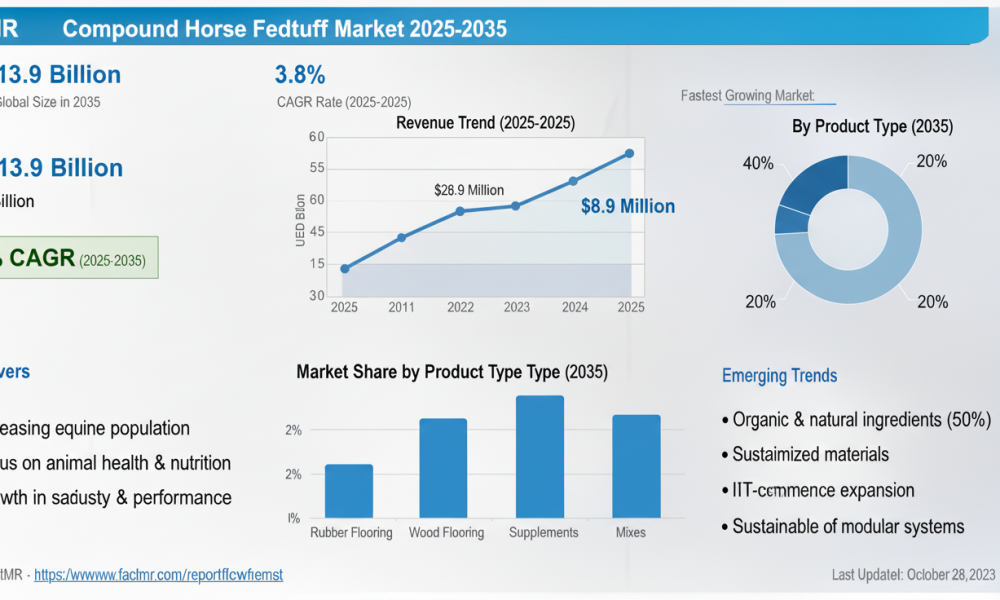
The global compound horse feedstuff market is projected to expand from USD 8.9 billion in 2025 to USD 13.9 billion by 2035, registering a compound annual growth rate (CAGR) of 4.6% over the forecast period. Demand is being driven by growing awareness of equine health and tailored nutrition, increased horse ownership for sports and leisure, and higher expectations for performance-optimized feed formulations.
Owners, breeders, and trainers are increasingly using compound feedstuff blends—composed of cereals, supplements, cakes/meals, and other ingredients—formulated for specific performance, age, or activity category (e.g. professional, breeding, leisure, senior horses). These feeds feature functional blends with additives like probiotics, slow-energy release carbohydrates, essential amino acids, and antioxidant supplements to support digestion, endurance, recovery, and overall wellness.
Key Market Insights at a Glance
Market Value (2025): USD 8.9 billion
Forecast Value (2035): USD 13.9 billion
CAGR (2025-2035): ~4.6%
Largest application segment (2025): Performance / professional horses (~44%)
Leading ingredient category: Cereals + balanced cereals-based blends dominate
Key growth regions: Europe, North America, Asia Pacific
To Access the Complete Data Tables & in-depth Insights, Request a Discount on this report: https://www.factmr.com/connectus/sample?flag=S&rep_id=985
Five Forces Driving Market Growth
Growing equestrian / sport demand: Equestrian sports, racing, leisure riding, and breeding are pushing demand for specialized nutrition tailored to horse category and discipline.
Increasing awareness of equine welfare: Horse owners emphasize gut health, longevity, digestive support, and supplementation (probiotics, vitamins, low starch diets) to maintain horse health and prevent metabolic issues.
Premiumization and clean labeling: Demand is rising for non-GMO, organic, additive-free, and clean-label formulas with transparent ingredient sourcing, driven by conscientious owners.
Technological advances in feed formulation: Improved processing methods (pelleting, extrusion, mash / pellet / cube formats) plus precision feeding tools and digital nutrition plans are supporting adoption.
Competitive & distribution dynamics: Feed manufacturers are expanding regional capacities, offering tailored feed lines by horse age and discipline, and distributing via offline retail and growing online / subscription channels.
Regional Outlook
Europe: Remains a leading region due to strong equestrian tradition, well-developed feed industry, and high requirements for premium feed products.
North America: Large horse population, competitive horse sports, breeding and leisure markets sustain strong demand for high-quality compound feedstuff.
Asia Pacific: Expected to be the fastest-growing region, fueled by rising disposable incomes, growing equestrian communities, and investment in equine sports.
Latin America: Emerging opportunities as horse ownership grows, with increasing demand for performance and breeding feed.
Middle East & Africa: Niche but growing demand in equestrian sectors, breeding, and leisure riding markets, aided by increasing awareness and imports of premium feeds.
Recent Developments
Feed producers are investing in novel formulations with functional additives—for gut health, slow release energy, and digestive support to meet performance and senior horse nutritional needs.
Several companies have introduced premium lines tailored by horse category (foal, mare & foal, senior, professional performance) with specific nutrient profiles and ingredient blends.
There is rising adoption of digital feeding platforms and subscription / direct-to-owner models that allow personalized nutrition plans based on horse activity, age, and health status.
Ingredient sourcing has become more sustainable, with non-GMO cereals, alternative protein meals, and clean-label supplements entering feed formulations to meet owner and regulatory demands.
Competitive Landscape
Key players in the compound horse feedstuff market include major animal feed companies, specialized equine nutrition firms, and ingredient suppliers that offer tailored feed blends for performance, breeding, leisure, and senior horses.
These companies are focusing on expanding manufacturing operations, innovating in feed formulation (additives, clean labeling, organic / non-GMO feeds), and strengthening both offline retail distribution and online subscription channels.
Market Outlook & Strategic Insights
Over the forecast period through 2035, the compound horse feedstuff market is expected to grow steadily as equestrian sports, recreational riding, and horse breeding continue to expand globally.
Suppliers that invest in scientifically calibrated, functional feed formulations (for performance, age, discipline), sustainable ingredient sourcing, and integrated digital nutrition solutions will be well positioned.
Emerging markets in Asia Pacific and Latin America present significant growth potential due to rising equestrian interest and increasing incomes, while mature markets in Europe and North America will demand premium, high-quality feed solutions.
Purchase Full Report for Detailed Insights
For access to full forecasts, regional breakouts, company share analysis, and emerging trend assessments, you can purchase the complete report: https://www.factmr.com/checkout/985
Have specific requirements or need assistance on report pricing or have a limited budget? Please contact [email protected]
Contact:
US Sales Office
11140 Rockville Pike
Suite 400
Rockville, MD 20852
United States
Tel: +1 (628) 251-1583, +353-1-4434-232
Email: [email protected]
About Fact.MR:
Fact.MR is a global market research and consulting firm, trusted by Fortune 500 companies and emerging businesses for reliable insights and strategic intelligence. With a presence across the U.S., UK, India, and Dubai, we deliver data-driven research and tailored consulting solutions across 30+ industries and 1,000+ markets. Backed by deep expertise and advanced analytics, Fact.MR helps organizations uncover opportunities, reduce risks, and make informed decisions for sustainable growth.



